SpaceXAI released Grok 4.7 on September 21, 2026 for coding agents and knowledge work, with access through its API, Grok Build, Cursor and an announced gradual rollout in GitHub Copilot. The model costs the same per token as Grok 4.6 at the basic API tier. That headline price obscures the real purchasing question: a stronger agent might finish more tasks, but it can also generate far more reasoning tokens and incur higher fees on long requests.
The distinction matters because the first independent results do not reproduce every broad marketing claim. Artificial Analysis reports meaningful gains on work involving extended tool use, yet sees relatively modest changes in its overall intelligence index and some regressions. A sensible assessment must measure completed, accepted work and the full bill, not compare token prices or promotional benchmark rankings alone.
What changed, and what the launch actually establishes
The official announcement describes a larger base model than Grok 4.6 and a longer reinforcement-learning run emphasizing demanding multi-hour tasks. SpaceXAI says it has improved self-checking and understanding of its agent harness. Those explanations come from the model developer; the training recipe and general claims about safety are not independently verified by publication of the announcement.
The September 21 API release notes confirm model identifier `grok-4.7`, a 500,000-token context window, text and image inputs with text-only output, and four reasoning settings: low, medium, high and xhigh. High is the default. The Responses API always returns `reasoning.encrypted_content`; callers maintaining a multi-turn reasoning conversation should pass the reasoning items back unchanged. This is a documented integration behavior, not a measure of accuracy.
Distribution also matters. GitHub says Grok 4.7 is rolling out across its Copilot environments, including the cloud coding agent and multiple IDEs, with access governed by organizational model policies. Availability is gradual, so inclusion in the announcement does not guarantee that every subscriber can select it immediately.
Independent evaluations show gains, not a universal jump
Artificial Analysis evaluated Grok 4.7 at xhigh reasoning and measured 46 on its Intelligence Index, two points above Grok 4.6. Its Coding Agent Index rose from 47 for Grok 4.6 xhigh to 56 for Grok 4.7 xhigh when both ran in Grok Build. The evaluator also reports stronger performance on its agentic professional-work benchmarks.
Those results require context. The coding comparison includes a specific agent harness, not just isolated model weights. Outside agentic work, the evaluator describes smaller shifts and reports regressions on two components, including long-context retrieval and an automation benchmark. The study does not establish that every coding repository, security task or business workflow will improve. Its xhigh configuration should not be casually compared with a different model's default high setting.
SpaceXAI's own launch benchmarks emphasize faster, cheaper results against competing models and large improvements on selected coding tests. They are vendor-reported, while Cursor's published measurements are not independent of the model's commercial ecosystem. The independent evaluation supports improvement in some important tasks but gives a more qualified picture of overall performance. Teams should preserve the evaluator, harness, effort level and test version when copying any score into a procurement document.
The price per token stayed flat; the bill may not
At the standard xAI API tier, Grok 4.7 costs $2 per million input tokens, $0.50 per million cached input tokens and $6 per million output tokens when the prompt stays below 200,000 tokens. Above that threshold, the published rates double to $4, $1 and $12. SpaceXAI says Grok 4.7 Fast uses a higher-priced serving tier available in Cursor and Grok Build, not its public API. It should not be represented as an option that any xAI API customer can enable.
Cursor's own model documentation describes a different billing boundary: a 256,000-token standard context and a 500,000-token long-context option. Once input exceeds 256,000 tokens, the full standard request is billed at twice standard rates; the corresponding Fast long-context rates are three times the standard rates. An engineering budget must therefore be tied to the actual provider and request size. Applying xAI's 200,000-token breakpoint to Cursor would misstate costs.
The more surprising cost variable is output. Artificial Analysis recorded roughly 81,000 output tokens per evaluated task for Grok 4.7 xhigh, versus around 38,000 for Grok 4.6 xhigh. That is more than twice the output volume in those tests, even though the published basic output rate is unchanged. This observation alone does not establish the total bill per successful task, because input, caching, retries and task-success rates also matter. It does show why a fixed token-price comparison cannot settle the price-performance question.
A measurable procurement test: cost per accepted result
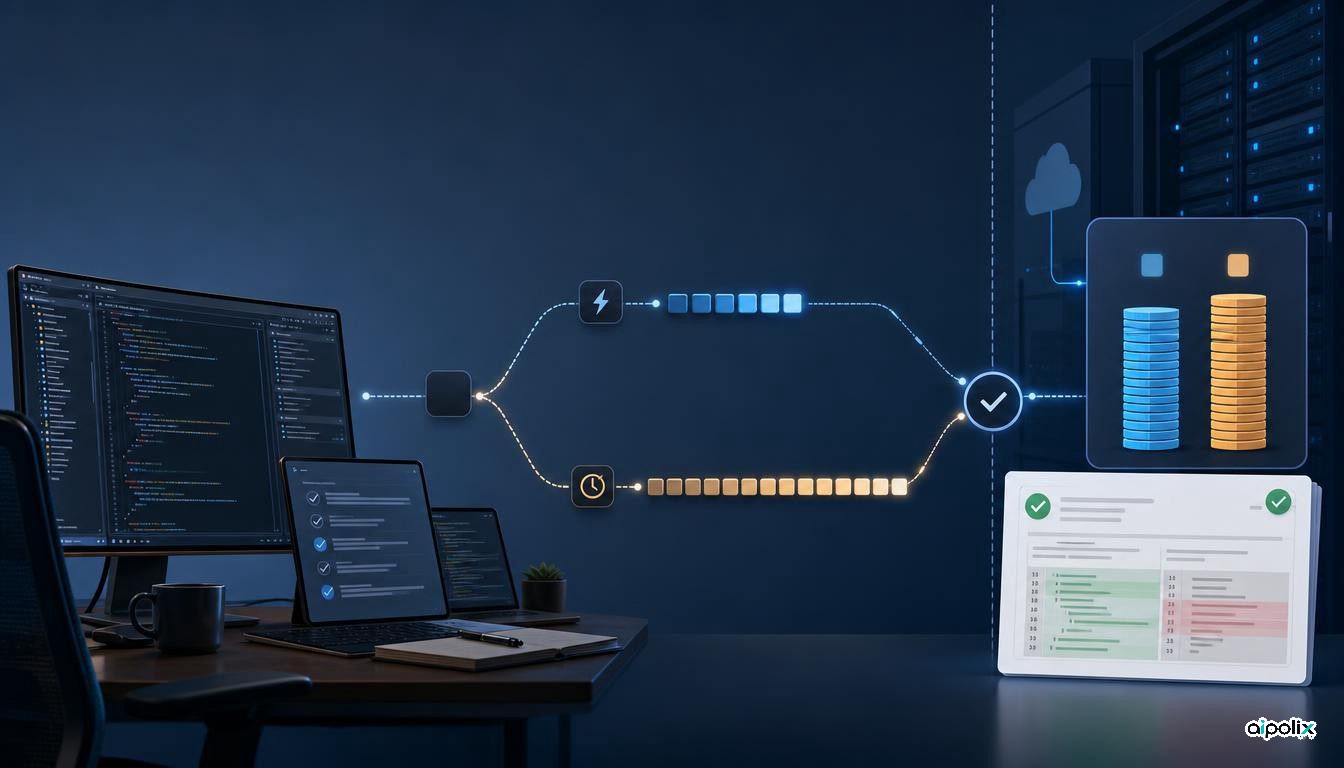
Aipolix's practical inference from the published prices and evaluation method is to define one unit of output before benchmarking: a completed change or document that passes an independent acceptance test. Run both models through the same tasks, tools, repository snapshots and retry policy. Record result acceptance, human correction time, elapsed time, input and output tokens, cache usage and total spend for unsuccessful attempts as well as successful ones.
The xAI API cost-tracking documentation provides `usage.cost_in_usd_ticks` for each request, covering billed tokens after discounts and server-side tool charges. A workflow should sum that value across requests and retries; the field is not a cumulative conversation total. When using another provider, reconcile its own billing records rather than assuming xAI's field or rate applies there.
An example illustrates the analytical point without pretending to be a measured result. If a model costs the same per token but spends twice as many output tokens, it needs enough extra accepted tasks, fewer retries or lower human-review cost to offset that consumption. Conversely, one successful run can be cheaper than several failed attempts by a less capable model. The threshold depends on each team's workload, not on an overall leaderboard position.
What engineering teams should verify before switching
Grok 4.7 is a material release with new model behavior, documented integration details and independently measured progress in agentic workloads. Yet the supplier's performance and safeguard assertions should remain attributed. The independent numbers show both improvements and trade-offs, while provider-specific long-context prices and rollout conditions complicate a simple migration.
Start with a bounded side-by-side trial at the intended reasoning effort. Freeze the harness and tasks, include a representative set of long-context requests, keep a known fallback model and audit policy access in Copilot. Compare accepted deliverables and complete operating costs, then expand only where results justify it. Grok 4.7 makes a credible case for evaluation; whether it is more economical to operate is an empirical question for the team deploying it.