
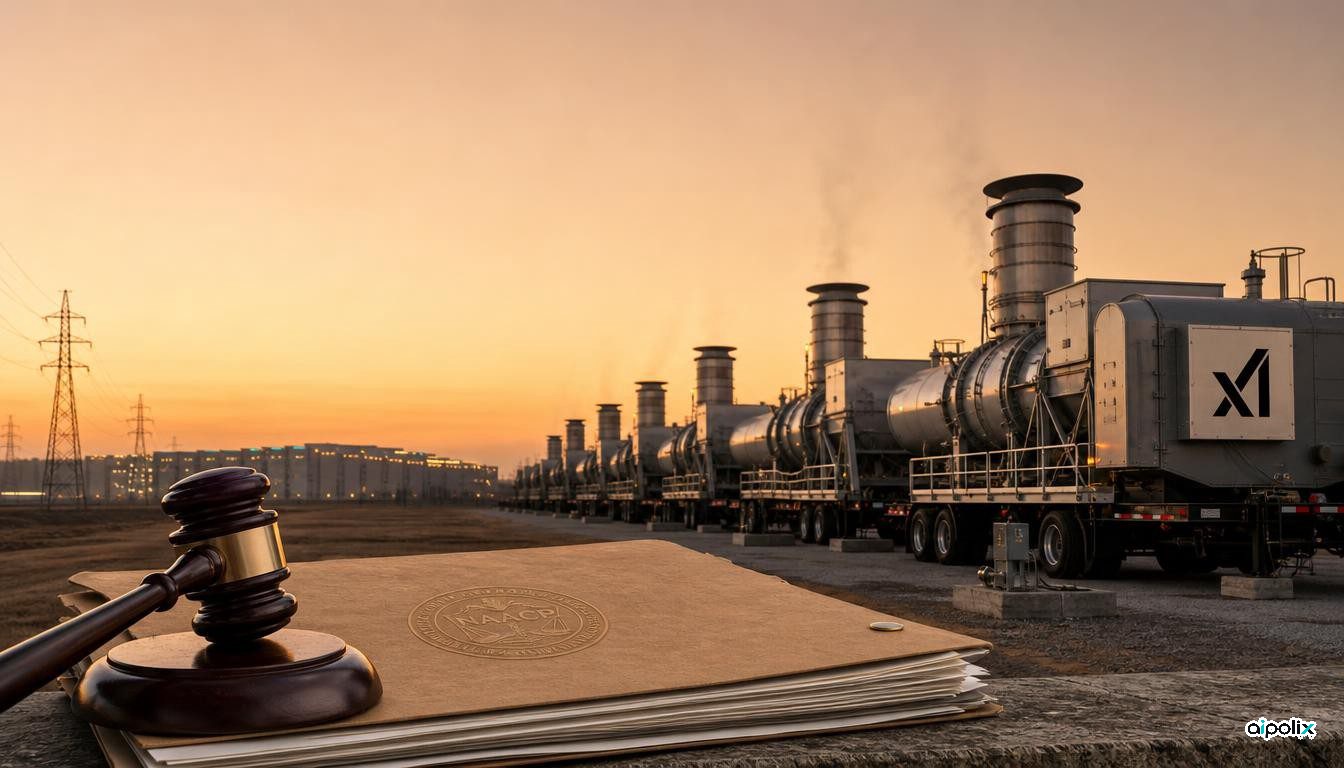
A federal judge in Mississippi has refused to throw out the NAACP's lawsuit accusing xAI of operating a gas-fired power plant without the air permits the Clean Air Act requires. In an opinion and order signed on Friday, October 30, U.S. District Judge Debra M. Brown of the Northern District of Mississippi denied the motion to dismiss filed by X.AI Corp. and its subsidiary MZX Tech LLC. The plant sits in Southaven, in DeSoto County, and supplies electricity to the company's Colossus 2 data center in the Memphis area.
The NAACP and its Mississippi state conference filed the case in April 2026, with the Southern Environmental Law Center and Earthjustice acting as counsel. Their complaint, as summarized in the ruling, says the companies installed gas-fired combustion turbines at the site between August 1 and December 18, 2025, and that at least 27 units were there by April 7, 2026: fourteen SMT-130s, one M35 and twelve TM 2500s of three generations, with a combined capacity of at least 495 megawatts. The plaintiffs put the potential yearly output at about 1,700 tons of nitrogen oxides, 580 tons of carbon monoxide, 180 tons of fine particulate matter and 19 tons of formaldehyde. They say neither company sought a federal Prevention of Significant Deterioration permit, a state construction permit or an operating permit. The suit asks for an injunction, pollution controls and civil penalties of up to $124,426 per day for each violation.
xAI's motion relied on three arguments. First, it said the NAACP had no right to sue under the statute because it alleged harm only to its members, not to itself as an organization. Second, it said the turbines were mobile sources outside the permitting rules, citing a July 29, 2025 message in which the Mississippi Department of Environmental Quality (MDEQ) treated the units as mobile because each sits on a flatbed trailer, and as temporary because each was expected to stay less than twelve months. Third, it argued that citizen suits under the Clean Air Act are unconstitutional because they hand executive power to private parties.
Judge Brown rejected all three. She found that the citizen-suit provision's wording about suing "on his own behalf" does not stop an association from suing for its members, and that this case also serves the NAACP's own mission, which treats environmental harm as a civil rights issue. On the central question, she used the federal definition of a mobile source, which covers motor vehicles, nonroad engines and nonroad vehicles. The turbines are plainly not vehicles. Nor can they be nonroad engines, she reasoned, because federal performance standards in Subpart KKKK apply to stationary combustion turbines rated at 10 MMBtu per hour of heat input or more, even when they are mounted on a vehicle to make them portable, and each unit at Southaven is alleged to exceed that level.
The state letter did not save xAI. Under Mississippi law, courts do not defer to an agency's interpretation of a statute, and the judge said MDEQ's reading of the term did not rest on facts within its expertise and was inconsistent with the state implementation plan. A fair-notice defense also failed, since MDEQ has not changed its position and is not the party seeking penalties. Finally, she held that citizens who sue in their own name for harms to themselves are not exercising the federal government's executive power.
This is xAI's second loss in the case in roughly two weeks. On October 19 the same court let the United States intervene on behalf of the EPA Administrator but refused its request to dismiss the suit, finding that the Clean Air Act gives the agency no power to end a citizen case over the plaintiffs' objection. A June motion for a preliminary injunction that would stop the plant until it is permitted remains undecided. The ruling also records that, after construction began, MDEQ granted MZX Tech a permit covering another gas plant planned for the same site, and that none of the turbines in dispute fall under it.
The order comes at the pleading stage, so the court treated the complaint's factual allegations as true and has made no finding that xAI broke the law. The company can still contest the facts, the emissions estimates and any remedy, and the judge noted that questions about what xAI intended and how reasonable its reading of the state letter was are not yet developed in the record. SpaceX, which now owns xAI and brands it SpaceXAI, did not immediately respond to CNBC or TechCrunch. The case matters beyond Memphis because on-site turbines are one way to power a new AI data center before permanent supply arrives, and this decision says a trailer and a temporary label do not by themselves put such equipment outside federal air permitting.