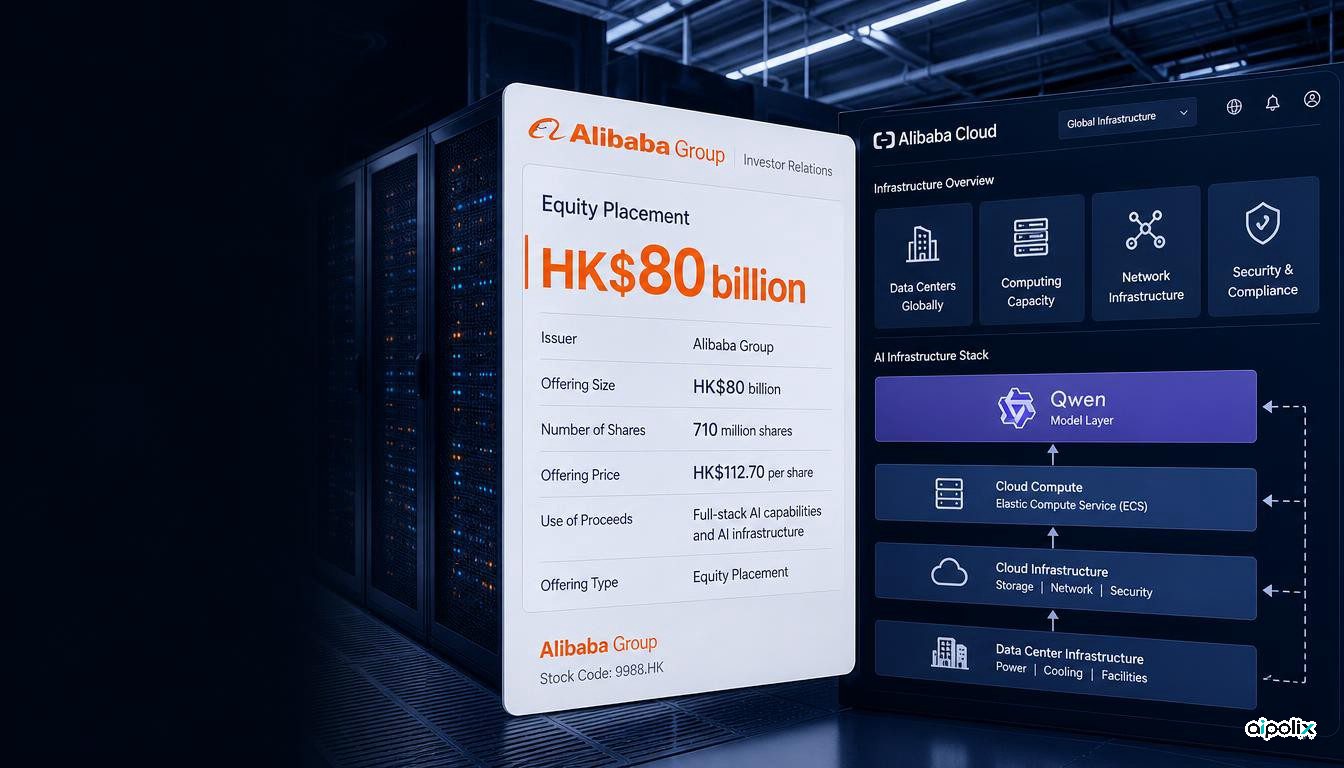
Alibaba has priced a HK$80 billion share placement that it says will direct all net proceeds into its full-stack artificial intelligence capabilities, including AI infrastructure. The company's pricing announcement says 710 million newly issued shares will be sold at HK$112.70 each, with closing expected on August 26 subject to customary conditions. The financing matters beyond Alibaba's balance sheet because it turns a broad AI investment program into a dedicated capital raise rather than relying only on operating cash flow.
Reuters reported that the transaction is worth about US$10.2 billion and is the largest primary follow-on offering by a Hong Kong-listed company. That scale is relevant to infrastructure planners, cloud buyers and technology leaders tracking how aggressively major AI providers are funding compute capacity. The immediate fact is financing, not a model launch: Alibaba is raising equity specifically for its AI stack, and the transaction still has to close.
What Alibaba has committed to fund
Alibaba's official statement is unusually direct about use of proceeds. It says 100% of the net proceeds are intended for investment in "full stack AI capabilities," including expansion and enhancement of AI infrastructure. The announcement does not provide a detailed allocation across chips, data centers, networking, model training, inference capacity or applications, so those categories should not be treated as confirmed spending buckets.
The company has already framed AI and cloud as central to its operating strategy. Its June-quarter results were published only days before the placement and provide the financial context for the decision. Reuters says Alibaba has already spent nearly half of a previously announced three-year AI investment program, while heavy capital expenditure contributed to pressure on quarterly profit. The new equity financing therefore arrives after accelerated spending, not before investment has begun.
For enterprise technology teams, that distinction matters. A capital raise does not prove that future compute supply will appear on a particular schedule, nor does it guarantee lower cloud prices or faster model releases. It does show that Alibaba is willing to dilute shareholders to secure more funding for AI expansion at a time when infrastructure capacity remains a strategic constraint across the industry.
Why the financing structure matters
Equity financing changes the risk profile of the investment program. Unlike debt, the placement does not create a fixed repayment schedule, but existing shareholders absorb dilution because new shares are issued. Reuters reported that Alibaba shares fell after pricing, illustrating that investors are weighing the long-term AI opportunity against the near-term cost of raising capital and spending it aggressively.
The pricing announcement says the 710 million shares were placed at HK$112.70 each. It also states that the shares are being sold to non-U.S. persons outside the United States under Regulation S and that closing is expected on August 26, subject to customary conditions. Until that closing occurs, it is more precise to describe the transaction as priced and expected to close, rather than as irrevocably completed.
For architecture and procurement leaders, the financing method is less important than what it can enable. Large-model providers need capital not only for training runs but for persistent inference capacity, regional cloud expansion, networking, storage and the operational systems around model serving. Alibaba has not broken down the placement proceeds into those components, so any specific allocation would be speculation. The defensible conclusion is narrower: the company has reserved a large new pool of equity capital for full-stack AI and infrastructure.
Implications for the competitive AI stack
Alibaba's strategy is vertically broad. Its Qwen model family sits above cloud infrastructure, while Alibaba Cloud provides a deployment layer used by enterprise customers. Funding the "full stack" therefore gives the company flexibility to invest across model development and the infrastructure required to train and serve those models. That matters to organizations evaluating long-term platform dependencies because supplier economics can affect model availability, regional capacity and service continuity.
The placement also highlights a wider industry pattern. Frontier AI competition is becoming capital intensive enough that product performance cannot be assessed separately from financing and infrastructure. A provider may publish strong benchmark results but still face bottlenecks if it cannot secure enough compute, power, networking and deployment capacity. Conversely, a large capital base does not prove technical superiority. The relevant signal is resilience: providers with more financing options may be better able to sustain expensive development and serving programs through multiple product cycles.
For businesses using Qwen or Alibaba Cloud, there is no immediate configuration change implied by the share sale. No new API price, region, quota or service-level commitment was announced in the placement statement. Technology teams should avoid converting a financing event into assumptions about product roadmaps. The practical value is strategic rather than operational today: it strengthens the evidence that Alibaba intends to keep investing at large scale in the infrastructure behind its AI portfolio.
What remains uncertain
The biggest uncertainty is execution. Alibaba says it intends to use all net proceeds for AI capabilities and infrastructure, but intentions are forward-looking and the company explicitly notes that the placement remains subject to closing conditions. It has not published a timetable showing when the new capital will translate into deployed capacity, nor a detailed breakdown of where the money will be spent.
There is also a financial tradeoff. Reuters reported a negative market reaction after pricing, reflecting concern about dilution and the cost of Alibaba's investment cycle. That does not establish whether the AI spending will produce an adequate return. Investors, customers and partners will need to watch subsequent capital expenditure, cloud growth, model adoption and infrastructure expansion rather than infer success from the size of the raise itself.
The decision-useful point for technology leaders is straightforward: Alibaba has moved from a broad multi-year AI spending commitment to a dedicated HK$80 billion equity financing whose stated purpose is entirely AI-related. That is material evidence of capital commitment, but not proof of future capacity, lower prices or model leadership. The next checkpoints are the expected August 26 closing and subsequent disclosures showing how quickly the proceeds are deployed.