
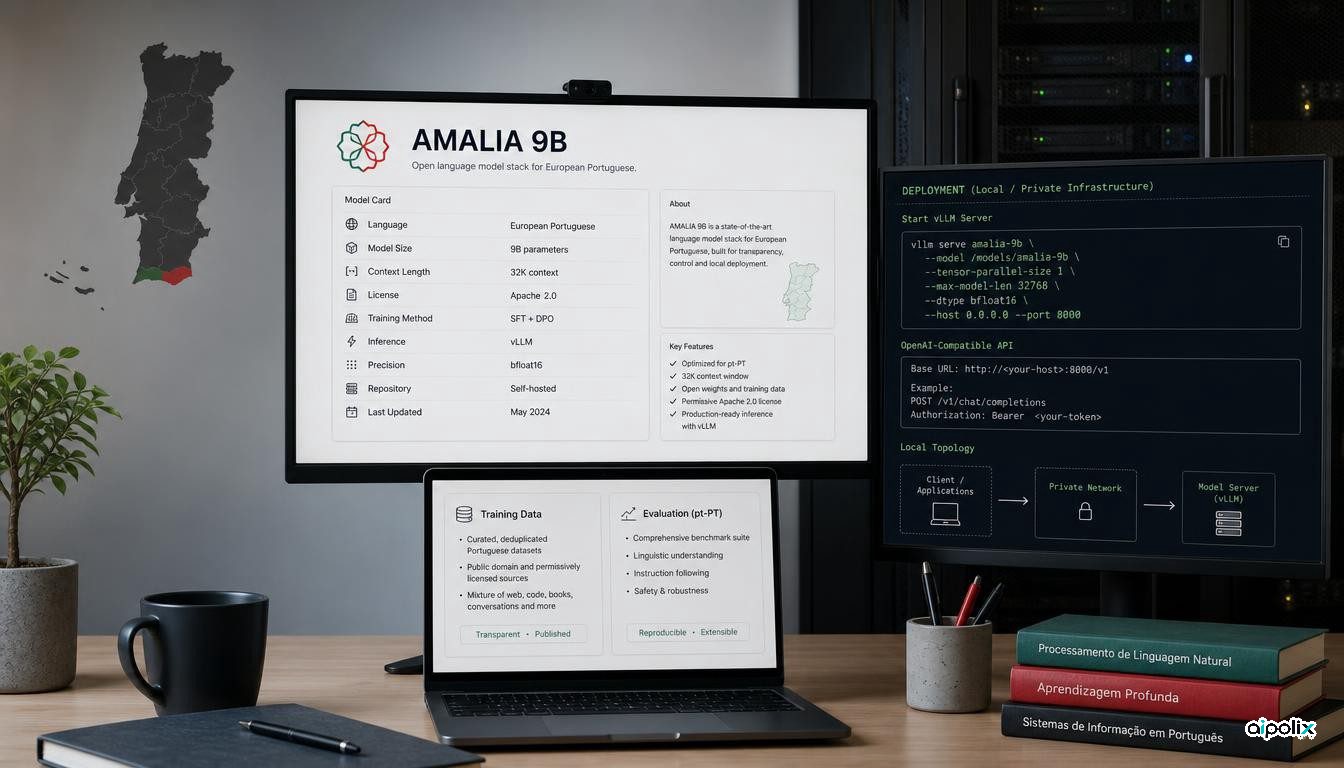
Portugal's AMALIA project has released a deployable 9-billion-parameter language model built specifically around European Portuguese, together with its training datasets, evaluation resources and a public deployment path. The final AMALIA release became publicly available on 1 July 2026, and the current 0626 DPO checkpoint is distributed under Apache 2.0 through the project's Hugging Face organization.
The technical significance is not simply that Portugal has another national-language chatbot. AMALIA extends EuroLLM pretraining with more European Portuguese data, increases the maximum sequence length to 32,000 tokens, then applies supervised fine-tuning and Direct Preference Optimization. The project also publishes the SFT and DPO datasets and a pt-PT-oriented evaluation suite, making the release more inspectable than a model exposed only through a hosted interface.
A 9B model tuned for European Portuguese
According to the official AMALIA model card, the project uses data from Arquivo.pt, EuroLLM pretraining data, Stack-v2 long-context samples and synthetic long-context examples. The post-training stage combines supervised fine-tuning with preference tuning through DPO.
The SFT stage ran for 76 hours on 64 NVIDIA H100 GPUs and the DPO stage for another 12 hours on the same GPU count. Training used the MareNostrum 5 supercomputer at the Barcelona Supercomputing Center and the DEUCALION system at the Minho Advanced Computing Center.
That matters for Portuguese developers because the model is positioned as a reusable base model rather than only a public demo. The project publishes the checkpoint, data and evaluation tooling under open licenses, so teams can inspect, fine-tune and serve it inside their own infrastructure.
Native pt-PT evaluation is part of the release
The AMALIA technical report argues that European Portuguese is underrepresented not only in training corpora but also in evaluation. Machine-translated benchmarks can miss vocabulary, grammar and cultural distinctions between European and Brazilian Portuguese.
To address that, the project released pt-PT benchmarks that combine translated standard tasks with new datasets focused on European Portuguese generation, linguistic competence and pt-PT versus pt-BR bias. The authors report that AMALIA remains competitive with strong baselines on translated benchmarks while improving on evaluations designed specifically for European Portuguese.
Those results should be read as project-reported research findings, not independent proof that AMALIA is generally superior to frontier commercial models. The important engineering signal is narrower: the team has created an evaluation surface that is explicitly designed to detect pt-PT behavior that generic multilingual benchmarks can overlook.
Developers can serve it with an OpenAI-style endpoint
The project's GitHub quickstart recommends vLLM for serving the 0626 DPO checkpoint. A standard vLLM serve command exposes the model locally and makes it available through an OpenAI-compatible chat-completions API.
That makes AMALIA easier to place inside existing application architectures. A team can run it as a local or private inference service, keep data inside infrastructure it controls, and route selected Portuguese workloads to AMALIA without rebuilding the whole client layer.
The 9B parameter scale is also operationally significant. It is much smaller than frontier models and has already attracted community quantizations for llama.cpp and Apple Silicon, although those derivative builds are separate community artifacts rather than the official release.
Portugal is treating the model as sovereign AI infrastructure
Portugal's Digital.gov.pt announcement describes AMALIA as the first large language model built specifically for European Portuguese and the national cultural context. The July release also includes a multimodal branch, but the text-model stack is already independently useful for developers because its weights, datasets and serving path are available now.
The sovereign-AI argument should not be reduced to model nationality. The more concrete value is control over the full technical stack: model weights, training data disclosures, evaluation resources and deployment choices. That can matter for public-sector systems, regulated workloads, language-specific products and research where reliance on a remote proprietary API is undesirable.
AMALIA does not remove the need for security review, domain evaluation or comparison with larger models. Its model card explicitly recommends deployment-specific input validation and output filtering, and its knowledge cutoff is June 2024. Teams should benchmark their own tasks before assuming that native pt-PT specialization outweighs differences in general reasoning, tool use or freshness.
For Aipolix readers, the release is therefore best understood as a new piece of Portuguese AI infrastructure: not a claim that one 9B model replaces global frontier systems, but a fully deployable open model that gives European Portuguese a stronger native path for local inference, adaptation and evaluation.