
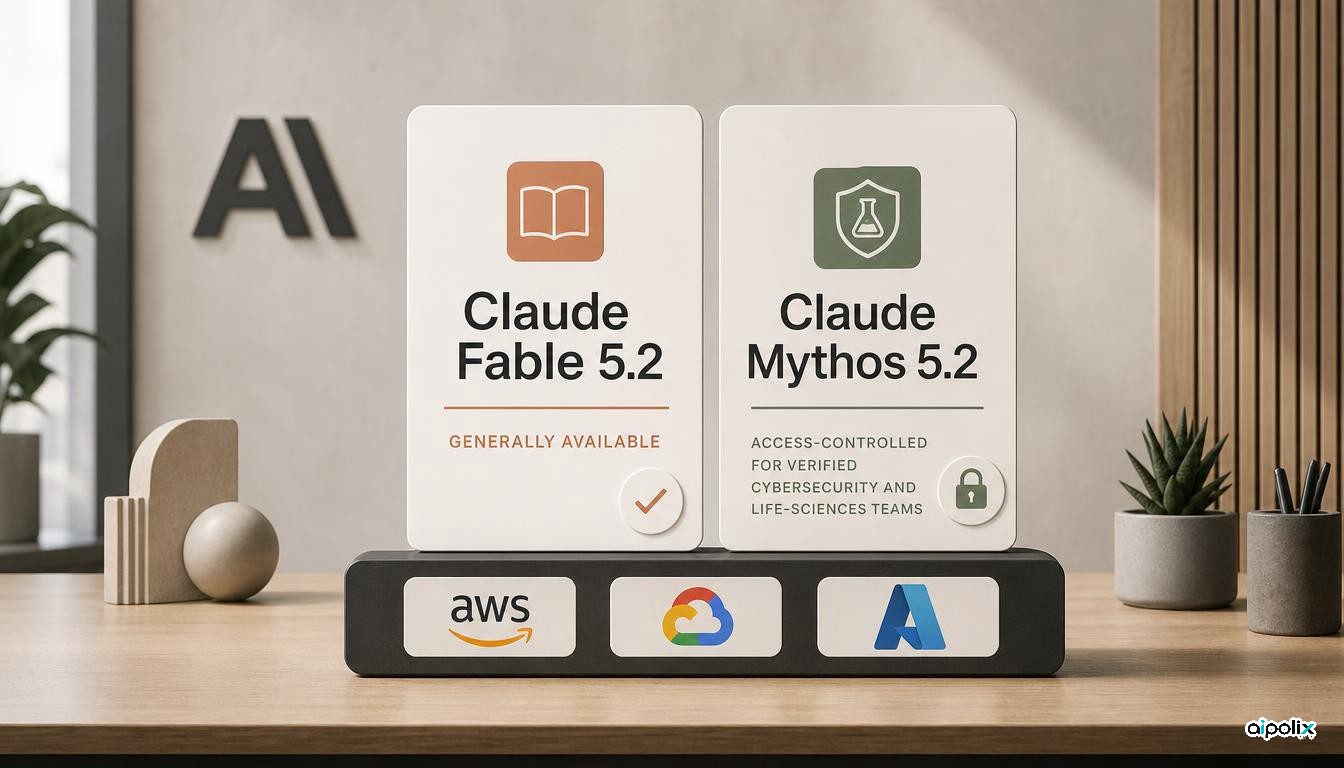
Anthropic on November 9, 2026 released Claude Fable 5.2 and Claude Mythos 5.2, describing them as upgrades of the models it builds for the hardest technical work. In a first-party announcement with no individual byline, the company said Fable and Mythos are the same underlying model. Fable 5.2 ships with cybersecurity and biology safeguards so it can be offered to all users. Organizations that want the version without those blocks can apply for Mythos 5.2 through Anthropic's Life Sciences and Cyber Verification Programs. Developers can call claude-fable-5-2 on the Claude Platform, and Anthropic said Fable 5.2 is available the same day on Amazon Web Services, Google Cloud and Microsoft Azure. CNBC's Ashley Capoot reported that the launch is Anthropic's first frontier-model release since chief executive Dario Amodei publicly called for a slower pace of AI development, and that the company is preparing for a possible initial public offering as soon as the following week.
Anthropic said testers found the new pair clearer than earlier Fable and Mythos models and that they generate outputs up to 30 percent faster than the 5.1 versions. Standard API pricing is $8 per million input tokens and $40 per million output tokens. An optional fast mode, which Anthropic said can speed token generation by up to 2.5 times, costs $16 per million input tokens and $80 per million output tokens. Fast mode is listed for Claude Code, the Claude Platform, Claude Models on Google Cloud and Microsoft Foundry, with Mythos fast mode limited to verified organizations. Anthropic platform documentation lists a 1 million token context window and a 128,000 token maximum output for Mythos 5.2, the same prices as Fable 5.2, adaptive thinking that is always on, and a June 2026 knowledge cutoff. The company recommends Claude Opus 5.5 as the everyday default and Fable or Mythos for more ambitious work, including as an advisor or orchestrator for smaller models.
The announcement reports internal and partner benchmarks that Anthropic says place Fable 5.2 above Claude Opus 5.5 on almost every capability it measured. On FrontierCode 2.0, which scores whether code changes would be merged, Anthropic listed 49.1 percent for Fable 5.2 at its highest effort setting, against 32.4 percent for Fable 5.1, 45.5 percent for Opus 5.5, 42.8 percent for GPT-6 Astra and 41.1 percent for Gemini 4 Carbon. Other claimed scores include 69.9 percent on FrontierSWE v2, 74.2 percent on Humanity's Last Exam with tools, and 64.9 percent on an internal RoboDojo Sim robotics run. Mythos 5.2 is credited with 76.3 percent on CyScenarioBench, 89.6 percent on an internal CVE Rediscovery test and 85.1 percent on a 24-hour protein-binder task. All of those figures are Anthropic's own reported results, often at the highest available effort, and the company pointed readers to a system card for methodology.
Anthropic also described several internal demonstrations. It said more than 90 percent of changes merged into its core codebase are now written by Claude with human guidance, and that agents running an earlier Fable 5.2 version migrated a production service from Python to Rust that now starts about 26 times faster. A team of about 1,000 Fable 5.2 agents was said to have formalized the proof of Fermat's Last Theorem in Lean in 30 hours, compared with 11 days for an earlier unreleased research version. The company also said Fable 5.2 completed two open theoretical-physics calculations about black holes and holographic duality, designed three working electronic devices with the circuit-board firm Diode, and that Mythos 5.2 predicted adeno-associated virus capsid structures by combining open protein-folding models with known symmetries, accurately modeling 28 of 34 capsids in its tests.
On safety, Anthropic said pre-release testing included new evaluations of sandbox-escape behavior and that high-stakes misalignment risk remains low. External testers named in the post include the UK AI Security Institute, Frontier Design and METR. Fable 5.2's cyber and biology classifiers are described as producing about 55 percent fewer unnecessary blocks than Fable 5.1. The company said it limited training-time gains on a narrow set of AI-research skills such as accelerator kernel optimization so those capabilities stay near Opus 5.5, and that Fable 5.2 has its strongest anti-distillation defenses yet, which a recent report said cut data harvested by illicit distillers by 90 to 99 percent. Enterprise Frontier Safeguards, a private beta that monitors prompts stored in a customer's own infrastructure, is named with Bridgewater, Salesforce and Stripe as early customers.
Independent coverage from The Verge, VentureBeat and CNBC confirmed the same-day split between general Fable access and gated Mythos access, the 30 percent speed claim and the lower list prices. An Amazon Web Services blog by Dani Mitchell, Aamna Najmi, Anshika Saxena, Alfredo Castillo and Sofian Hamiti said both models are available on Amazon Bedrock and that Anthropic designates Fable 5.2 as a Covered Model with default retention and human safety review. Paid Claude plans that include Fable are getting extra usage for the launch week, Anthropic said. Performance, physics, formalization and safety conclusions in the announcement remain vendor claims pending independent replication.