
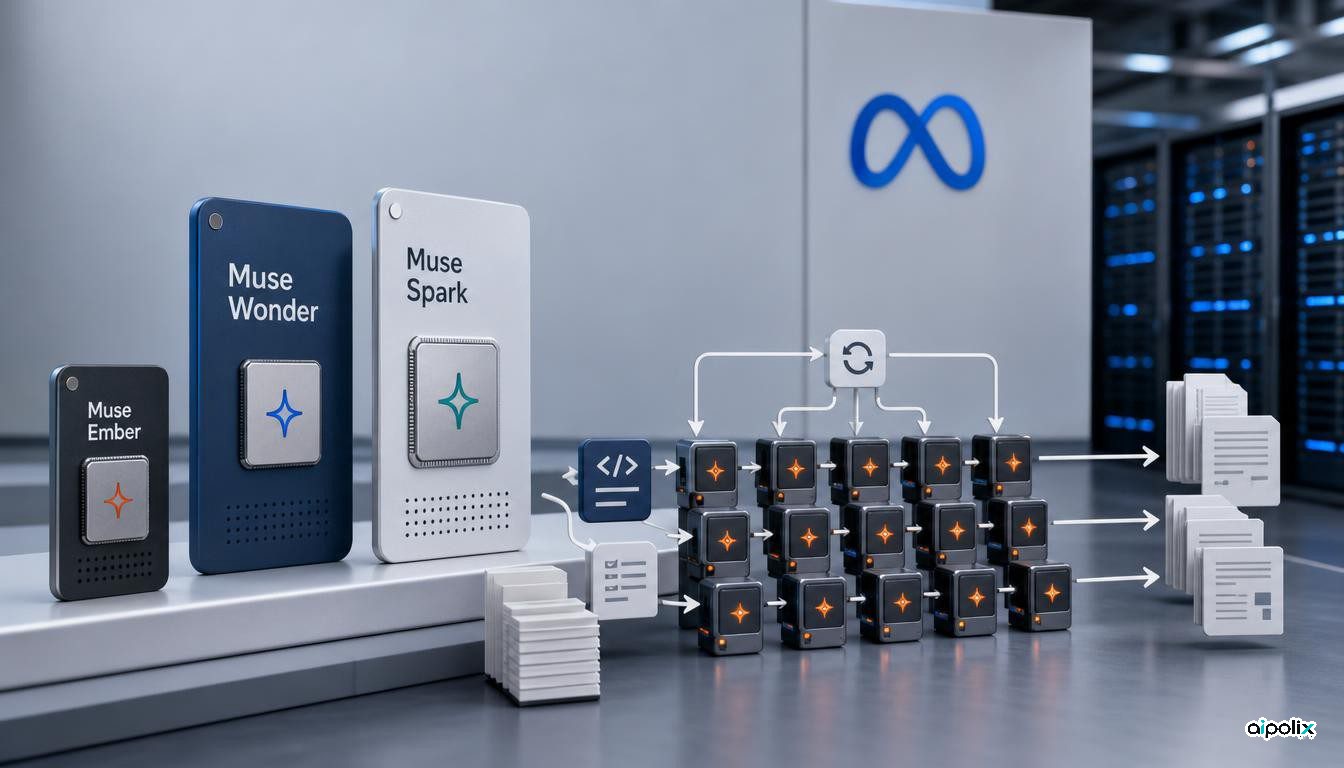
Meta Superintelligence Lab on November 9, 2026 introduced Muse Ember, calling it the smallest and most efficient model in the Muse family. The unsigned research blog said Ember is designed for complex reasoning execution and the work agents repeat all day: tool calls, coding subtasks, routing, extraction and long document parsing. The model ID is muse-ember-1.0. It is available the same day on the Meta Model API and in Muse Code, on pay-as-you-go billing and on every Muse Code subscription. List prices are $0.10 per million input tokens, $0.004 per million cached input tokens and $0.50 per million output tokens, with higher long-context rates above 200,000 input tokens. Meta said Ember has a context window of 1,048,576 tokens and can emit up to 524,288 output tokens, and that it accepts text, image, video, audio and PDF inputs.
The company positioned Ember as a volume worker that should sit beside larger Muse models rather than replace them. The blog said Muse Wonder plans and Muse Ember handles the volume, and developer documentation tells teams to hand repeated subtasks to Ember while Muse Wonder or Muse Spark run the main planning loop. Meta added that Ember is the first specialized model trained using Muse Wonder Full. Against Muse Spark 1.3, Meta listed an Artificial Analysis Intelligence Index of 36 for Ember at maximum reasoning effort versus 37 for Spark, at an estimated $0.14 per index task compared with $2.39, and input and output prices of $0.10 and $0.50 versus $1.25 and $4.25 per million tokens.
Meta said Ember delivers more intelligence per dollar than Claude Haiku 5.5 or GPT-6 Luna at every reasoning setting it plotted, matching Haiku's best Artificial Analysis score at about a third of the cost and beating every Luna setting. In a results table, at maximum effort, it reported 37.8 on AutomationBench-AA against 13.9 for Haiku and 20.2 for Luna; 61.6 on an internal Agents' Last Exam Linux subset; 46.8 on its internal Personal Superintelligence Index; 40.9 on Terminal-Bench 4.0 in the mini-swe-agent harness against 39.2 for Haiku and 16.4 for Luna; and 46 on Coding Agent Index-AA. FrontierCode 2.0-AA was a miss relative to Haiku: 27.2 for Ember versus 34.9 for Haiku and 25.2 for Luna. Multimodal scores included 22.8 on GDP.pdf-AA, 69.5 partial credit on an internal OSWorld 2.1 run and 80.6 on PerceptionBench with tools. Those comparisons mix Artificial Analysis figures dated November 9, 2026 with Meta's own evaluations.
Early testers quoted on the research blog described Ember as a fast, cheap subagent. Yashodha Bhavnani, vice president of AI products at Box, said it could score a contract against a negotiation playbook and screen candidates against a brief. Saoud Rizwan, founder of Cline, called it purpose-built for subagent coding and document analysis. Konstantinos Papamiltiadis of Oracle said early testing showed an encouraging ability on complex engineering tasks. Dane Knecht, chief technology officer at Cloudflare, said Ember ran up to 30 percent faster at the tail than the comparable model his team tested. Chak Pothina, inference lead at You.com, said Ember finished every coding quest in their tests with a 95th-percentile latency of 2.2 seconds and used 36 to 48 percent fewer output tokens than leading open-weight models they compared. A companion Meta developer post described a 16-agent demo that ported lexers from Python to Rust in parallel, with Ember handling about 158 million input tokens against 4.4 million for Muse Wonder at a pay-as-you-go cost of about $3.96.
On safety, Meta said it evaluated Ember under its Superintelligence Scaling Framework, including chemical and biological, cybersecurity and loss-of-control risks, and that the model stayed below the framework's high-risk thresholds. The same testing covered whether Ember respects user intent, handles sensitive information, resists hidden instructions in web pages, documents or tool outputs, and asks for human input before high-impact actions. Developer documentation notes that on the Model API Ember runs only in Standard mode, with no Contributor-mode variant.
Independent coverage matched the first-party facts. TechCrunch's Russell Brandom, writing at 10:00 a.m. Pacific Time on November 9, and The Verge's Jay Peters reported the same positioning: a lightweight execution model meant to pair with Muse Wonder, priced at 10 cents per million input tokens and compared by Meta with Haiku and Luna on cost per task. All benchmark, latency and price-performance figures above are Meta's claims or partner testimonials unless attributed to Artificial Analysis.