
Anthropic's biology research lab reported on November 4, 2026 that it has determined the first three-dimensional structure of a vault particle from the prokaryotic world, the domain of bacteria, archaea and the viruses that infect them. Vaults are huge, hollow protein barrels found in most complex cells, including human ones. They were discovered in 1986 and their function is still unknown. The company presents the work as a test of how far Claude can speed up basic biology, and has submitted a preprint to bioRxiv.
Relatives of the vault protein had already been spotted in bacterial and phage genomes, but no one had shown that they actually build vaults. Using Claude Science, the team searched a database of about 15 billion predicted proteins and found such relatives in 29 bacterial phyla and four archaeal ones, yet in less than 1% of sequenced species. Researchers picked 44 candidates; Claude converted each sequence into DNA designed for the host cell and prepared the constructs. Fifteen of 24 produced soluble protein in E. coli, seven formed vault-like particles under the microscope, and cryo-electron microscopy confirmed the vault shape for four.
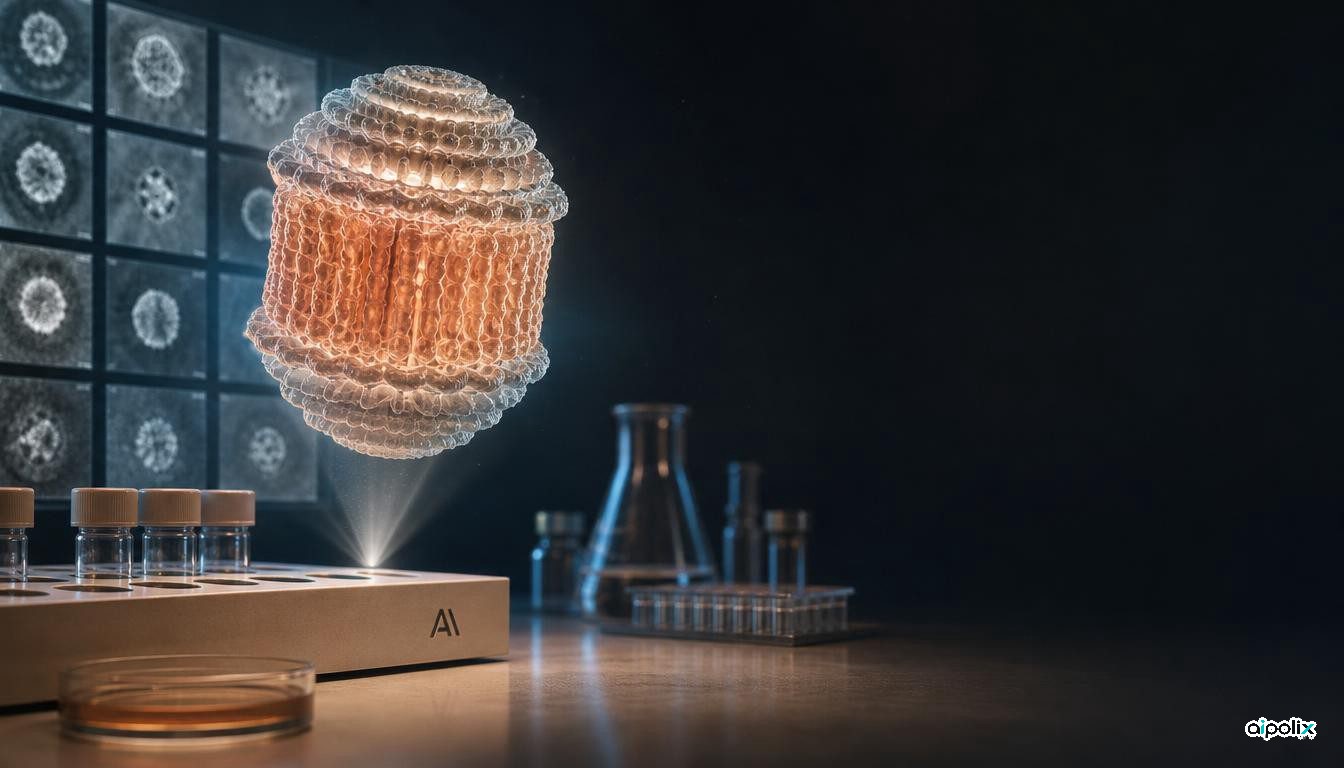
The structure the team chose to solve comes from a phage protein it calls L05. The particle is made of 96 copies of that protein, against 78 in mammalian vaults, and weighs about 9.5 megadaltons. It is shorter and wider than the human version, about 54 by 45 nanometers, yet encloses roughly 25% more volume. Its end caps narrow in three steps, like a tiered dome. When the researchers duplicated two segments of the protein's wall, the particle grew by about a fifth in volume, which they suggest shows how vaults could have changed size during evolution and how they might be adapted as nanocapsules for delivering enzymes.
Anthropic says Claude changed the pace of the work. A purification method that normally takes about three days took roughly 90 minutes after the model recommended size-exclusion chromatography on raw cell extract, an approach it had first argued against. Working in an internal multi-agent setup with hundreds of GPUs, Claude ran the cryo-EM processing software and had a first structural model ready in 34 hours, a task the team estimates would usually take weeks. The model also flagged an unidentified small molecule in a pocket of each protein copy that resembles coenzyme A, a possible clue to function.
The post is candid about mistakes. One protocol Claude wrote included an additive that blocks DNA uptake and cost two weeks, and early processing produced a flawed map blended with its mirror image until researchers told the model to stick to standard steps. Leonard Rome, a co-discoverer of vaults who advised the project, said the function remains a hard problem.
The findings have not yet been peer reviewed, the preprint link was not live at publication, and the vaults have so far been produced only in E. coli rather than in the organisms where they occur naturally. Anthropic says the structures and further data will be released soon.