
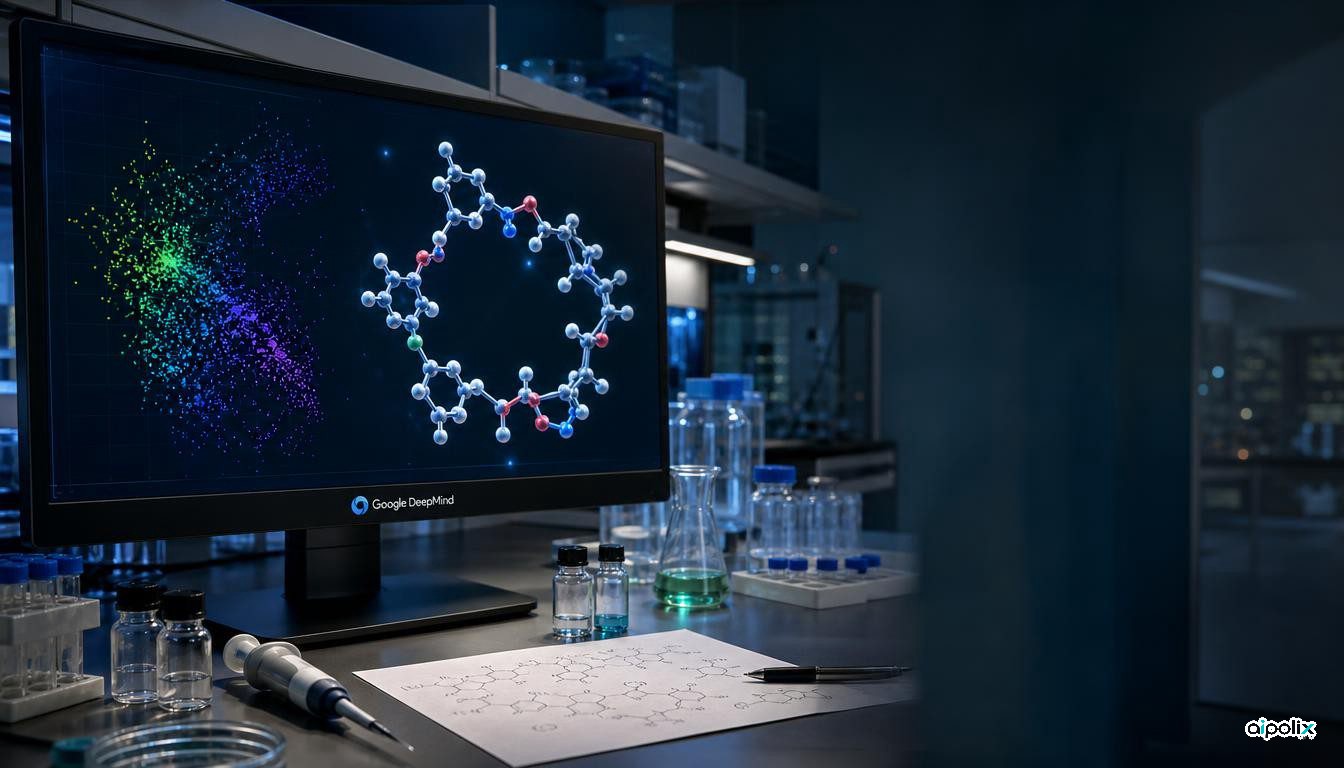
Google DeepMind wants its Antigravity agent environment to become a working tool for medicinal chemists. In a technical post published on November 3, 2026, the lab introduced a suite of Cheminformatics Skills for Google Antigravity, made them available through the app's Science plugin, and opened applications for 10,000 scientists to use Antigravity's highest usage tier at no cost for six months.
The skills split the work in a deliberate way. The language model orchestrates the workflow, navigates databases and reasons about chemistry, while deterministic tools carry out the molecular calculations. Those tools are grounded in RDKit, the long-running open-source cheminformatics toolkit, and the package adds connectors to the curated ChEMBL and PubChem databases. DeepMind's argument is that chemistry leaves no room for small mistakes: change a single atom or bond and the agent is describing a different compound, so exact computation should not be left to the model's text generation.
To show the workflow, the authors walked through a classic medicinal chemistry tactic called rigidification, using two approved lung-cancer drugs. Crizotinib, a first-generation kinase inhibitor, has five major rotatable bonds; lorlatinib, a later drug in the same class, is cyclized so that its effective rotatable bonds drop to zero, which contributes to higher potency. The agent searched the literature for both drugs and their analogues, pulled thousands of compounds, filtered out irrelevant entries such as buffers and solvents, documented where each came from, and opened an interactive viewer that plots potency against rotatable bonds.
From there it ran a matched molecular pair analysis comparing cyclized and non-cyclized pairs, which confirmed the expected pattern of fewer rotatable bonds and generally higher potency. It also trained and validated a range of potency prediction models across four experimental readouts, using scaffold splits to estimate how well they generalize, and finally proposed new rigidified macrocycles with reaction schemes, electron-pushing diagrams and synthesis routes consistent with documented procedures. DeepMind says the loop, which would previously have taken several days and significant computational expertise, ran in about an hour, and the results can be exported to standard chemistry software or passed on to AlphaFold or molecular dynamics.
The release extends a strategy DeepMind has been pursuing with Antigravity as a science workbench rather than only a coding tool, building domain skills that run on a researcher's local tooling. Enterprise users can reach the same skills by signing in with Google Cloud credentials. The free-tier offer is rolling and depends on eligibility, capacity and selection.
The post is careful about limits. Sparse data, noise between laboratory assays and narrow dynamic ranges cap how precise any potency model can be, and DeepMind stresses that computational designs are hypotheses: every proposed molecule still has to be synthesized and tested. The walkthrough reproduces a known success story rather than discovering a new drug, and the one-hour timing comes from DeepMind's own demonstration rather than an outside evaluation.