
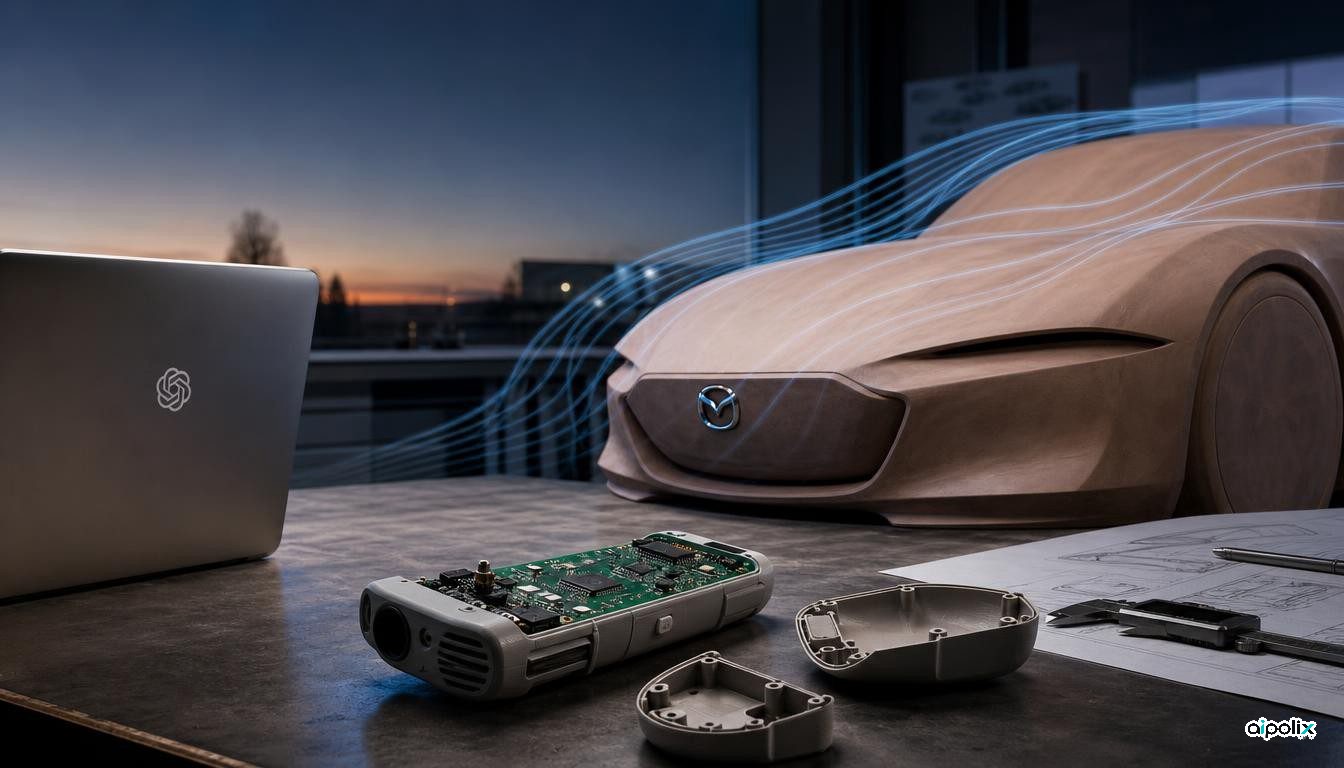
OpenAI is pitching its frontier models at a new kind of customer: engineers who build physical things. In a post dated November 3, 2026, the company described how GPT-6 Astra and Codex are being used inside OpenAI for mechanical and electrical design, released a new benchmark comparison, expanded its work with the Chip Ganassi Racing team and announced a research collaboration with the Japanese carmaker Mazda.
The most concrete example is a small device built to talk to Codex. OpenAI says Astra defined the requirements and designed the look, the enclosure and the internal structures, picked the electrical components, laid out the printed circuit board and wrote the firmware and software integrations, all without direct human edits to the design. Two staff members worked on it as a side project for under a week, and a contract manufacturer produced a small batch of prototypes in less than a month.
OpenAI is open about where the model fell short. Preparing the device for manufacturing took several rounds of review, because Astra did not reliably account for the manufacturer's production limits, tolerances or assembly details. The company presents those gaps as input for future model training rather than as solved problems.
Inside the company, the hardware and infrastructure groups now use Codex and ChatGPT to create and revise CAD models, turn 3D designs into 2D manufacturing drawings, set up finite element simulations, work in electronic design tools and review designs for robotics and compute infrastructure. OpenAI says token usage across those hardware teams has grown 23-fold since February. It also reports results on BenchCAD 2.0, a test of whether models can rebuild 3D parts and assemblies and trace connections on circuit boards: a newer internal model averaged 0.875, compared with 0.594 for GPT-6 Astra at its highest reasoning setting. The internal model is not named, and the figures have not been reproduced outside OpenAI.
Outside partners are the second half of the story. Chip Ganassi Racing's research and development engineers are testing workflows that convert 3D scans of existing parts into editable CAD models and manufacturing drawings, which helps when the original design files no longer exist, and they check the outputs for accuracy and manufacturability. With Mazda, OpenAI's research and forward deployed engineering teams are working with aerodynamics and crash-safety engineers on airflow and structural simulations that weigh performance against styling and cost. One early use has Astra in Codex generating and simulating alternative nose shapes to cut drag. OpenAI says it will share results in the coming months.
The announcement fits a broader push by AI labs to show value beyond software, where coding agents already have measurable traction. Engineering design is a harder test: errors in geometry, tolerances or crash behavior have physical consequences, and the tools involved are specialized and often proprietary. OpenAI is also openly recruiting engineers, engineering firms and software vendors in mechanical, electrical and electromechanical fields to help shape training and tooling.
For now, the evidence is first-party. The device build, the token growth and the benchmark scores all come from OpenAI, the Mazda work is at an exploratory research stage with no published results, and the company itself says human review remained necessary before anything could be manufactured.