
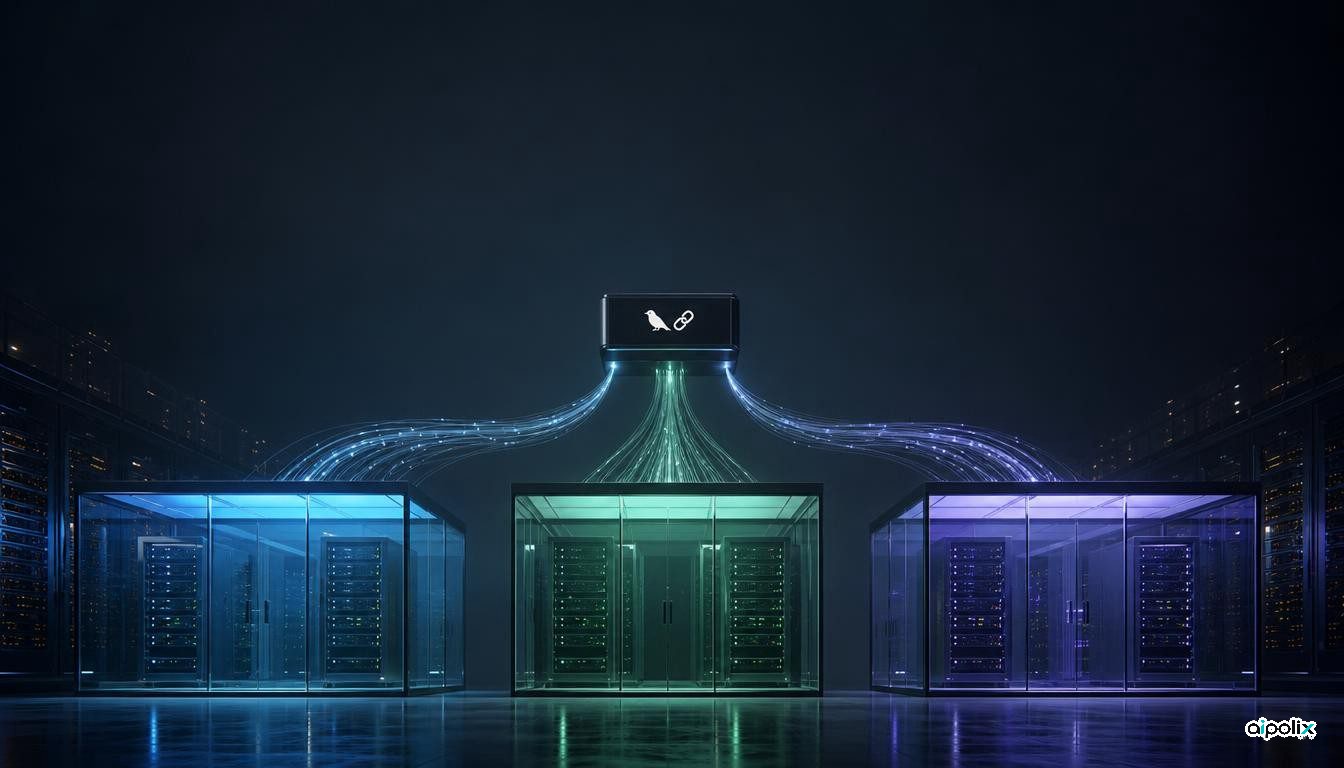
LangChain is widening the deployment options for LangSmith, its platform for tracing, evaluating and running AI agents. In a post dated November 3, 2026, the company said LangSmith Bring Your Own Cloud (BYOC) now runs on Microsoft Azure and Google Cloud in beta, in addition to Amazon Web Services, where the option is generally available. LangChain first launched BYOC on AWS in August.
The product is aimed at companies with strict data-residency or compliance rules that still want a managed service. BYOC splits LangSmith in two. LangChain operates the control plane, which holds authentication, organization and workspace configuration, billing metadata, hashed API keys and static interface assets. The customer owns the data plane inside its own cloud account, and that is where the sensitive material lives: traces, prompts, datasets, evaluation results and deployed agents. An organization can run several data planes, split by region, environment or business unit, and each can sit in a different account or even a different cloud.
Until now, organizations with those constraints had to self-host LangSmith, which in LangChain's telling meant dedicating platform engineers to patching stateful services, configuring databases, running schema migrations and coordinating Helm upgrades across environments. With BYOC, LangChain provisions and operates the stack inside the customer's network and handles scaling and updates. The company says AWS customers have cited continuous upgrades, faster access to features shipped on LangSmith Cloud and automatic scaling as the main benefits.
The implementation differs by cloud. On Azure, the data plane runs in a dedicated virtual network with a private AKS API endpoint, using Istio and KEDA for routing and event-driven scaling and sending system telemetry to Azure Monitor; LangSmith Sandboxes are not yet supported there. On Google Cloud, data planes can run in any region and are managed from LangSmith's US control plane. On AWS, BYOC runs inside the customer's existing VPC, with the database in chosen subnets and security groups attachable per application role. On all three clouds, the data planes can also run Managed Deep Agents endpoints.
LangChain is also offering a path off self-hosting. An open-source migration tool copies workspace resources such as users and roles, datasets, experiments, prompts, annotation queue settings, automation rules, dashboards and Fleet resources, while leaving the self-hosted instance running. Traces, runs and feedback move separately using LangChain's internal tooling, and that step is available only on AWS today. The Terraform modules behind BYOC are public, and the LLM Gateway on the data plane can call models from 11 providers plus any OpenAI- or Anthropic-compatible endpoint.
For teams building agents in regulated industries, the change mainly removes a cloud constraint: an organization standardized on Azure or Google Cloud no longer has to choose between running LangSmith itself and sending telemetry to LangChain's cloud. The commercial model is unchanged, with data planes provisioned through LangChain's sales team.
Some caveats apply. Azure and Google Cloud are labeled beta, trace migration is limited to AWS, and LangChain has not published pricing or service-level terms in the announcement. At run time, LangChain's main BYOC documentation page still described AWS as the only generally available provider with others planned, so details for the new clouds may still be settling. Customer benefits cited in the post are LangChain's own account.