
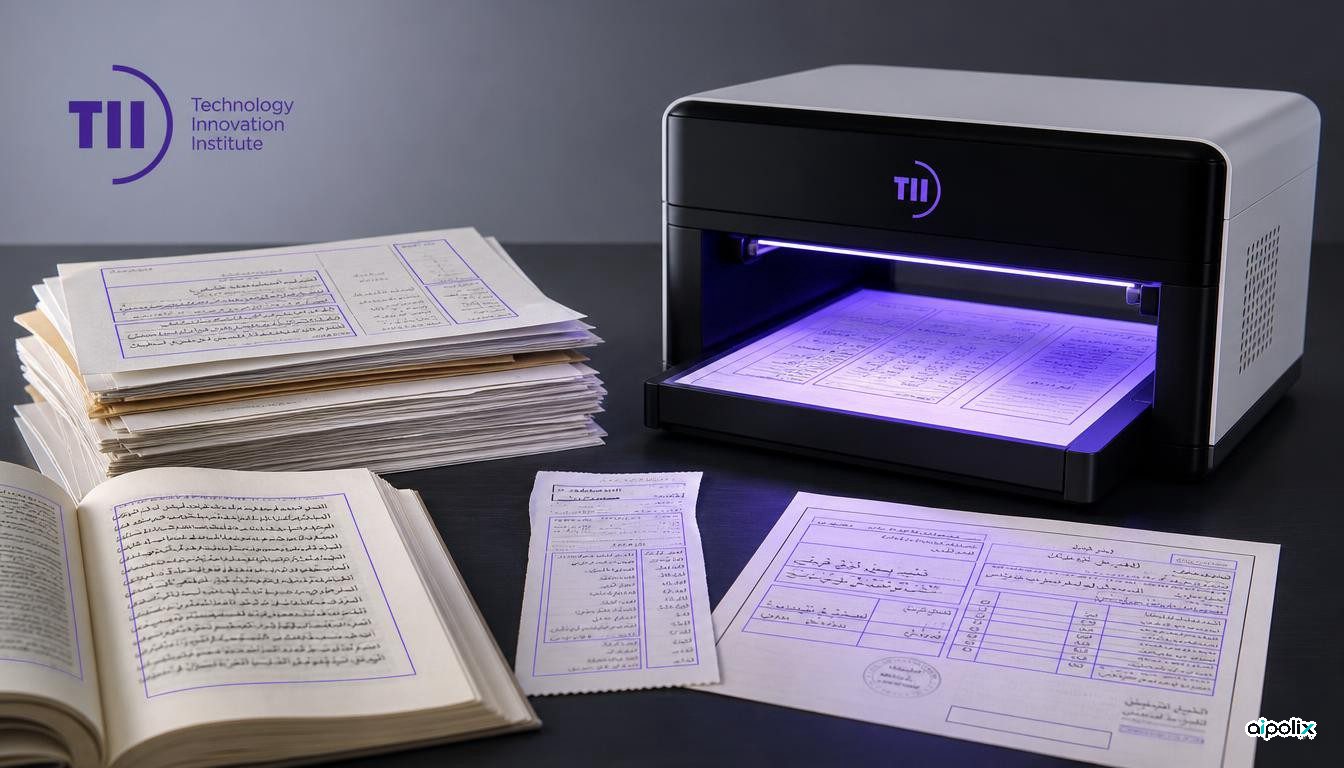
Technology Innovation Institute (TII) has introduced Falcon-OCR-Arabic, a 270M-parameter OCR model adapted specifically for Arabic documents. The release extends the existing Falcon OCR architecture rather than replacing it with a larger system: TII says it kept the same early-fusion design and adapted the model in two stages, first with supervised fine-tuning on real and synthetic Arabic documents and then with reinforcement learning on a curated set of higher-quality samples.
The technical motivation is unusually concrete. Arabic OCR has to handle contextual letter shapes, small dot differences that can change a character, optional diacritics, right-to-left layouts, mixed Arabic and Latin text, and documents that combine Western and Eastern Arabic numerals. TII says the adaptation data covers practical document categories including receipts, invoices, administrative forms and books. The reinforcement-learning stage is intended to target errors that matter to document users but can be weakly represented by ordinary token loss, such as a misplaced dot, an invented diacritic, a skipped line or repeated table content.
TII evaluated Falcon-OCR-Arabic on an Arabic document benchmark containing 11,974 real-world samples across 15 categories, using the OmniDocBench evaluation framework. According to TII's published results, the model reached 81.87% text accuracy, second to Gemini 3.5 Flash at 84.34%, while achieving the highest Table TEDS score in the comparison at 59.95%. TII also reports that the model ranked first on official documents, administrative forms, receipts and invoices. These numbers are notable for a 270M-parameter model, but they are vendor-reported results from a benchmark introduced and run by the model's own team, so they should not be treated as independent validation.
The release builds on Falcon OCR, whose public Hugging Face model card describes a 270M-parameter early-fusion vision-language architecture that processes image patches and text tokens in one shared Transformer. The existing model card also documents an Apache-2.0 license and public model weights, giving developers a concrete path to inspect and run the underlying Falcon OCR stack. The Arabic announcement says the adaptation keeps that architecture and changes the training rather than adding a separate vision encoder or task-specific OCR modules.
For Arabic document processing, the practical significance is the combination of specialization and small model size. If the reported results hold across external evaluations, a compact model that performs competitively on Arabic forms, receipts and tables could be useful where latency, deployment cost or local inference matter more than broad multimodal capability. It may also illustrate a broader pattern: targeted post-training on script- and document-specific failure modes can potentially narrow the gap with much larger general-purpose vision-language models.
The main caveat is evidence independence. The core release, model size, architecture and public Falcon OCR assets are supported by TII's own announcement and model materials, but the new Arabic benchmark and comparative performance claims currently come from the releasing team. Independent reproduction, access to the exact Arabic benchmark, and third-party testing on noisy scans and real production documents will be important before drawing stronger conclusions about state-of-the-art performance.