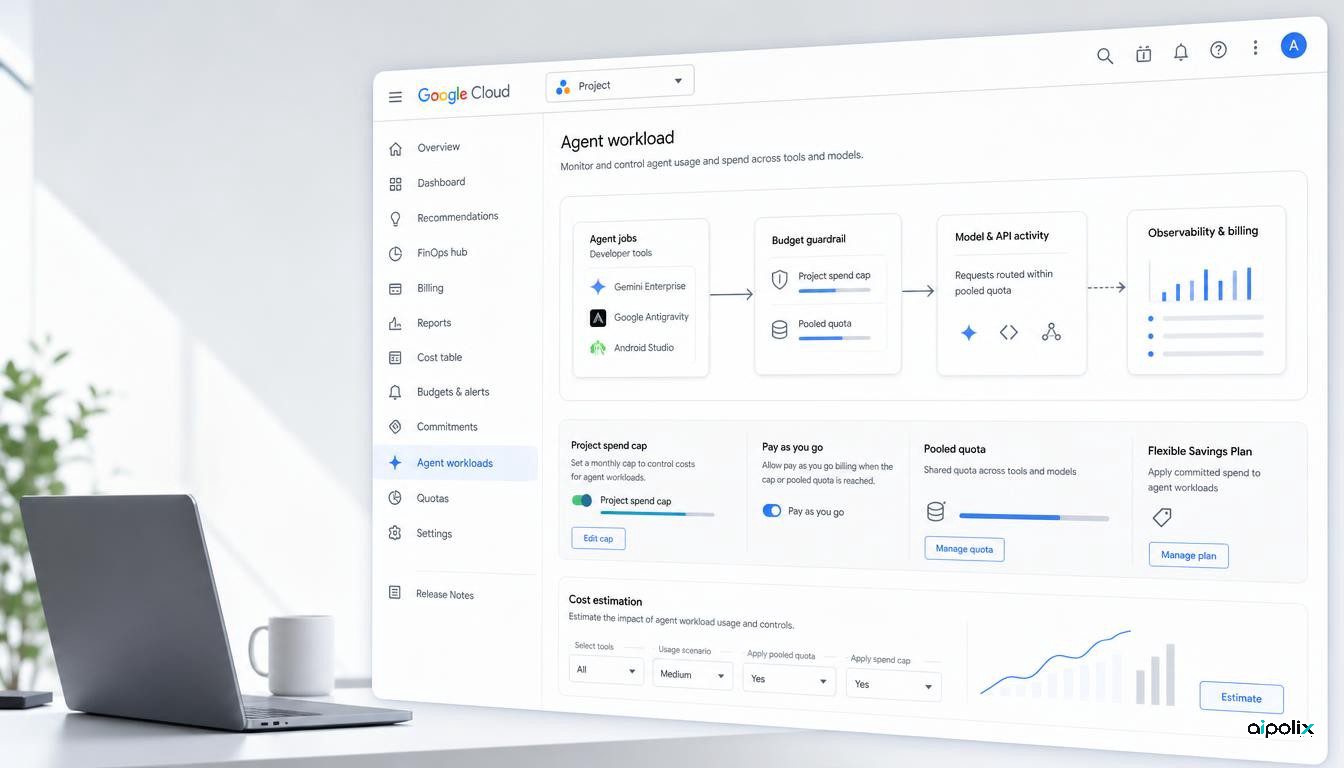
Google Cloud has introduced a new set of billing and cost controls for agent workloads that changes how enterprises can budget for Gemini Enterprise, Google Antigravity, Android Studio AI, and custom agents. The release adds pay-as-you-go capacity, pooled quotas, project-level spend caps, savings plans and cost visibility designed for workloads that can run for many steps rather than a single prompt-response exchange.
For engineering leaders, the important change is that agent cost is being treated as an execution control, not only a finance report produced after the fact. Google Cloud’s announcement says project-level monthly limits can pause agent API calls when a project reaches its cap, while administrators can instead enable overages when continuity matters more than a hard stop. That creates a direct connection between FinOps policy and agent runtime behavior.
Agent quotas become a shared project resource
Google is also changing how developer-tool capacity is packaged inside Gemini Enterprise. Antigravity and Android Studio AI usage can now be included in eligible Gemini Enterprise subscriptions, with developer-tool quota pooled at the Google Cloud project level. Instead of each developer or surface consuming an isolated allowance, business applications, developer tools and custom agents can draw from the same project pool.
That matters for teams that run coding agents unevenly. A conventional per-seat subscription assumes relatively predictable individual use, while an agent can consume large amounts of inference during a long task and almost nothing between tasks. Google’s new model lets organizations combine seat subscriptions with pay-as-you-go usage so an agent does not necessarily stop when the included quota is exhausted.
The company had already expanded Antigravity for enterprise customers with administrative controls and pooled usage. The August 26 FinOps release makes the cost boundary more explicit and connects it to the broader Gemini Enterprise billing model.
Hard spend caps can stop agent execution
The strongest operational control is the project-level spend cap. Google says administrators can define a firm monthly limit in Cloud Billing. When the limit is reached, the agent’s API calls pause for that project without stopping unrelated production infrastructure. Email alerts can warn teams as spending approaches the configured limit, and administrators can resume work or allow overages when appropriate.
This is more than a dashboard feature. A cost threshold becomes a policy that can interrupt execution. For autonomous or background agents, that is useful because runaway cost can be caused by loops, unexpectedly long tasks, retries, high-volume tool calls, or a workload that routes more steps to expensive models than the team expected.
Independent reporting from IT Pro highlighted the same developer-facing shift: enterprises can use tighter spend controls while bringing Antigravity consumption under the same subscription and budgeting structure as other Gemini Enterprise workloads.
Google adds savings plans and deferred execution
Google is also introducing Flexible Savings Plans for organizations with steady or growing usage. The company says customers can commit to a monthly spend level and receive a 10 to 20 percent reduction in token costs, without creating a separate billing silo. That is a vendor pricing offer, not evidence that every workload will become cheaper, because actual savings depend on utilization and the mix of models and agent tasks.
A coming deferred-execution option is intended for work that does not need immediate results. Google says eligible workloads will be able to run in off-peak capacity windows at lower inference cost and outside standard quota constraints. Because the feature is not yet generally available, teams should treat the promised economics as a planned capability rather than a current production guarantee.
The broader architecture is notable. Agent platforms are beginning to expose scheduling and budget policy in the same way cloud platforms expose CPU limits, autoscaling and reserved capacity. Long-running agent work makes those controls more important because the unit of consumption is no longer a single API call. The system may decide how many reasoning steps, model calls and tool interactions are needed to finish a goal.
What engineering teams should measure
Teams adopting these controls should not assume that a monthly cap alone solves agent economics. They still need per-task and per-workflow visibility. A project that stays under budget can still be inefficient if one class of task consistently consumes far more tokens than expected or if retries hide reliability problems.
A useful cost model should connect spend to outcomes: which agent completed the task, which model tiers it used, how many steps and tool calls were required, whether a human had to intervene, and whether the result passed the organization’s quality gates. Without that context, FinOps can tell a team that spending is rising without explaining whether the increase represents productive automation or waste.
Google’s August 26 release is therefore significant for agentic engineering because it moves quota, billing and spend policy closer to the runtime. For organizations using Gemini Enterprise and Antigravity, cost control is becoming part of the agent execution architecture. That is a practical shift from treating token spend as an invoice problem to treating it as a governed resource that can be pooled, capped, scheduled and, when necessary, used to stop work.