
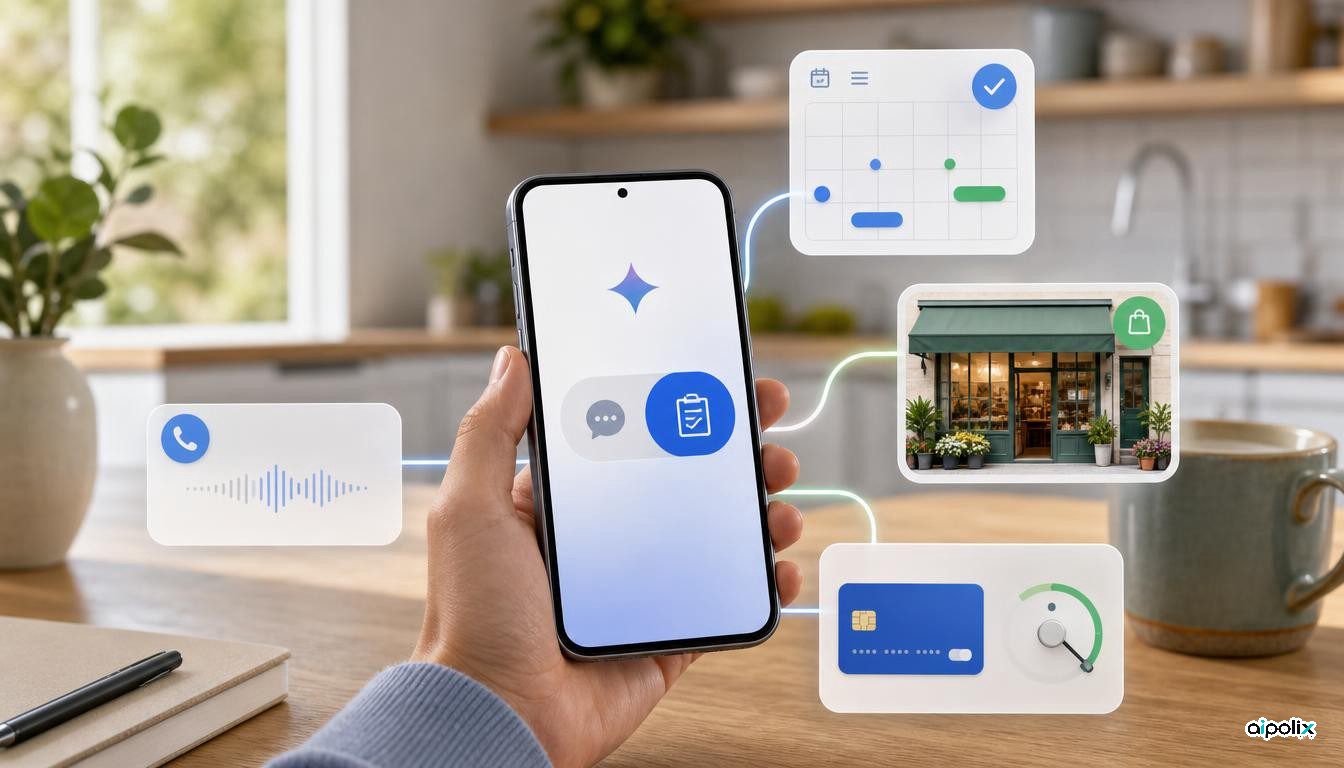
Google said on November 17, 2026 that Tasks in the Gemini app, a mode in which Gemini carries out errands for the user, is rolling out free of charge to hundreds of millions of people in the U.S., Japan, Korea, Canada, Australia and India, running on its new Gemini 4 Hydrogen model. In a blog post by Josh Woodward, Vice President of Labs, the Gemini app and AI Studio, Google also said a set of advanced features is starting in the U.S.
Google describes what Tasks can do. Gemini can call businesses on the user's behalf, including calling several at once and sitting through hold music, and then add the result to the user's calendar. It can analyze billing statements found in email, with permission to use a utility portal through a new Google Password Manager integration, and it can compare products and check out through a new Google Pay integration. Users can also forward emails to [email protected] or text Gemini in the U.S., and Google says Gemini connects with more than 60 apps and that developers can apply to join a Connected Apps Platform.
Payments are a notable part of the update. Google says Gemini now uses the Agent Payments Protocol, known as AP2, to make purchases, that it is working with American Express (coming soon), Mastercard and Visa on digital tokens for supported cards, and that users can set a hard spending cap and still earn card rewards and purchase protections. Receipts land in Google Wallet, which Google says is expanding to iOS starting the same day. Google adds that it will next integrate the Universal Commerce Protocol into Gemini.
On safety, Google says each task runs in a hardware-isolated virtual machine dedicated to the user's account on Google Cloud's Agent Compute Engine, with prompt-injection filters and Safe Browsing limits on which links can be opened. Gemini is designed to pause for confirmation before critical steps such as clicking Buy, though users can set routine actions to always allow. Calls disclose that the caller is an AI, businesses can opt out, and calling is not available in Indiana, Louisiana, Minnesota, Montana and Nebraska. Google acknowledges that tasks can fail or miss the mark and asks for thumbs-down feedback, and notes that many websites are still adapting to personal assistants, so Gemini sometimes hands the final click back to the user.
TechCrunch's Lucas Ropek, in a report the same day, independently describes the expansion and adds background: the feature began with select testers in May as Gemini Spark, was extended to U.S. Google AI Ultra subscribers and later became Task Mode. His report matches Google's account of calls, purchases through Google Pay and secure sign-in.
The examples in Woodward's post, such as a minivan service booking and a $389 electricity bill analysis, are his own anecdotes and were not independently verified.