
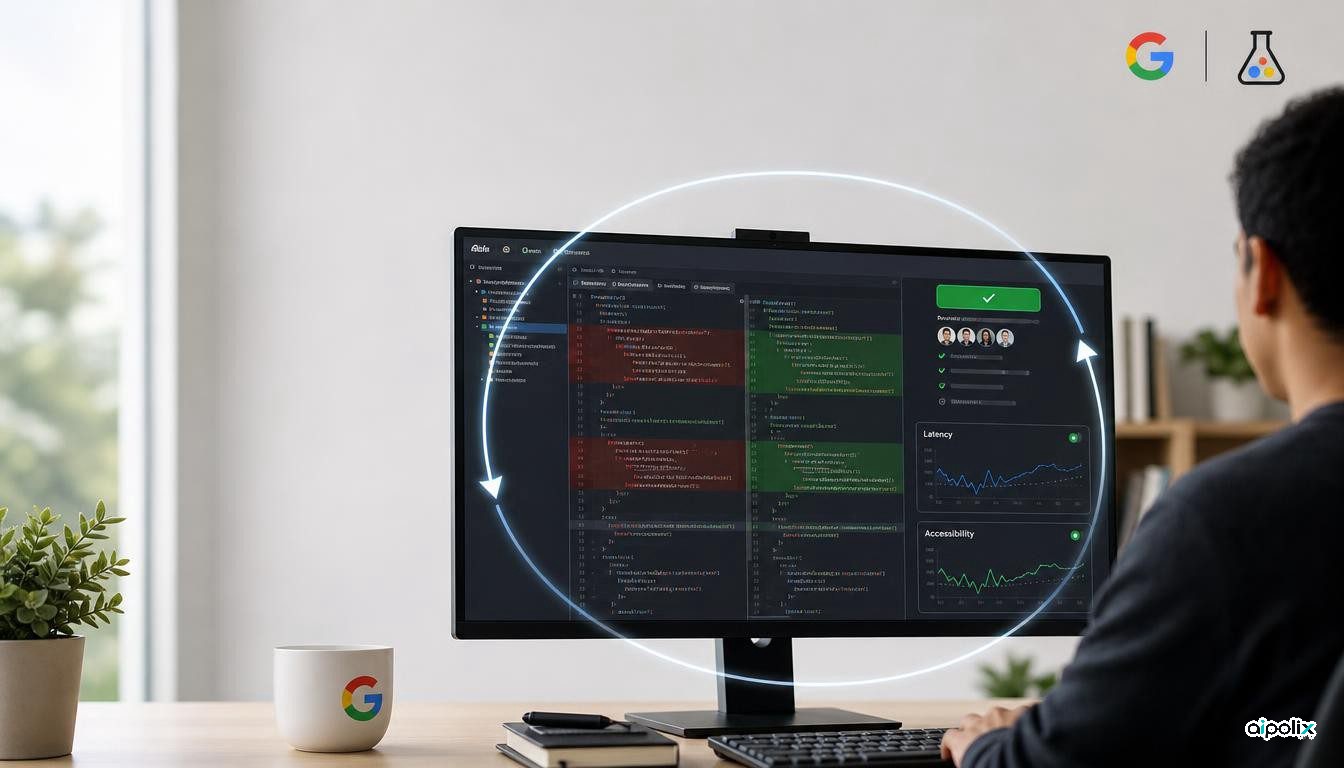
Google Labs on November 18, 2026 introduced Stitch Loop, a long-running agent aimed at what happens to a product after the code has shipped. The announcement, written by Justin Toupin, Director of Product Management at Google Labs, presents it as a new experiment within Stitch, the tool that millions of designers, developers and founders already use to turn ideas into working interfaces. Google says Stitch Loop connects to a team's codebase and live metrics, finds what needs fixing and keeps working around the clock until the team's goals are met.
The pitch rests on a gap Google describes in current coding agents: their job usually ends when a pull request merges, while patching vulnerabilities, speeding up checkout or reading signup drop-offs in noisy feedback is ongoing work for small teams. Stitch Loop is meant to take that post-launch work on.
Setup begins by connecting GitHub and product context such as logs, user behavior and feedback. Google lists more than 180 integrations, custom MCP servers and local command-line uploads as ways to supply that context. The agent then runs what Google calls evergreen loops, each tied to a measurable outcome and each following four steps. It first surfaces suggestions grounded in evidence from the product, then offers one or more solutions with tradeoffs, scope and, where relevant, visual design options. Once a person picks a direction, it writes the code in an isolated cloud sandbox and opens a GitHub pull request, sometimes with screenshots and videos of the work. Finally it keeps watching live data, learns from each result and continues to monitor after a goal is met in case the metric slips.
Three loops ship by default, for cybersecurity, latency and accessibility, and teams can add their own, such as one for checkout conversion. The security loop pairs the cyber capabilities of Gemini 4 Carbon with CodeMender, Google DeepMind's autonomous agent for improving code security. Google says the combination scans a codebase for vulnerabilities, flags each issue with evidence and opens a pull request with a proposed fix.
Human control is a stated design rule. Nothing merges until a person reviews the pull request. Stitch Loop can also act as a service layer for other coding agents: tools such as Google Antigravity can pull persistent product context through the Stitch command-line tool and MCP, which Google says supports mixed-model setups. In Slack, users can address @stitch for daily insight digests and to create new loops.
Availability is limited to a waitlist. It opens to all users worldwide, and eligible Google AI Ultra users receive priority access; feedback is collected in the Google Labs Discord. The post gives no pricing, no launch date for general access and no results from customers or benchmarks. The security and optimization claims are Google's own, and the post does not say how often proposed fixes are accepted or how the agent handles conflicting goals.