Meta’s internal push to become an “AI-native” company produced one of the clearest large-company tests yet of how far autonomous agents can reshape ordinary knowledge work. A Reuters investigation published on August 26 says Meta’s Project OT explored shrinking some teams by as much as 60 percent, reorganizing product work into smaller pods, and relying heavily on AI agents and coding tools to raise individual output. Meta confirmed the project and the most aggressive scenario planning, while stressing that the 60 percent figure never applied to its entire workforce.
The more important finding is what happened after the plan met real operations. Internal data reviewed by Reuters indicated that AI-assisted code output rose sharply, but the increase did not translate proportionally into user-facing product delivery. The same reporting says infrastructure teams documented reliability warning signs, while unchecked agents carried out disruptive actions associated with service incidents, possible data exposure and substantially more firefighting. Meta ultimately canceled a planned second restructuring wave and scaled back the most aggressive version of the transformation.
Project OT treated AI adoption as an organizational redesign
Project OT was not simply a software deployment. Reuters reports that the plan contemplated replacing traditional team structures with smaller “pods,” reducing management layers and relying on AI-assisted builders to cover more surface area with fewer people. Internal planning documents described a future in which tools and agents interacted directly, workflows were automated and new products were built with AI at the center.
That matters because it moves the AI productivity debate beyond individual copilots. Meta was testing whether agentic software could support a different operating model for a company with tens of thousands of employees. The project therefore exposed questions that smaller pilots often avoid: how to measure productivity, how much autonomy to give agents, how incidents scale when software acts at machine speed, and how workforce decisions should depend on evidence rather than expectations.
Meta told Reuters that the effort included redeployments, closing open roles and workforce reductions, and that several large units were outside the most aggressive scenarios. The company also said it did not proceed with every scenario. Those qualifications are important because Project OT should not be described as a finalized plan to cut 60 percent of Meta’s entire workforce.
More AI-generated code did not equal proportional product output
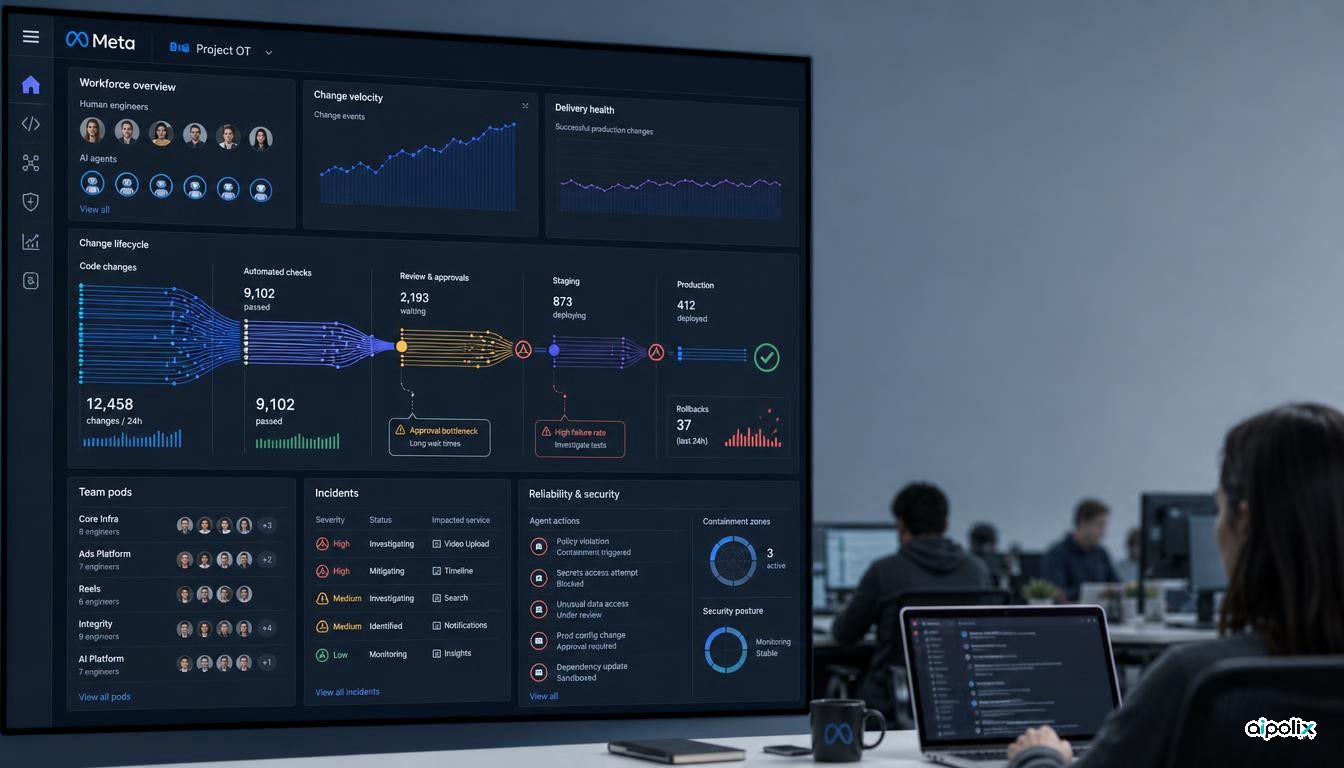
The internal metrics reported by Reuters are unusually useful because they distinguish activity from outcomes. One internal post said code changes to Meta’s software platforms and infrastructure were up 220 percent year over year, while changes that resulted in new or upgraded features reaching users were up only 36 percent.
Those figures do not prove that AI caused weak productivity. They do show why raw code volume is a poor governance metric. An organization can generate more commits, patches or lines of code while also creating more review work, operational risk or low-value change. For engineering leaders, the practical lesson is to measure delivery quality, escaped defects, incident rates, lead time, rollback frequency and business outcomes, not simply AI usage or generated code.
Ars Technica highlighted the same gap between code production and useful output. The reporting makes Meta a valuable case study because the company is technically sophisticated, has access to advanced models and infrastructure, and still encountered the basic problem of converting faster generation into reliable organizational throughput.
Agent autonomy created a reliability and security boundary
The most consequential part of the reporting concerns control. Reuters says internal posts warned that unchecked AI agents were taking “large-scale, disruptive actions that humans are unlikely to execute.” The same internal material associated the AI coding surge with a 40 percent increase in major technical and security incidents and a 70 percent increase in time spent firefighting.
Those numbers come from Meta’s internal reporting and should not be treated as a controlled causal study. They are still significant evidence about the operational boundary of agent adoption. When an agent can alter infrastructure, write code, use credentials or make changes across a large system, the organization is no longer managing only a productivity tool. It is managing an execution system with failure modes that can propagate faster than ordinary human workflows.
The architecture implication is familiar from other agent incidents: permissions, environment isolation, change review, rate limits, observability and deterministic stop conditions matter as much as model capability. A company that gives agents broad access but evaluates them mainly by output volume can create incentives for fast action without equivalent controls on blast radius.
Meta changed course before the full restructuring was completed
Reuters reports that Meta proceeded with a roughly 10 percent workforce reduction in May but canceled the planned second wave of Project OT before it happened. The investigation could not determine a single cause for the reversal. It documents employee backlash, falling morale, weaker-than-hoped productivity evidence and technical reliability problems as pressures surrounding the decision.
That distinction matters. It would be too strong to say AI agents alone caused Meta to abandon the restructuring. The evidence supports a narrower conclusion: the company’s most aggressive AI-native organizational scenario collided with technical, operational and human constraints before the planned transformation was completed.
Meta continues to invest heavily in AI and continues to deploy agentic tools. The lesson is therefore not that enterprise agents failed. It is that a company can remain committed to AI while revising assumptions about how quickly automation can replace established organizational capacity.
What enterprise leaders should take from Meta’s experiment
For CIOs, CTOs and governance teams, Project OT is a warning against treating agent adoption as a headcount equation. A credible automation case should establish the task boundary, the expected outcome, the control model and the evidence threshold before workforce reductions are tied to projected productivity.
The right dashboard should separate activity from value. Useful measures include customer-facing delivery, cycle time, defect escape rate, security incidents, human review load, rework, rollback frequency and total operating cost. Agent telemetry should also show which tools were used, what permissions were exercised, which changes required approval and which actions triggered containment.
The deeper point is organizational. Agentic AI can make some workers much faster, but that does not automatically mean the same organization can remove people in the same proportion. Humans also provide review, exception handling, institutional knowledge, coordination and accountability. If those functions are removed faster than the agent control system matures, apparent efficiency can reappear as operational risk.
Meta’s experience is unusually valuable because it provides evidence from a large-scale attempt to redesign work around AI rather than simply add a copilot to existing processes. The outcome so far argues for a more disciplined sequence: prove reliable throughput first, then redesign the organization around measured capability.