
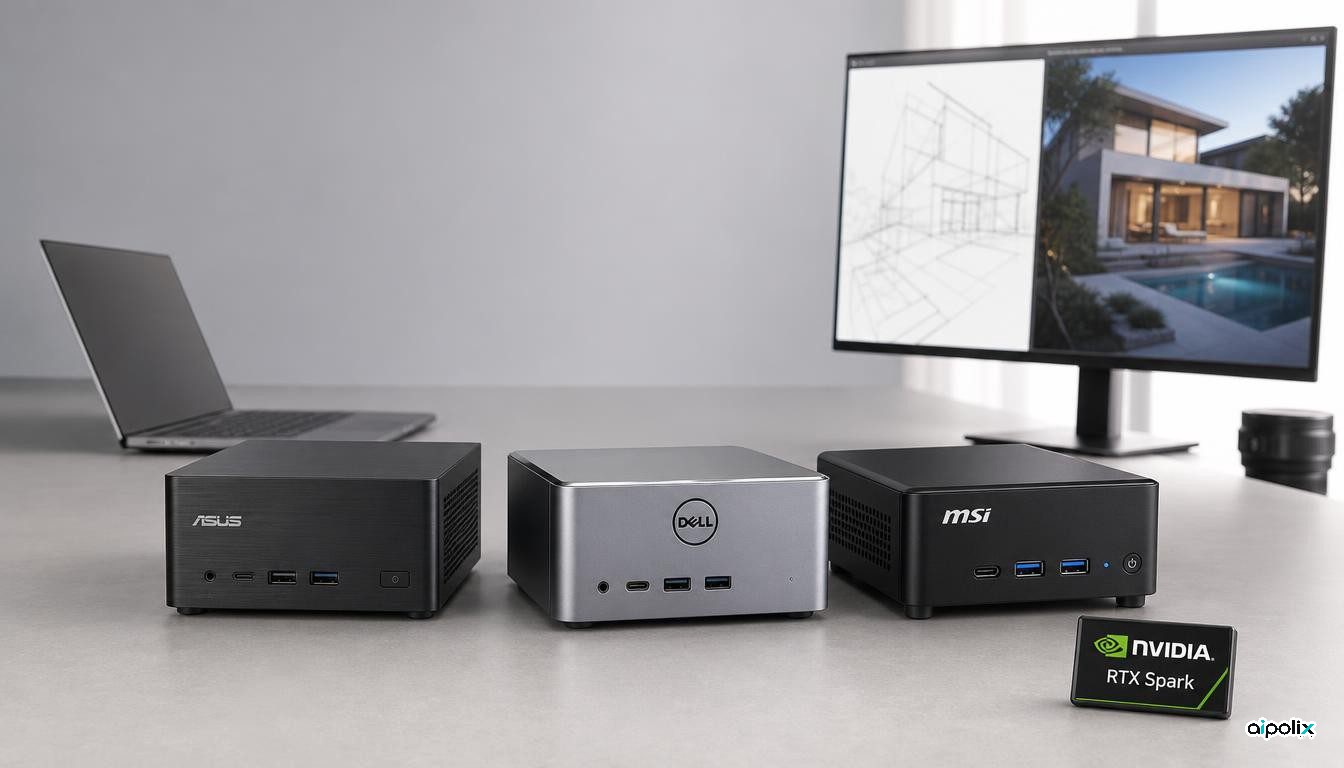
NVIDIA said on November 18, 2026 that its first RTX Spark compact desktops are on sale from ASUS, Dell and MSI. They join RTX Spark laptops already available, and NVIDIA says mini PCs from Acer, GIGABYTE and HP are coming soon, along with the Microsoft Surface RTX Spark Dev Box. The company presents the machines as dedicated Windows PCs for local AI agents, image and video generation, model fine-tuning and creative work, able to keep agents and scheduled tasks running while a laptop travels.
The hardware is specified in the announcement. Each system has a 20-core NVIDIA Grace CPU and an NVIDIA Blackwell RTX GPU with 6,144 CUDA cores, plus up to 128GB of unified memory and up to 1 petaflop of AI performance. NVIDIA lists 10-gigabit Ethernet for moving large datasets and model files, and says the memory is large enough to run 120-billion-parameter language models locally, render 90GB-plus 3D scenes in real time and edit 4:2:2 video smoothly. It also argues that running supported models locally keeps code and files on the PC and avoids per-token cloud API charges for those tasks.
On software, developers can use CUDA and Windows Subsystem for Linux, set up agents with Hermes Agent or NVIDIA NemoClaw blueprints, and fine-tune supported models with Unsloth. NVIDIA says its Switchyard routing component is now available in Hermes and automatically sends agent tasks between local and cloud models, so everyday tasks run on the device while harder reasoning uses the cloud. A demonstrated creative workflow connects Photoshop and ComfyUI through Hermes Agent so sketches become rendered images and animations from natural-language instructions, with RTX Video Frame Generation and HDR available in ComfyUI.
The post also bundles ecosystem updates. Adobe is expanding native Windows on Arm versions and RTX acceleration, with Premiere, Photoshop, Substance 3D Painter 12.2 in public beta, Illustrator and InDesign named, and NVIDIA citing more than 50% quicker turnaround on some H.264 deliverables in Premiere and up to 30% higher Illustrator performance than the emulated version. Blender 5.3 adds DLSS 4.5 Ray Reconstruction to its Cycles viewport.
Two items were announced at Microsoft Ignite. NVIDIA DGX Station for Windows, built on the GB300 Grace Blackwell Ultra Desktop Superchip, is adding support for Windows Server 2028, and Windows ML can now run any GGUF model from Hugging Face through the llama.cpp backend, with an experimental DirectX 12 backend for game developers.
NVIDIA's announcement does not give prices for the desktops. Performance figures such as 1 petaflop and the Adobe speedups are NVIDIA's own and come without independent testing, and the Switchyard and agent workflows are demonstrations rather than measured results.