
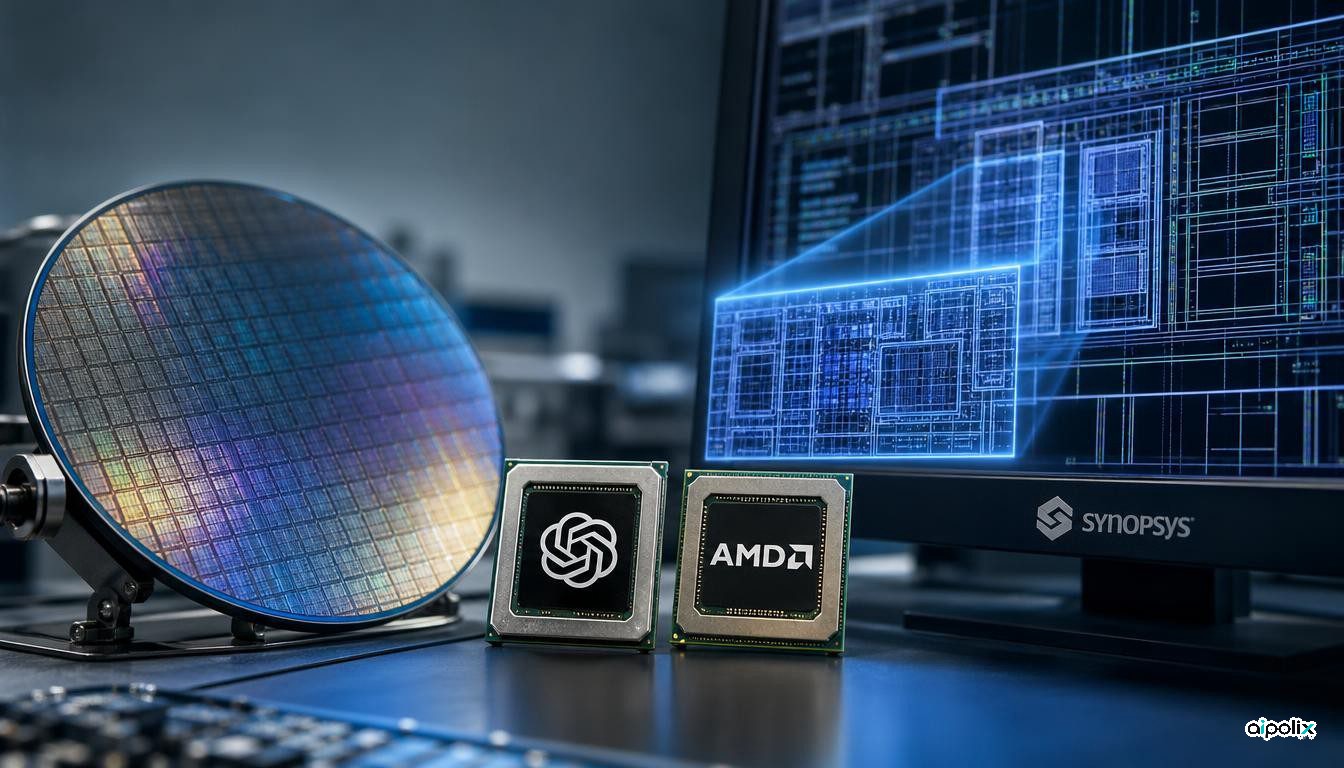
OpenAI on November 18, 2026 published a detailed account of how its models are being used to design chips, with figures from its own custom inference chip, from work with AMD and from tests on open-source processors. The company says its models are quickly improving the chips that power AI, and that the post follows an August disclosure about using frontier models to speed up Jalapeño, its first custom inference chip.
On Jalapeño, OpenAI says a model began helping with design in early 2025, starting with GPT-4o, and found nontrivial improvements in power, performance and area even then. In the vector unit, savings came from floating-point adders and multipliers, conversion functions, reduction logic and the special-function unit. In the matrix unit, one multiplier redesign used about 15% less cell area in synthesis while cutting latency from two clock cycles to one, and a separate adder redesign saved about 15% of area at the same latency. Across the effort, the team estimates model-proposed changes reduced standard-cell area by about 13% in the vector unit and 10% in the matrix unit. OpenAI says these optimizations were proven in silicon during Jalapeño's bring-up.
The same approach is being applied to third-party hardware. OpenAI reports up to 14% improvement in power, performance and area over heavily optimized baselines on AMD's flagship GPU IP, achieved by rewriting the SystemVerilog code that describes the circuits, and calls it roughly a year of progress in under five months. According to OpenAI, AMD has already included some changes in a recent design sent for manufacturing and added others to production design files, and AMD verified single-digit percentage gains across key blocks of its upcoming flagship CPU using designs written by the model. Synopsys tools were used to check that each rewrite preserved behavior and to measure trade-offs.
To track progress between model generations, OpenAI tested models on two open-source 32-bit RISC-V cores: PicoRV32, built for programmable chips, and Ibex, the processor in the OpenTitan security chip. In one task models tried to raise the throughput of the existing design, and in another they designed a core from written requirements. At a comparable budget of about 112,000 tokens per run, GPT-6.2 Astra had the highest average score on both cores, and GPT-6.1 Sol outscored GPT-5.6 Sol. Across 9,881 scored runs, all five models scored higher when designing from requirements than when improving an existing design.
OpenAI flags a limit on that last result. Starting from requirements lets models leave out features of the original cores, such as performance counters and extra instructions, which may do little for throughput on the test workloads and could explain part of the gap. The company says requiring those features, tightening area limits and checking timing after physical synthesis would make the test closer to production chip design.
Looking ahead, OpenAI is partnering with Synopsys to train GPT-Synopsys, a model meant to use Synopsys electronic design automation tools the way expert chip designers do. Every figure in the post comes from OpenAI and its partner descriptions, and AMD's own account of the gains is not included.