
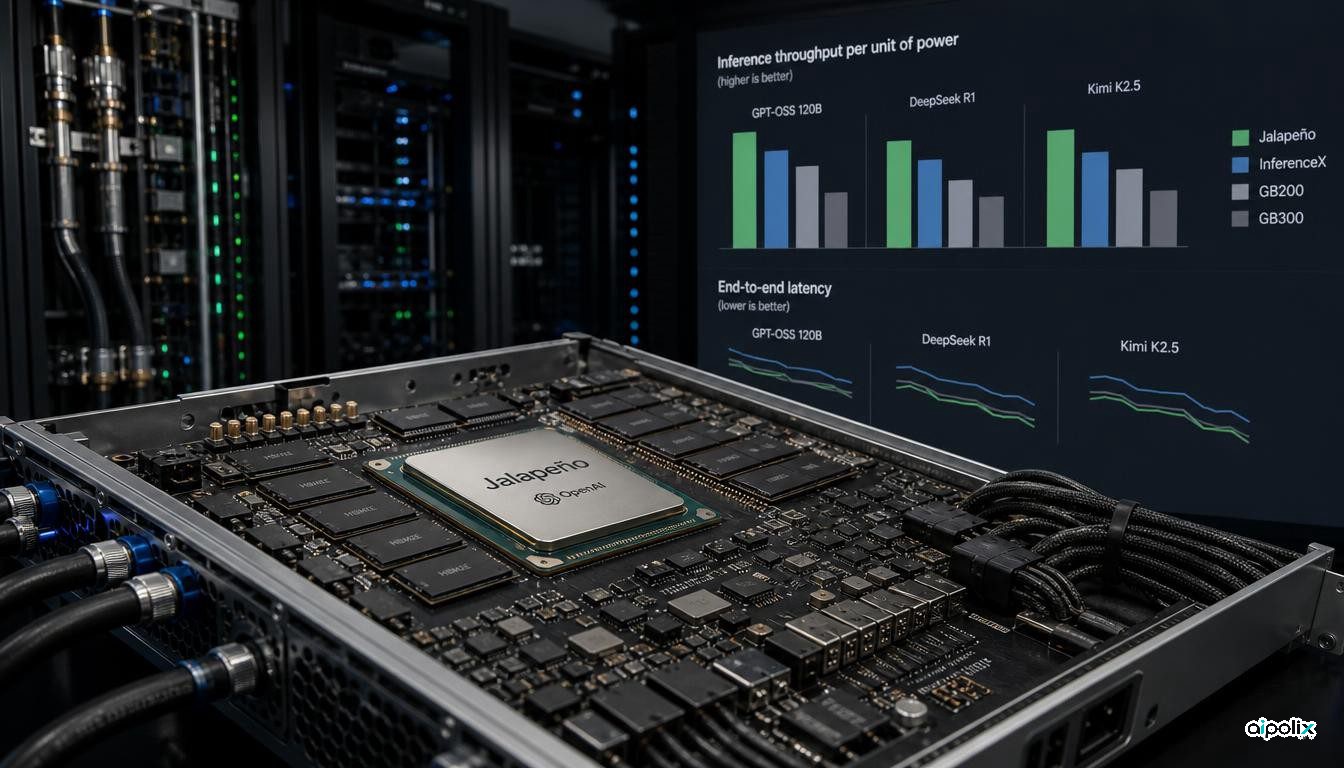
OpenAI has published the first measured benchmark results for Jalapeño, its first custom inference accelerator, turning a June hardware announcement into a more concrete infrastructure story. The company says the chip can deliver more AI inference work per unit of power while reducing response latency, a combination that matters directly for interactive agents because delays compound across multi-step tasks. The new evidence does not prove that Jalapeño will outperform every commercial alternative in production, but it gives developers and infrastructure teams their first public view of how OpenAI intends to reshape the economics of serving frontier models.
According to OpenAI's benchmark report, Jalapeño was tested with InferenceX, a public benchmark from SemiAnalysis, across GPT-OSS 120B, DeepSeek R1 670B and Kimi K2.5 1T. OpenAI reports that the chip reached a better combination of throughput per kilowatt and latency than the Nvidia Blackwell systems used in the comparison. The published results put the advantage at roughly 1.5 to 1.9 times higher peak performance per watt and 1.7 to 3.6 times lower end-to-end latency, depending on the workload and operating point.
Why inference efficiency matters for agents
Training gets most of the attention in AI infrastructure, but inference is the recurring cost of actually running a model. Every user request, tool call, retry, reflection step and sub-agent exchange consumes serving capacity. In long-running agent workflows, latency is not just a user-interface issue. A few hundred milliseconds repeated across dozens or hundreds of sequential model calls can materially extend the time needed to complete a task.
That is why Jalapeño's design target is important. OpenAI says it optimized the system for both throughput and low latency rather than maximizing one at the expense of the other. The company frames performance per unit of power as the more useful infrastructure metric because power availability is increasingly a practical constraint on how much inference capacity can be deployed in a data center.
The TechCrunch report adds useful context from OpenAI hardware chief Richard Ho, who described the results as a significant advance over the state of the art. More importantly, TechCrunch notes the timing limitation: the benchmark compares Jalapeño with currently available Blackwell systems, while newer competing hardware may be available by the time OpenAI reaches broader deployment. That makes the benchmark meaningful, but not a permanent ranking.
The benchmark is stronger than a vendor-only chart, but still bounded
The new results deserve more weight than an internal, proprietary test because OpenAI used InferenceX and ran public model families rather than only an undisclosed internal workload. SemiAnalysis, which operates InferenceX, says it inspected the chip and benchmarked the system. That gives the results a more useful external reference point than a simple marketing claim.
There are still important limits. Jalapeño is not commercially available for independent buyers to rent, install or test. The comparison hardware is Nvidia GB200 and GB300, both from the Blackwell generation, rather than the newer Vera Rubin platform that will define a later competitive baseline. SemiAnalysis explicitly argues that Rubin is the more relevant forward-looking comparison.
OpenAI also says its internal results on frontier OpenAI models show a larger advantage, but those tests cannot be independently evaluated from the public evidence. Those figures should therefore be treated as an attributed company claim, not an established cross-vendor performance result.
A custom chip changes OpenAI's infrastructure leverage
Jalapeño is an inference ASIC, not a general-purpose training accelerator. That distinction matters. OpenAI is not replacing Nvidia across its compute stack, and it still depends heavily on external accelerators for model training and other workloads. Instead, Jalapeño gives OpenAI a captive option for one of its largest recurring cost centers: serving trained models at scale.
The strategic value comes from co-design. OpenAI can optimize model software, runtime, networking and silicon around its own traffic patterns instead of relying entirely on a merchant accelerator designed for many customers. The company says the first-generation chip is rated at 700 watts and stayed at or below 550 watts of sustained power on the tested workloads. It is also designed to operate in large systems rather than as an isolated accelerator.
The Verge's coverage reports that OpenAI plans limited deployment by the end of 2026 and broader scaling in 2027. That schedule is important because the business impact depends on deployment volume, utilization and software maturity, not benchmark leadership alone.
What this means for AI platform economics
For enterprises consuming OpenAI through APIs or products, Jalapeño will not appear as a chip SKU. The relevant question is whether custom inference hardware eventually translates into lower serving costs, faster response times, higher capacity during demand spikes, or more aggressive pricing. None of those downstream outcomes is guaranteed by the benchmark itself.
For the wider market, the development reinforces a structural shift. The largest AI labs increasingly have enough predictable inference demand to justify custom silicon. Google has TPUs, cloud providers have their own accelerator programs, and OpenAI is now demonstrating measured results from a chip designed around its own serving workloads. Merchant GPU vendors still benefit from enormous scale and fast product cycles, but hyperscale AI buyers now have stronger incentives to optimize portions of the stack themselves.
This also changes how architects should interpret model-service performance. The model name alone is becoming a less complete description of system capability. Runtime software, batching, memory systems, networking, power envelope and accelerator architecture can materially affect how quickly an agent executes and how much it costs to operate.
What to watch next
The next useful evidence will come from deployment rather than another benchmark chart. OpenAI needs to show that Jalapeño can maintain its performance advantages across large clusters, real production traffic, changing model architectures and sustained utilization. Reliability, yield, networking behavior, software tooling and total cost of ownership will matter as much as peak benchmark points.
It will also be important to compare Jalapeño with the next generation of competing inference hardware on matched workloads and matched service-level targets. Blackwell is a credible current reference, but infrastructure decisions for 2027 will be made against newer systems.
For now, the significance is narrower and more defensible: OpenAI has moved its custom inference program from promised efficiency to publicly measured results on a third-party benchmark. If those gains survive production deployment, Jalapeño could give OpenAI more control over the latency, capacity and power economics behind agentic AI services. The benchmark does not settle the hardware race, but it shows that OpenAI is becoming a more vertically integrated AI infrastructure operator rather than only a buyer of other companies' accelerators.