
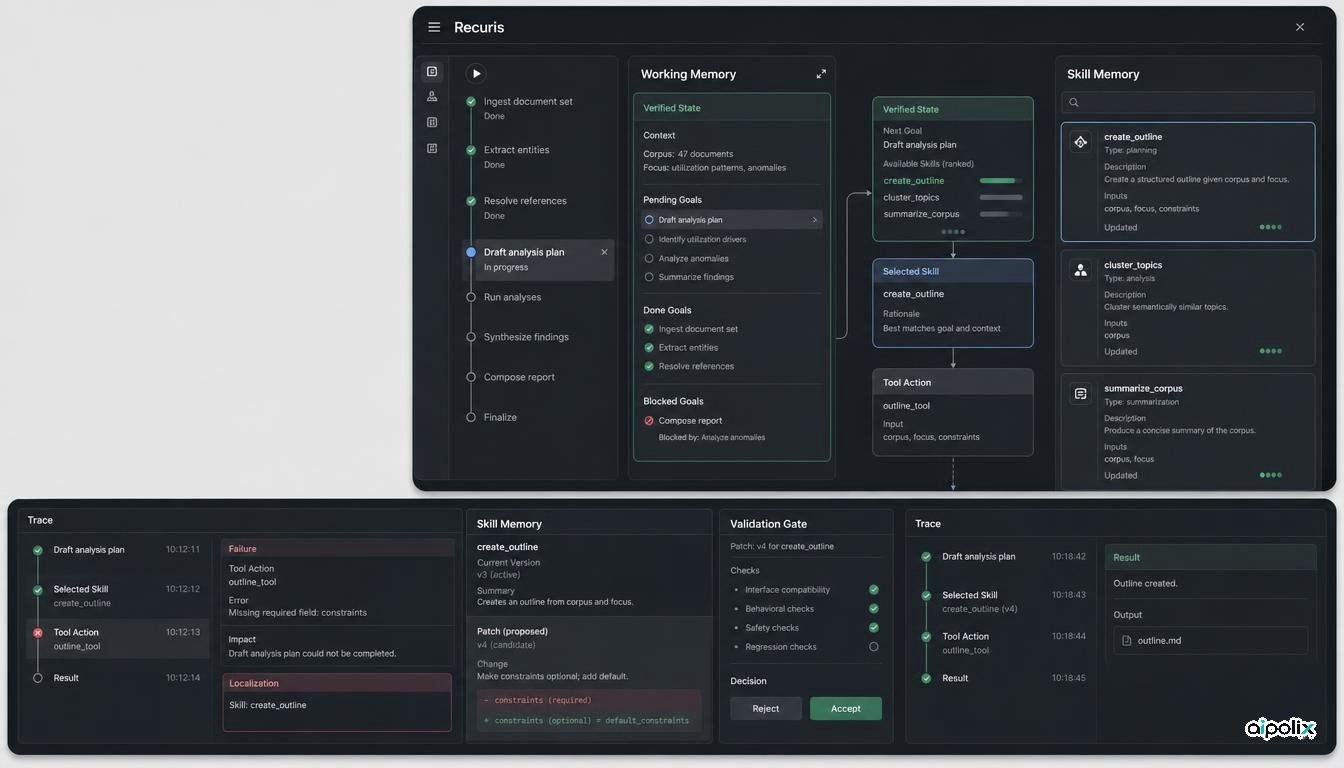
Researchers from NUS, Stanford University, the University of Oxford and Princeton University have introduced Recuris, a memory architecture for long-horizon AI agents that improves execution without changing the underlying language model. The system keeps the base LLM frozen and instead evolves an external memory-control layer that tracks verified task state, selects reusable skills and learns from failures.
The distinction matters because "recursive self-improvement" can easily imply that a model is rewriting its own weights. Recuris does something narrower and more inspectable. Its Working Memory records what has been completed, what remains unresolved and which observations support that state. Experiential Memory stores reusable skills. The current verified state, rather than the entire conversation history, determines which skills enter context.
A memory system that learns from execution
During a task, Recuris couples Working Memory and Experiential Memory. After an action or tool call, a checker decides whether the environment's response actually supports a proposed state update. That prevents an agent from marking a goal complete merely because it attempted a tool call or received verbal confirmation.
Across tasks, the harness records structured traces linking task state, selected skills, actions, observations and checker decisions. A fixed Meta-Agent uses those traces to identify which part of the memory system appears responsible for a failure and proposes a localized patch. The patch is admitted only if a fixed validation gate confirms that it repairs the failure without regressing a held-out development set. The base model, Meta-Agent and outer improvement procedure remain fixed.
Strong gains on long-horizon benchmarks
In the paper's evaluation across four long-horizon benchmarks and ten models, Recuris improved task success in 35 of 37 completed model-benchmark pairs. On τ²-Retail, GPT-5.6 Sol improved from 58.3% to 76.1%, while Claude Opus 5 rose from 72.4% to 87.9%. On SkillFlow, Qwen3.6-27B increased from 42.2% to 58.7%.
The authors also report that the advantage grows on longer interactions. Their analysis finds gains of up to 32.2 percentage points on the longest task group and reductions of up to 80% in several common long-horizon failure modes. A controlled fault-localization experiment also showed that structured traces identified the responsible memory component much more accurately than the final task outcome alone.
More context was not the answer
One of the more useful engineering results is that simply putting more skills into the prompt performed worse. In a controlled comparison, keeping the full skill library permanently in context added 3,111 tokens to the first call, scored 18 points below Recuris and consumed 46% more tokens per successful task.
That result supports a narrower systems lesson: useful memory is not the same as large context. For long-running agents, the difficult problem is deciding what state is true now, which experience is relevant to that state and when that experience should be invoked.
Important limits
The results are promising, but they remain author-reported results from a new arXiv preprint. Independent reproduction is still needed. The strongest cross-task gains also appear where tasks share tools, policies or reusable structure. On Terminal-Bench 2.1, where tasks are more isolated, cross-task evolution admitted no patch in thirteen evolution runs.
The paper separately tests within-task adaptation on Terminal-Bench. At a matched four-attempt budget, adaptation improved solved-within-budget performance by 2.3 points, but the reported p-value was 0.774. The authors explicitly state that the memory terms remain within run-to-run variation at the available sample size. The large headline improvement there came primarily from allowing retries, not from memory learning itself.
Why this matters for agent engineering
Recuris shifts the trainable surface of an agent from model weights to the harness around the model. That is operationally attractive because memory changes can be localized, validated, rolled back and transferred across models without retraining the base LLM.
For teams building long-horizon agents, the paper reinforces a practical architectural direction: verified state tracking, selective skill invocation and bounded memory evolution may matter as much as choosing a stronger model. The code is public, making the next question straightforward to test: whether these gains reproduce outside the authors' benchmark harnesses and survive real production workflows with noisy tools, partial failures and changing task distributions.