
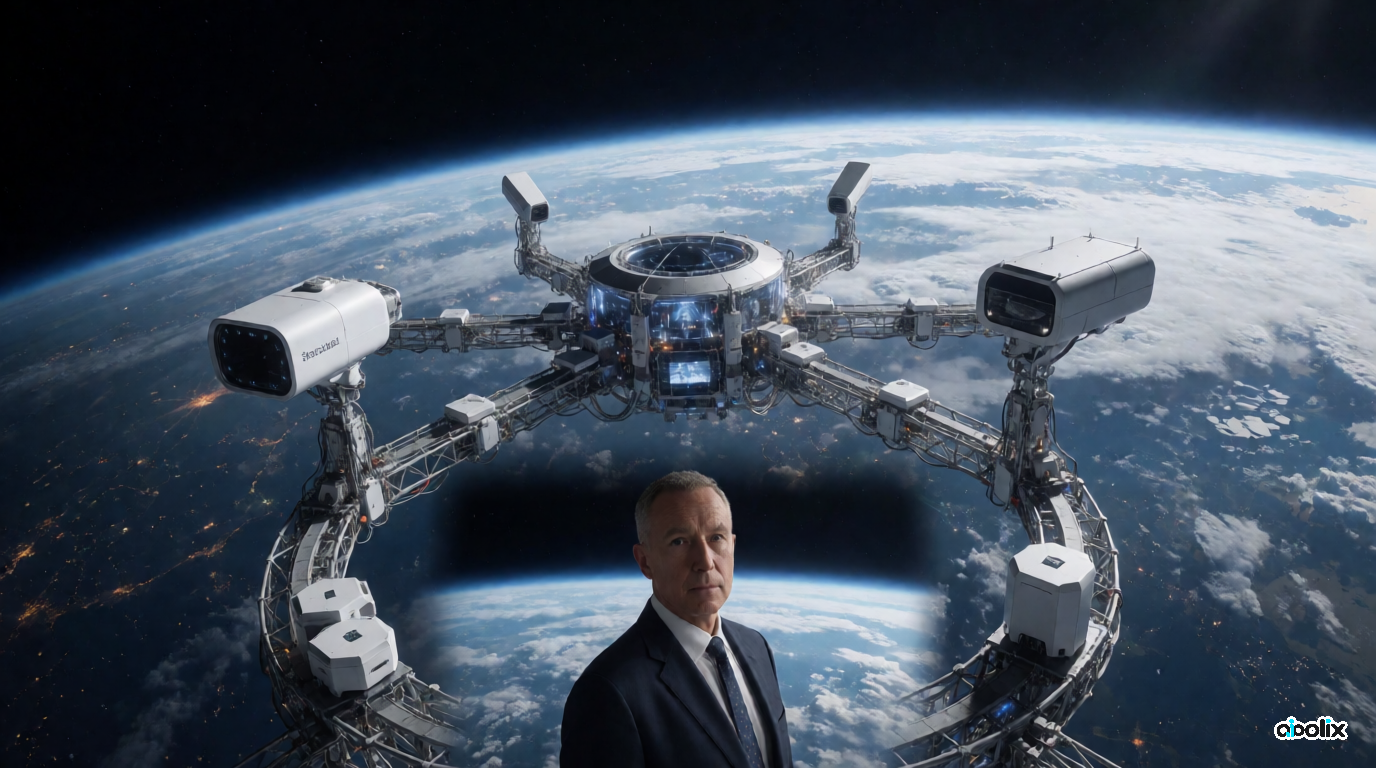
Starcloud has raised a $250 million extension to its Series A at a $2.3 billion post-money valuation, giving the orbital-compute startup fresh capital to move from a single in-orbit demonstration toward manufacturing and launch infrastructure for larger AI data centers in space. The August 21 round was led by Manhattan West and included new investors Nvidia and Cisco Investments alongside existing backers such as Benchmark and EQT. The financing brings Starcloud’s total capital raised since its 2024 founding to $450 million, less than a year after the company put an Nvidia H100 GPU into orbit aboard Starcloud-1.
The funding is important because it is tied to a more concrete hardware roadmap rather than only a long-range vision of moving cloud computing off Earth. Starcloud says the money will expand manufacturing capacity, support engineering work with Nvidia, and secure future launch allocation. The two companies are collaborating on Nvidia’s Space-1 Vera Rubin Module, a space-oriented accelerated-computing platform designed for environments where conventional data-center assumptions about cooling, radiation exposure and physical access do not apply. Nvidia says the Space-1 module is intended to deliver data-center-class AI performance for orbital data centers and other space workloads.
That collaboration makes the financing more strategically significant than a normal venture round. Nvidia is not only a supplier to Starcloud but now also an investor, while Starcloud is acting as a flight platform for the chipmaker’s space-computing roadmap. Starcloud previously flew an H100 on Starcloud-1 in November 2025 and says that mission demonstrated high-power inference and model training in orbit. Nvidia’s own space-computing materials list Starcloud among the partners using its accelerated platforms and say the Vera Rubin Space-1 module can deliver up to 25 times the AI compute per GPU of an H100 for space-based inference.
The engineering constraints remain formidable. Large terrestrial AI clusters remove heat with extensive liquid or air-cooling systems and depend on continuous maintenance, dense networking and reliable power distribution. In orbit, Starcloud expects to reject heat primarily through large radiators, while hardware must also survive launch vibration, radiation and long periods without physical servicing. TechCrunch reported that the company is using data from Starcloud-1 to study tradeoffs between chip operating temperature, radiator size, shielding and ruggedization as Nvidia develops its space-specific platform.
The company is therefore using the new capital to build industrial capacity, not just another prototype. Starcloud is developing a roughly 100,000-square-foot manufacturing facility in Woodinville, Washington, and is working toward larger spacecraft generations intended to carry much more compute than Starcloud-1. Independent reporting says the company plans to use the financing for production equipment, engineering and launch procurement. Starcloud’s long-term ambition is much larger still: it has discussed an 88,000-satellite constellation capable of providing around 20 gigawatts of orbital compute, though that target remains a distant plan rather than a deployed system.
For AI infrastructure teams, the practical significance is the attempt to change the location economics of compute. Orbital data centers are attractive in theory because solar power is abundant and some workloads originate in space, allowing data to be processed before expensive downlink. But moving training or inference off Earth also creates new costs in launch, redundancy, networking, thermal design, radiation hardening and operations. A credible architecture has to show that those costs can be lower than, or strategically preferable to, expanding terrestrial data centers. The new round does not prove that equation, but it gives Starcloud more resources to test it at meaningful scale.
The Nvidia relationship also matters for the broader AI hardware market. The company is extending its platform from conventional data centers into constrained edge and orbital environments using products such as Jetson Orin, IGX Thor and Space-1 Vera Rubin. If Starcloud becomes an early large user of space-rated Nvidia systems, Nvidia gains operational data and a potential new infrastructure market while Starcloud gains access to a supplier with an established AI software and hardware ecosystem. That alignment can accelerate development, but it also increases Starcloud’s dependence on a single compute architecture at a stage when its business model is still unproven.
Investors should therefore separate what is established from what remains aspirational. The $250 million financing, the $2.3 billion valuation, Nvidia and Cisco’s participation, the Starcloud-1 H100 mission and the ongoing Space-1 collaboration are all supported by company statements and independent reporting. By contrast, the economics of hyperscale orbital compute, the timing of large commercial deployments, the feasibility of tens of thousands of satellites, and the eventual cost per unit of useful AI compute are not yet demonstrated. The financing validates investor appetite and technical interest, not commercial viability at terrestrial data-center scale.
There are also operational bottlenecks outside the AI stack. Launch supply is tightening, and Starcloud has said it needs to reserve substantial future launch capacity. Spacecraft manufacturing must scale at the same time as the company proves reliability, radiation tolerance and thermal performance. Regulatory approvals, orbital-debris management and spectrum or communications requirements could become material as deployments expand. Those constraints mean that the next phase of Starcloud’s story is likely to be measured less by model benchmarks and more by manufacturing cadence, launch execution and sustained in-orbit performance.
The material development is therefore not simply that another AI startup raised money. Starcloud has more than doubled its valuation since March, added Nvidia and Cisco as strategic investors, and tied the new capital to manufacturing, launch procurement and a specific next-generation compute collaboration with Nvidia. That moves orbital AI infrastructure a step closer to an engineering and supply-chain program rather than a laboratory experiment. The next evidence to watch will be progress on the Space-1 Vera Rubin flight hardware, larger Starcloud spacecraft, manufacturing output, launch commitments and any customer workloads that can demonstrate a durable economic advantage for running AI compute in orbit.