
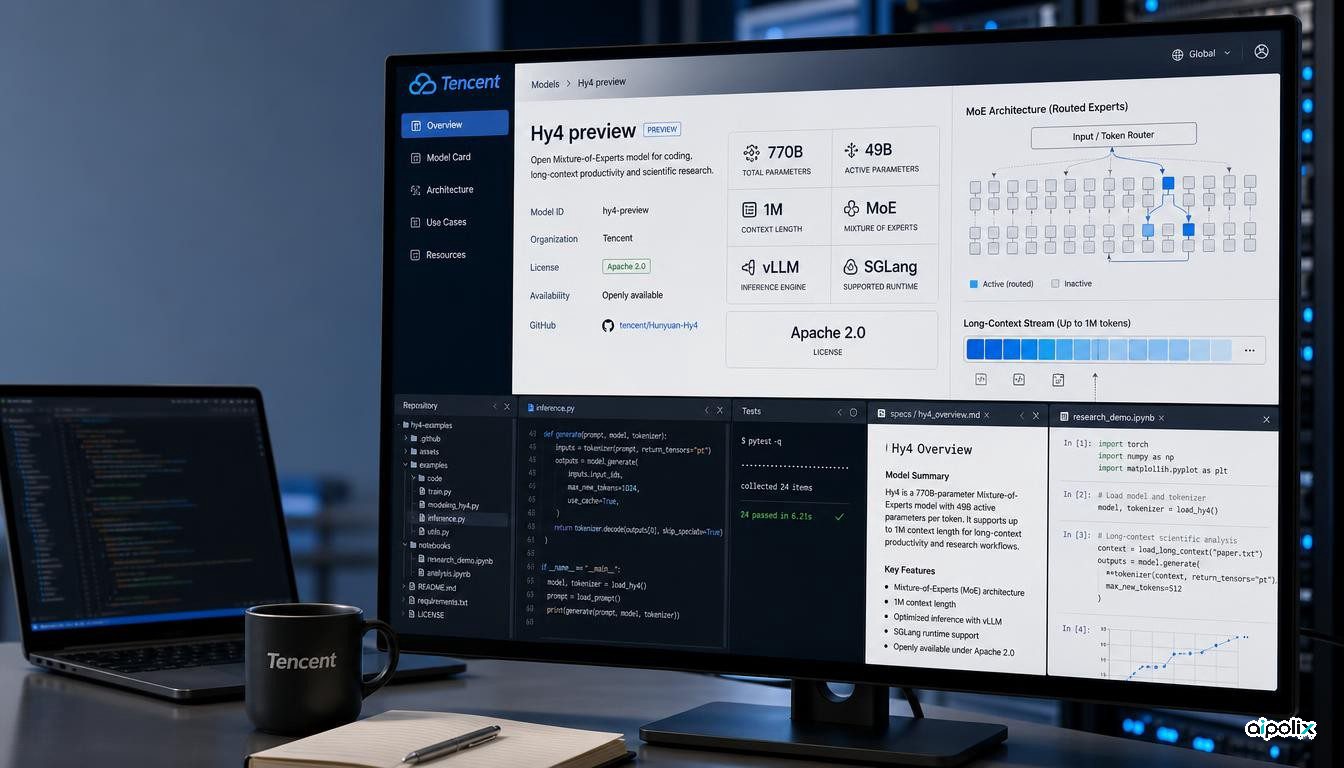
Tencent released Hy4 preview on August 28 as an openly available large language model aimed at software engineering, office work and scientific research. The release matters less because Tencent calls it a frontier model and more because the company shipped a complete developer surface around it: downloadable weights under Apache 2.0, a one-million-token context window, documented vLLM and SGLang deployment paths, finetuning and quantization tooling, and paid API access.
That combination makes Hy4 preview a practical new option for teams evaluating large open models for long-context agentic work. According to Tencent's announcement, the model has 770 billion total parameters but activates 49 billion parameters per token. The official repository describes a Mixture-of-Experts architecture with 256 routed experts, eight activated routed experts per token, a shared expert, sparse attention and a native speculative-decoding layer. Reuters independently reported the August 28 release and its focus on coding, research and analytical work.
A very large model with a smaller active footprint
Hy4 preview is large even by current open-model standards. Tencent lists 770 billion backbone parameters, 49 billion active parameters and a context length of one million tokens. The model uses a Mixture-of-Experts design, so most parameters are not active for every token. That does not make deployment lightweight, but it changes the compute profile compared with a dense model of similar total size.
The repository exposes architectural details that are useful for infrastructure teams rather than only publishing an API endpoint. The backbone has 78 layers. Tencent says the attention path uses Gated DeepSeek Sparse Attention with an IndexCache mechanism for reusing sparse indices across layers. It also includes a native multi-token-prediction layer intended to support speculative decoding. The repository includes deployment guidance for vLLM and SGLang, plus finetuning and quantization paths.
For architects, this means Hy4 preview can be evaluated as a model that an organization can operate and modify, not just consume behind a hosted interface. Apache 2.0 licensing is especially relevant for companies that need clearer rights for internal adaptation and redistribution than more restrictive model-specific licenses provide. Teams still need to review the full license and their own compliance requirements, but the licensing choice materially lowers one common adoption barrier.
Tencent is targeting work products, not only chat
Tencent positions Hy4 preview around productivity workloads rather than conversational benchmarks alone. The company says it built training data with software engineers, game developers, finance analysts and security specialists inside Tencent. Its stated target is long-horizon work that spans planning, debugging, validation, cross-document analysis and production of artifacts such as documents, spreadsheets and presentations.
The release is also integrated into Tencent products including CodeBuddy and WorkBuddy, and Tencent says it is available through Tencent Cloud TokenHub and OpenRouter. That gives the preview several evaluation routes: self-hosting the weights, using a managed API, or testing the model through products that package agentic workflows around it.
Tencent reports an internal blind evaluation involving 163 experts and 203 engineering tasks, where Hy4 preview scored 2.99 out of 4.00, slightly above the comparison models cited by the company. Those numbers should be treated as vendor-reported evidence, not as an independent ranking. The task design, evaluator population and comparison conditions matter, and independent reproducibility is not yet established.
The self-optimization claim is interesting but needs restraint
One of Tencent's more unusual claims is that Hy4 preview participated in parts of its own development. The company says the model proposed approaches, ran experiments and iterated on training methods, data strategies, evaluation frameworks and low-level operators. Tencent also says the model analyzed inference bottlenecks and helped produce operator-fusion and communication optimizations that increased end-to-end throughput by 31.8 percent against its baseline.
This is potentially important for teams building automated model-engineering or agentic infrastructure workflows. It suggests a loop in which a model is not only the workload being optimized but also an active participant in diagnosing and modifying the system around itself.
However, the evidence currently comes from Tencent. The release does not establish that the same process generalizes to other model stacks, hardware environments or engineering teams, and the reported throughput improvement depends on Tencent's baseline and implementation conditions. It is better understood as a concrete internal use case that merits replication than as proof of general recursive self-improvement.
What developers should evaluate next
For software-engineering use, the practical questions are more important than headline parameter counts. Teams should measure repository-scale task completion, tool reliability, patch quality, test discipline, context retention and cost under their own harnesses. A one-million-token context window can reduce some retrieval pressure, but long context does not automatically produce better decisions or lower total inference cost.
Infrastructure teams should also test serving behavior under realistic concurrency. A 49-billion-parameter active path is still substantial, while the 770-billion-parameter total footprint creates storage, memory-placement and expert-routing considerations. Quantization and speculative decoding may help, but production economics will depend on hardware topology, request length and utilization.
Tencent lists API pricing at $0.834 per million input tokens, $2.501 per million output tokens and $0.042 per million cached tokens. Those hosted prices offer a useful baseline for comparing self-hosting against managed access, although they do not by themselves indicate total application cost for long-running agents.
Hy4 preview is therefore notable because it combines three things that are often separated: a very large open model, a developer-operable deployment stack and a clear focus on producing real work artifacts. The performance claims still need outside validation, and the product is explicitly a preview. But for teams evaluating open models for coding and long-context agent systems, the release is concrete enough to test now rather than merely watch.