
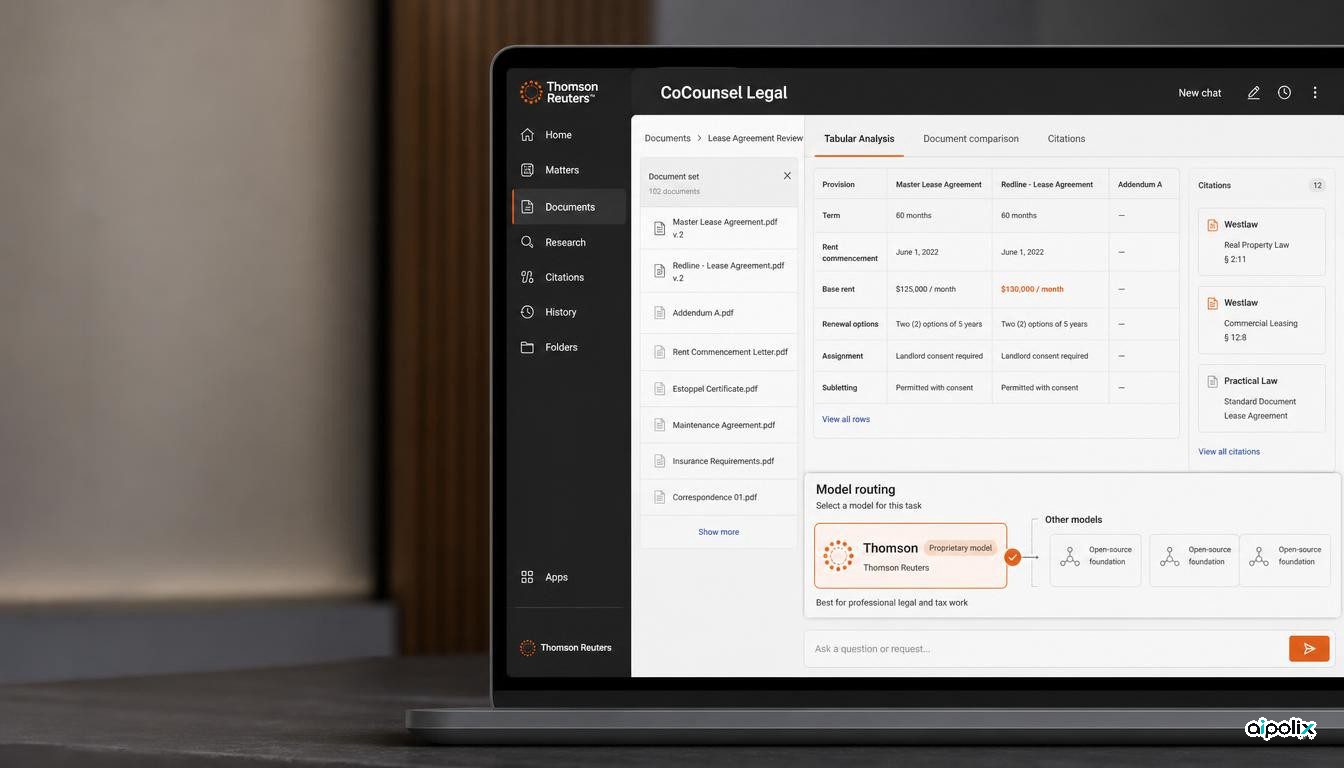
Thomson Reuters has moved from buying access to external large language models to owning one of the models inside its professional AI stack. On August 24, the company launched Thomson, its first proprietary LLM, after spending about $40 million on talent and compute. The model starts from an open-source foundation and is specialized with Thomson Reuters content and expert input, rather than being trained from scratch as a general-purpose foundation model.
That distinction matters more than the company's use of the word “frontier.” The verified development is that a large legal, tax and information provider has built, deployed and begun productizing its own domain model. Business Insider reported that the move is intended to reduce dependence on third-party models such as Anthropic's Claude while preserving a multi-model strategy. For enterprise architecture teams, the story is less about whether Thomson beats general models on every benchmark and more about when proprietary data, domain training and controlled deployment can justify owning part of the model layer.
A domain model built on an open foundation
Thomson Reuters says Thomson was created from a strong open-source base, then adapted through mid-training and post-training using material from Westlaw, Practical Law, Checkpoint and Reuters, with subject-matter experts involved in training objectives and evaluation. The company says less than 10% of its content library has been used so far. It has not publicly established that proprietary content volume alone caused the reported performance gains, so that relationship should be treated as the company's interpretation rather than a proven causal result.
The $40 million figure covers people and compute across the program, according to the launch announcement. That is materially different from the cost profile of training a general-purpose foundation model from zero, but it is not a like-for-like comparison with the budgets of frontier labs. Thomson Reuters began with an existing open foundation and specialized it for professional work. The useful architectural lesson is therefore about specialization economics, not a claim that a $40 million program can reproduce the full capability envelope of a frontier lab.
Thomson Reuters had already published early benchmark results in July, before today's formal launch. Those evaluations said Thomson performed competitively with several major models on selected legal and general tasks. Those are company-run results, and the launch release says outside academics have begun direct evaluation. Some researchers quoted by the company reported strong citation quality and useful legal responses, but broader independent replication is still limited. Aipolix therefore treats the benchmark comparisons as attributed claims rather than established superiority.
CoCounsel is the first production destination
The immediate product consequence is concrete. Thomson Reuters says Thomson's first deployment is in Tabular Analysis inside CoCounsel Legal, a workflow for structured, high-volume document review. The company says CoCounsel will remain multi-model: Thomson will be used where Thomson Reuters believes its specialization provides an advantage, while other leading models will continue to handle different tasks. That is an important constraint on the launch narrative because Thomson is not replacing every external model in the product.
For product and platform teams, this is a useful example of model portfolio design. An organization with valuable proprietary data does not necessarily need to choose between a fully external stack and complete model self-sufficiency. It can own a specialized model for predictable domain tasks, preserve external frontier models for broader reasoning, and route workloads based on quality, cost, latency, data-handling requirements and operational control. The architecture resembles a model router with an owned option rather than a single-model replacement strategy.
The approach also changes the vendor-risk discussion. Owning the model weights and training pipeline can give a company more control over deployment location, update cadence, data governance and model behavior. It does not eliminate dependencies: the open foundation, infrastructure stack, evaluation tooling and product integrations still matter. But it can reduce the risk that a core workflow is entirely exposed to another vendor's pricing changes, model deprecations, policy changes or regional availability.
Control and sovereignty become product requirements
Thomson Reuters is explicitly positioning ownership as a response to demand for AI sovereignty. In practical terms, sovereignty questions include where inference runs, which data shaped the model, who can change it, how customer information is handled and whether a workload can be deployed under jurisdiction-specific controls. The company says customer data is not used to train Thomson without explicit consent. That policy is significant for legal and tax customers, although implementation details still need to be assessed in individual deployments.
For governance teams, an owned model can simplify some questions while creating new ones. The provider has more direct responsibility for model documentation, evaluation quality, change management, red-team coverage, data provenance and incident response. External-model contracts can shift some of those obligations to a vendor; internal ownership brings them back inside the organization. A company pursuing this path needs a model lifecycle process that is closer to software and data product governance than to ordinary API procurement.
There is also a security tradeoff. Keeping more of the model stack under organizational control can reduce external exposure for sensitive workloads, but it increases the internal attack surface and the operational burden of securing model artifacts, training data, inference infrastructure and privileged tools. “Sovereign” does not automatically mean safer. The security outcome depends on how the system is deployed, monitored and isolated.
The economics are workload-specific
The strongest business case for a specialized model is likely to come from high-volume workflows with stable task definitions and valuable proprietary context. Document review is a good example because the organization can repeatedly evaluate the same classes of extraction, comparison and reasoning tasks. If an owned model reaches acceptable quality at lower marginal inference cost, the economics can improve as volume grows.
That does not mean every enterprise should train its own LLM. Thomson Reuters has unusually deep proprietary corpora, established professional products, subject-matter experts, an acquired AI research team and enough workload volume to amortize development. Most organizations will not have that combination. For them, retrieval, fine-tuning, adapters, prompt engineering or managed model customization may offer a better return than taking responsibility for a model program.
The more transferable lesson is to separate model ownership from model strategy. Teams should identify where external models create unacceptable cost, governance or differentiation constraints, then test whether a specialized owned or open-weight model can meet the task. The decision should be based on measured task success, total operating cost, update requirements, compliance obligations and fallback options, not on a general preference for owning technology.
What still needs independent validation
The main unresolved question is how well Thomson performs outside Thomson Reuters' own evaluation framework. The company has published comparative claims and says external academics are testing the model, but today's evidence does not establish universal frontier-level performance. The company also says a smaller version will be made available as open weights for academic and non-commercial use, which could improve external scrutiny if the released artifact is representative enough to study.
Another open question is how much of the announced cost advantage survives at scale. Development spending is only one component of total cost. Inference hardware, serving efficiency, model updates, evaluation, security, support and governance all contribute to lifecycle economics. The company says Thomson runs at a fraction of the cost of comparable frontier models, but detailed independently verified operating-cost data is not yet public.
For AI leaders, the practical signal is still meaningful without accepting every performance claim. A major professional-services information company has decided that model ownership is strategically useful for selected workflows, has committed tens of millions of dollars to specialization, and is deploying the result alongside rather than instead of external models. That makes Thomson a concrete case study in hybrid enterprise AI architecture, where proprietary data, model routing and governance control become part of the product design.