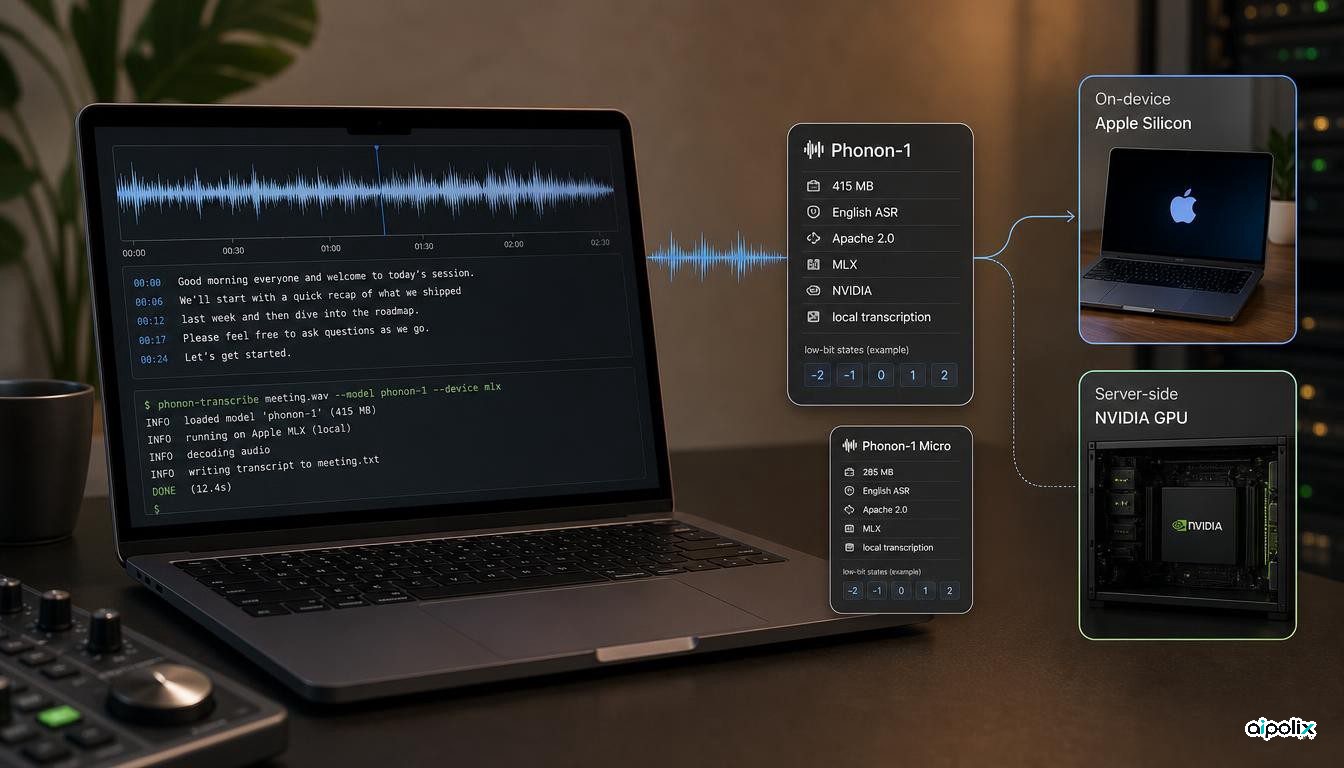
Fermion Research has released Phonon-1, a compact English automatic speech recognition model designed to run locally on a laptop as well as on NVIDIA datacenter GPUs. The default model downloads in 415 MB, is licensed under Apache 2.0, and can be used through Fermion's command-line tools or an OpenAI-compatible transcription endpoint.
The release is relevant because it targets a practical gap between very small local speech models and larger transcription systems that require substantially more storage or compute. Fermion says Phonon-1 was trained from Qwen3-ASR-0.6B using a low-bit training approach rather than applying ordinary post-training quantization after the model was complete. The Hugging Face model card lists the model for English speech-to-text, Apple Silicon and low-bit on-device use.
A 415 MB model built around low-bit training
Fermion describes Phonon-1 as a model trained at 2.4 bits per decoder weight from the start. The company says the complete artifact averages 4.65 bits per parameter and that the low-bit decoder is represented using five learned states. This is intended to preserve more of the teacher model's accuracy than a conventional low-bit conversion performed after training.
The default Phonon-1 build is 415 MB. Fermion also provides Phonon-1 Micro, a smaller 285 MB variant, and a larger Big build. The default model is the most interesting reference point for developers because it is positioned as the balance between size, accuracy and latency.
The weights and command-line tooling are distributed under Apache 2.0. Fermion states that the base model, Qwen3-ASR-0.6B, is also Apache 2.0. That makes the release easier to evaluate for internal and commercial workloads than models that use more restrictive custom terms, although organizations should still perform their normal license and compliance review.
What Fermion's benchmarks show
On its published evaluation, Fermion reports a word error rate of 2.640 percent on LibriSpeech test-clean and 5.699 percent on test-other for the 415 MB model. It also publishes results for TED-LIUM, SPGISpeech, VoxPopuli, GigaSpeech, Earnings-22 and AMI, with an eight-benchmark macro WER of 7.67.
Those numbers are promising, but the evidence needs careful interpretation. Fermion explicitly marks most comparison cells as measurements performed by its own team using full test sets, the Whisper English text normalizer and greedy decoding. Some competitor figures are taken from published model cards or leaderboards, while many are re-measured by Fermion under its protocol.
Fermion further says that across five real-world benchmarks it could not find a downloadable model that was both smaller and more accurate than Phonon-1. That is a vendor claim based on the comparison set and protocol the company selected, not an independently established frontier result. The page also notes that NVIDIA's Parakeet-0.6B 4-bit model is more accurate across all eight benchmarks in Fermion's table, but has a larger download.
Local deployment is part of the product
Phonon-1 is not only a model-card release. The fermion-research package on PyPI exposes a local workflow with `fermion transcribe` for audio files and `fermion serve` for an OpenAI-compatible `/v1/audio/transcriptions` route. Existing applications built around OpenAI-style transcription clients can therefore point at a local server instead of requiring a completely different client integration.
Fermion says the same weights run through MLX on Apple Silicon and through its NVIDIA GPU runtime. The company reports a median decoding speed of 23.9 times real time across nine corpora on a base M5 MacBook Air, which would correspond to transcribing roughly an hour of audio in about two and a half minutes. It also reports low hundreds of milliseconds of median latency for live dictation.
These speed figures are again Fermion's own measurements. Actual throughput will depend on audio length, batching, hardware, memory pressure, runtime version and the characteristics of the input.
Where teams should be cautious
The main limitation is not hidden: this is an English-focused ASR model expecting 16 kHz audio. Organizations working across multiple languages will need another model or a routing strategy. Teams operating in noisy meetings, accented speech, telephony, specialist vocabulary or domain-specific audio should also avoid extrapolating directly from LibriSpeech or a macro benchmark.
There is also no independent reproduction yet for the most important performance claims. Hugging Face and PyPI confirm that the artifacts and tooling are available, but they are Fermion-controlled distribution surfaces rather than independent evaluators.
For developers, that does not make the release uninteresting. It changes the right next step. Phonon-1 should be treated as a compact open model that is concrete enough to benchmark immediately. A useful evaluation would compare word error rate, punctuation quality, streaming behavior, memory use and end-to-end latency on the organization's own recordings and target hardware.
If those results hold, the combination of a 415 MB download, permissive licensing, local execution and an OpenAI-compatible API could make Phonon-1 a practical speech layer for desktop tools, private transcription systems and local-first AI applications. The benchmark table is a reason to test it, not a substitute for the test.