The Linux Foundation has taken governance of TRACE, an open specification for creating hardware-attested records of how AI agents and other confidential workloads actually ran. The change matters because most enterprise AI governance today depends heavily on logs produced by the same software stack being audited. TRACE is designed to produce a portable cryptographic record that can be independently checked against a hardware root of trust, giving security and compliance teams a stronger basis for proving what code executed, under which policy, against which class of data, and with which tools.
The Linux Foundation announcement says TRACE was contributed by OPAQUE and developed with AMD, Intel, Microsoft and the Technology Innovation Institute. The specification is now an LF Project, with related work hosted through the Coalition for Secure AI. That governance shift is more significant than a normal project release because it moves the standard away from control by a single vendor and gives infrastructure providers, cloud platforms and enterprise buyers a neutral venue for shaping interoperability.
What TRACE records
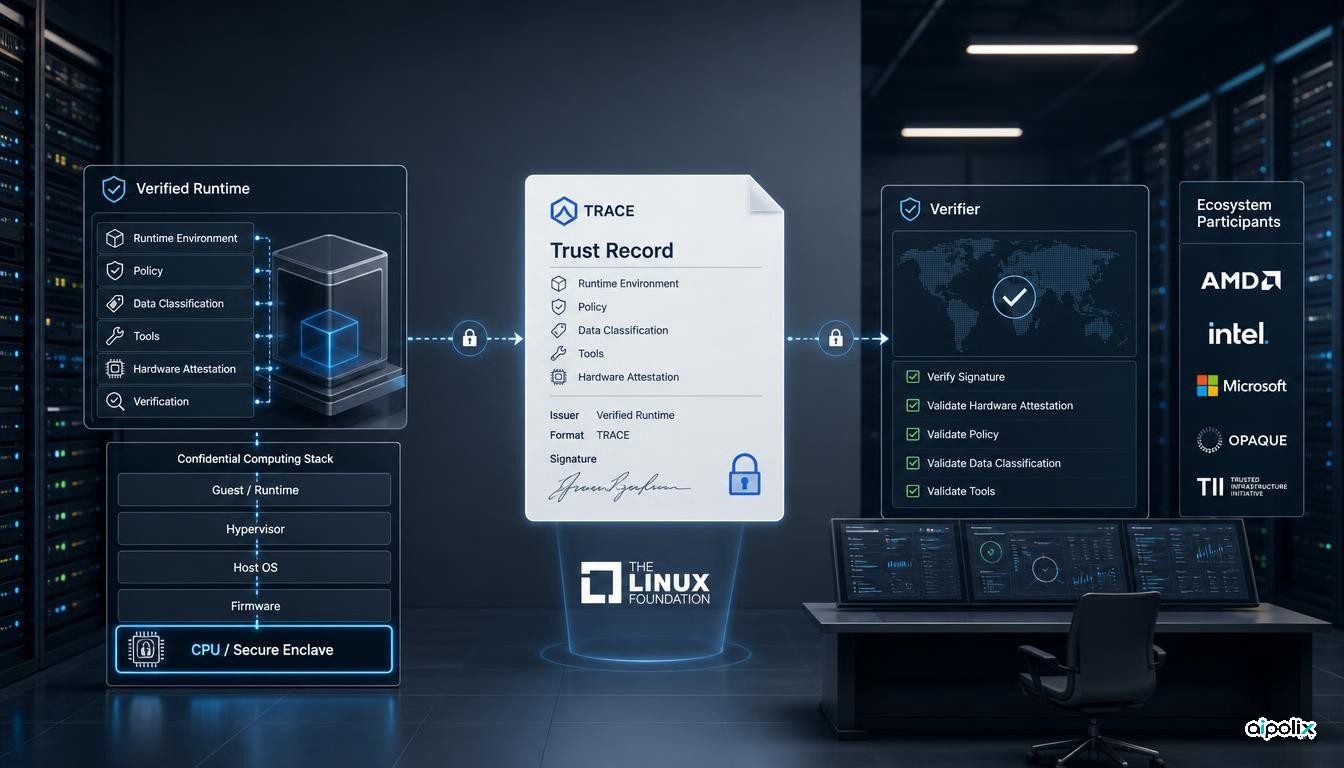
The TRACE specification defines a signed "Trust Record" that binds together the runtime environment, software identity, policy, data classification and invoked tools. The goal is to let a verifier answer concrete operational questions after an agent has run: what executed, where it ran, which policy was in force, which data class it touched and which tools it called.
This differs from a conventional application log. A normal audit log is usually emitted by the application or platform being inspected and can therefore depend on the integrity of that same operator. TRACE instead anchors evidence in a trusted execution environment and hardware attestation. The current developer-preview specification builds on existing standards including RATS, EAT, SLSA, SCITT, SPIFFE and EAR rather than defining an entirely separate security stack.
Why this matters for production agents
Agentic systems create a harder audit problem than conventional request-response applications. A single agent session can run for minutes or hours, call external tools, access multiple data stores, delegate work and take actions with real business consequences. Reconstructing those steps from application logs can be difficult when evidence is fragmented across the model gateway, tool server, identity system, cloud runtime and target applications.
TRACE tries to create one portable evidence layer across those components. For engineering leaders, the practical implication is that agent governance can move closer to verifiable runtime controls rather than policy documents and retrospective log correlation alone. A financial institution, for example, could require proof that an agent executed inside an approved confidential-computing environment and used a specific policy before allowing the resulting record to satisfy an internal control or audit workflow.
The design is especially relevant to MCP-style tool use and multi-agent systems because the Trust Record can capture which tools were invoked. It does not solve authorization by itself, but it can provide evidence that the expected authorization and policy environment was present when an action occurred.
The standard is still early
The important limitation is that TRACE is not a mature production standard yet. The public repository describes version 0.2 as a developer preview and explicitly tells implementers to review limitations before relying on it in production. Conformance details, ecosystem integration and operational practices can still change before a stable specification emerges.
That distinction matters because the Linux Foundation announcement also cites nearly 135,000 PyPI downloads in the first ten weeks after the project was introduced. Download counts show interest, but they do not prove production adoption, security effectiveness or interoperability across vendors. Those outcomes will need evidence from real implementations and independent testing.
The AI Governance Institute analysis describes TRACE as a potential new audit baseline for agentic systems, but that should be treated as analysis rather than proof that regulators or auditors have accepted the format. There is currently no basis for claiming that a TRACE record automatically satisfies a specific legal or regulatory requirement.
Where it fits in an agent architecture
For architects, TRACE is best viewed as an evidence layer, not an agent framework. MCP can connect an agent to tools, A2A can coordinate agents, identity systems can determine who or what is allowed to act, and policy engines can decide whether an action is permitted. TRACE is intended to record verifiable evidence about that execution context so another party can inspect it later without trusting only the runtime operator.
That separation is useful because it can reduce coupling between the platform that runs an agent and the system that verifies compliance. If the specification gains broad implementation support, a verifier could evaluate records produced across different confidential-computing environments rather than learning a separate proprietary audit format for every platform.
What engineering teams should watch next
The next important signals are implementation quality and interoperability, not announcement volume. Teams evaluating TRACE should watch for stable conformance tests, support across multiple trusted-execution technologies, clear verifier behavior when evidence is incomplete, and practical integrations with agent runtimes, MCP gateways, identity layers and policy engines.
Security teams should also test the boundaries of what the record proves. Hardware attestation can strengthen evidence about where code ran and what was measured, but it does not guarantee that the model made a correct decision, that a policy was well designed, or that a tool call was safe in context. Those remain separate assurance problems.
TRACE is therefore notable because it addresses a concrete gap in production agent governance: portable proof of runtime conditions. Its move under Linux Foundation governance gives the project a more credible path toward cross-vendor adoption, while its developer-preview status is a reminder that the standard still has to prove itself through implementation and verification.