
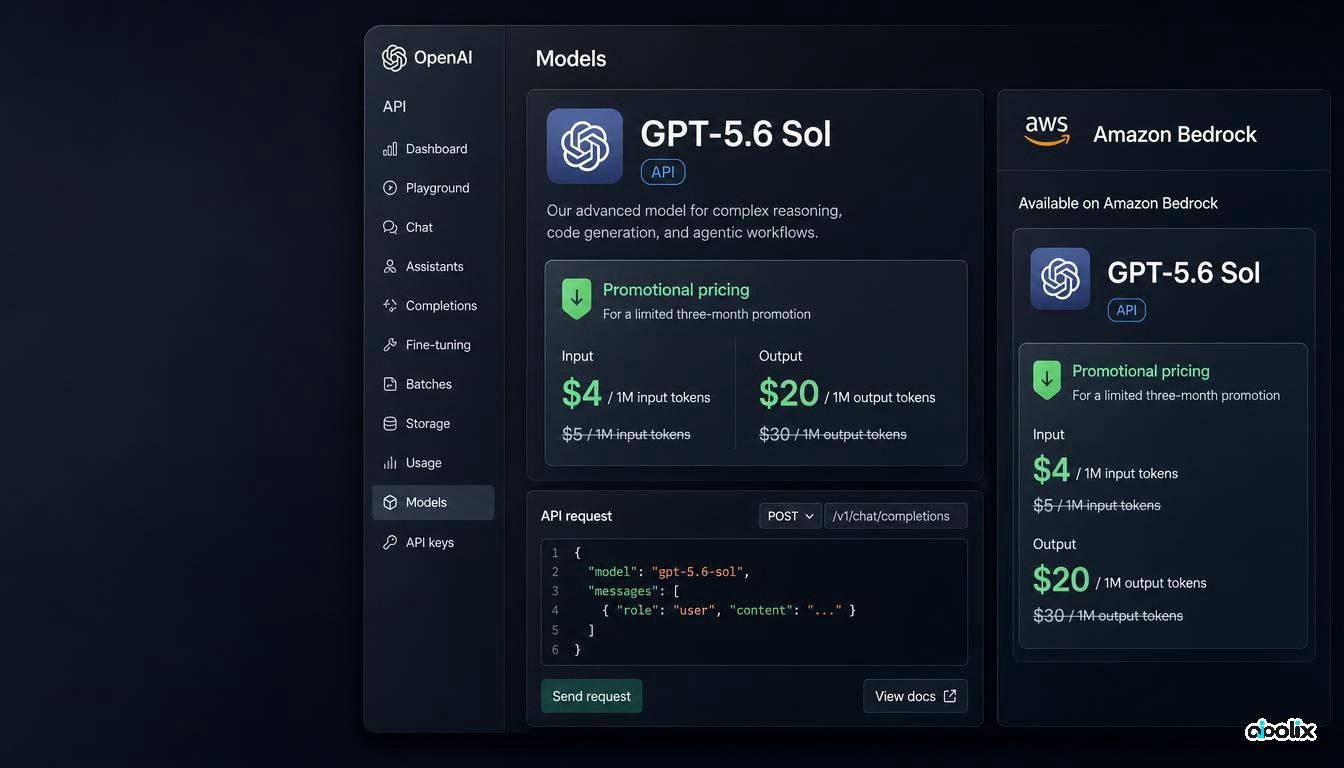
OpenAI has cut the price of GPT-5.6 Sol for a three-month promotional period, creating a meaningful change in the economics of using its flagship model for production workloads. The company added an August 21 update to its GPT-5.6 launch material saying API and credit pricing for Sol had fallen by more than 20%. Reuters independently reported the change, while Amazon Web Services published concrete new Bedrock rates and said the promotion would remain available at least through November 21, 2026.
On Amazon Bedrock, GPT-5.6 Sol now costs $4 per million input tokens and $20 per million output tokens. The previous public Sol rates were $5 for input and $30 for output. That translates to a 20% reduction on input and a 33.3% reduction on output. The asymmetry matters because many advanced reasoning, coding and agent workflows generate substantial output, including plans, code, intermediate reasoning artifacts exposed through tools, structured results and multi-step responses. For those workloads, the effective savings can be closer to the larger output reduction than the headline figure suggests.
The change follows an earlier July 30 repricing of the rest of the GPT-5.6 family. OpenAI cut Terra from $2.50 to $2 per million input tokens and from $15 to $12 for output, while Luna dropped much more sharply to $0.20 input and $1.20 output. Sol pricing was left unchanged at that point. The August 21 move therefore completes a broader repricing cycle across the family rather than introducing an entirely new model tier.
For engineering leaders, the practical implication is that model-routing assumptions deserve another look. A team that previously routed most traffic away from Sol because of its $30 output price may find that the new $20 rate changes the break-even point for difficult tasks. The correct response is not necessarily to send everything to the flagship model. It is to rerun workload-level evaluations that combine task success, retries, latency, token consumption and human escalation. A more capable model can be cheaper overall if it completes a task in fewer attempts, but the opposite can also be true for routine work that Terra or Luna handles adequately.
Agent systems are particularly sensitive to this calculation. A single user request can trigger planning, tool selection, tool results, validation, retries and final synthesis. If several subagents are involved, total generated tokens can rise quickly even when the visible answer is short. Reducing Sol output pricing by one third therefore changes the cost envelope for multi-step automation more than it changes the cost of a simple chat completion. Teams operating coding agents, research agents or long-running enterprise workflows should model cost per completed task rather than cost per individual API call.
The discount also affects architecture decisions around model fallback. Some systems use a cheaper model by default and escalate difficult cases to a frontier model. With a lower Sol price, organizations can lower the threshold for escalation or use Sol earlier in a workflow where better planning might prevent expensive downstream retries. Conversely, the temporary nature of the promotion argues against tightly coupling a product's economics to the discounted rate. Routing policies should remain configurable so a post-promotion increase does not force an emergency redesign.
Procurement and finance teams should pay attention to that temporary status. OpenAI describes the reduction as lasting for the next three months, and AWS says promotional pricing is available at least through November 21. Neither statement establishes the rate as permanent. Forecasts for contracts, customer pricing or unit economics extending beyond that date should therefore include a sensitivity case using the earlier $5 input and $30 output rates, or another conservative assumption, rather than treating today's discount as guaranteed.
The move is also a competitive signal. Reuters linked the reduction to intensifying competition from Anthropic and Chinese AI developers. Price competition at the frontier increasingly happens alongside capability, latency, context size and tool-use quality. For buyers, that is useful because it creates more leverage to benchmark providers on completed-work economics instead of accepting list prices as fixed. It also makes static annual model-selection decisions less defensible when vendors can materially reprice models within weeks.
There are operational details beyond token price. OpenAI's model documentation still describes GPT-5.6 Sol as a frontier model for complex professional work, and long-context requests can have different pricing behavior. Teams should therefore calculate costs from their actual prompt distributions, caching patterns and tool usage rather than multiplying average tokens by the base rate. Prompt caching can substantially change repeated-context workloads, while very large contexts can move requests into higher-priced bands.
For product teams, the lower rate may make previously marginal features viable. High-quality code review, document synthesis, complex support escalation and deeper background analysis can become easier to justify when the most expensive generated tokens cost one third less. But price alone should not trigger a rollout. Existing evaluation suites should be used to determine whether Sol's quality advantage is meaningful for the target task and whether latency, safety controls and failure modes remain acceptable.
Governance teams also have a role because cheaper frontier inference can increase usage. When a model becomes less expensive, teams often expand the number of workflows, users or autonomous steps that can access it. That can raise aggregate data exposure and tool-execution volume even if each request costs less. Access policies, logging, retention rules and approval boundaries should scale with adoption rather than assuming a price reduction is purely a procurement event.
The most useful next step for practitioners is a controlled re-benchmark using current prices. Measure cost per successful task across Sol, Terra and any competing models, include retry and escalation costs, and separate input-heavy from output-heavy workloads. For agent systems, include all subagent and tool-orchestration tokens. That will show whether the new Sol price actually changes the optimal routing policy for a specific application.
What happens after November is the key uncertainty. OpenAI may extend the promotion, make it permanent, replace it with another pricing structure or return to higher rates. Until that is clear, organizations can take advantage of the discount without building fragile assumptions around it. The immediate fact is still significant: one of the leading frontier models has become materially cheaper to run, especially on output-heavy work, and that is enough to justify reopening cost and routing decisions now.