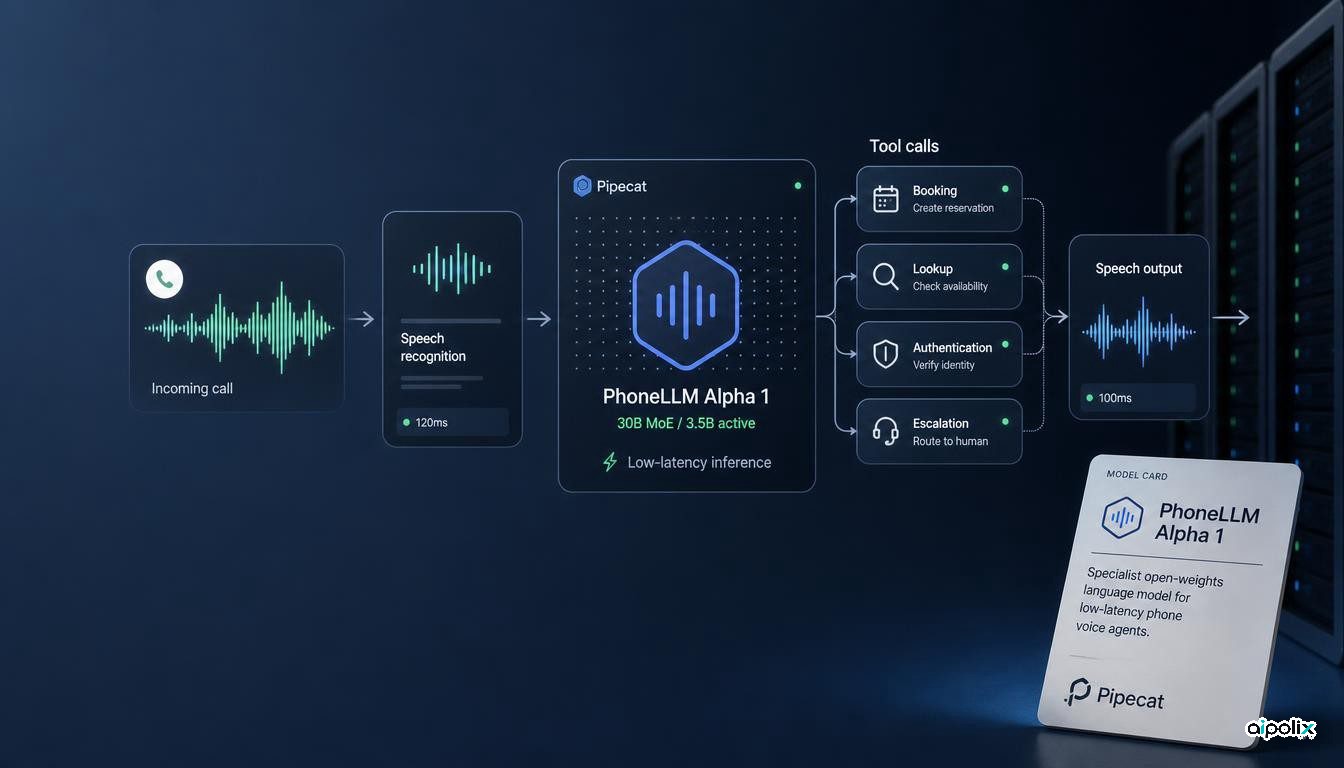
Daily's Pipecat team has released PhoneLLM Alpha 1, an open-weights language model trained specifically for phone-based voice agents. Rather than competing as a general-purpose frontier model, PhoneLLM is optimized around a narrower production problem: responding quickly, maintaining multi-turn state and invoking tools correctly without relying on long reasoning traces.
That distinction matters for voice agents. In a text interface, an extra second of model latency can be inconvenient. In a phone conversation, it can make the interaction feel broken. Pipecat argues that many frontier models are optimized for workloads where additional reasoning time is acceptable, while production phone agents often need a different balance of speed, tool accuracy and cost.
A 30B MoE with 3.5B active parameters
PhoneLLM Alpha 1 is a full-parameter fine-tune of NVIDIA's Nemotron 3 Nano 30B-A3B. The model has roughly 30 billion total parameters but about 3.5 billion active parameters per token because it uses a mixture-of-experts architecture.
Pipecat trained the model with NVIDIA NeMo and publishes the weights on Hugging Face. The model card lists a 262,144-token context window, English as the supported language and recommends deterministic inference with temperature set to zero and thinking disabled.
The model can be served with vLLM or SGLang. Pipecat says it fits comfortably on a single NVIDIA B200 and reports sub-100 ms P95 single-request time-to-first-token on that hardware. Those serving figures are first-party measurements, so they should be treated as deployment guidance rather than independent performance validation.
PhoneLLM is also not a speech-to-speech model. It sits in the LLM layer of a conventional voice-agent pipeline and is designed to work alongside speech recognition and text-to-speech systems.
PhoneBench measures the economics of a phone agent
The more interesting part of the release may be PhoneBench Alpha 1, Pipecat's new benchmark for phone-agent LLMs.
PhoneBench evaluates 15 models on realistic multi-turn customer-service conversations, including tool calls, authentication behavior, escalation discipline, factual grounding, conversation coherence and whether the model's spoken response matches the action it actually performed.
Because many of those properties are difficult to score with exact string matching, Pipecat uses a panel of LLM judges calibrated against human labels. The team says benchmark scenarios, tools and prompts are kept separate from PhoneLLM's training data.
The benchmark also measures time-to-first-answer-token and estimates cost per minute. That makes it closer to a production voice-agent decision than a conventional academic language benchmark, where latency and serving economics are often absent.
Pipecat reports near-GPT-5.6 Terra quality at much lower cost
On PhoneBench Alpha 1, Pipecat reports a score of 72.3% for PhoneLLM, almost identical to GPT-5.6 Terra at 72.4%. Gemini 3.6 Flash leads the benchmark at 78.6%.
The cost and latency numbers are where PhoneLLM stands out in Pipecat's results. The benchmark estimates PhoneLLM at about $0.0025 per conversation minute, compared with $0.0347 for GPT-5.6 Terra. Pipecat describes that as roughly 94% cheaper.
PhoneBench also reports PhoneLLM at roughly 600 ms P95 time-to-first-answer-token, versus 1,957 ms for GPT-5.6 Terra, a difference of about 1.3 seconds.
These are notable numbers, but they require an important qualifier. PhoneBench was designed and run by the same organization that trained PhoneLLM. The benchmark uses LLM judges, estimated serving costs and Pipecat's chosen production configuration. The results therefore show how PhoneLLM performs inside Pipecat's evaluation framework, not an independently established superiority claim.
The larger signal is specialization
The release points to a broader architecture choice for production agents.
A general frontier model is attractive because one model can handle many tasks. But a narrowly scoped agent often does not need broad world knowledge or long reasoning on every turn. It needs predictable tool use, low latency, stable dialogue behavior and economics that scale to thousands of interactions.
Pipecat is effectively testing whether those requirements can be moved into model weights through targeted fine-tuning rather than solved only through prompting and routing to larger models.
That pattern could matter well beyond phone agents. Customer support, scheduling, transactional assistants and other bounded workflows may increasingly use specialist models for the majority of turns, while routing exceptional cases to larger models.
The open weights also change the deployment equation. Teams can self-host PhoneLLM, tune inference settings around their own latency targets and keep sensitive conversational workloads inside controlled infrastructure. The underlying Nemotron license obligations still apply alongside Pipecat's BSD terms.
What to watch next
PhoneLLM Alpha 1 is still an alpha release and currently English-only. The strongest claims come from Pipecat's own benchmark, so independent testing will be important, particularly across different accents, noisy audio pipelines, longer conversations, tool schemas and real production traffic.
The more durable idea is already clear: voice-agent performance is becoming a systems problem involving model specialization, serving configuration, evaluation, latency and cost at the same time.
PhoneLLM and PhoneBench make that trade-off explicit. Instead of asking which LLM is best overall, the production question becomes which model is best for this agent, at this latency target, with this tool set and this cost envelope.