
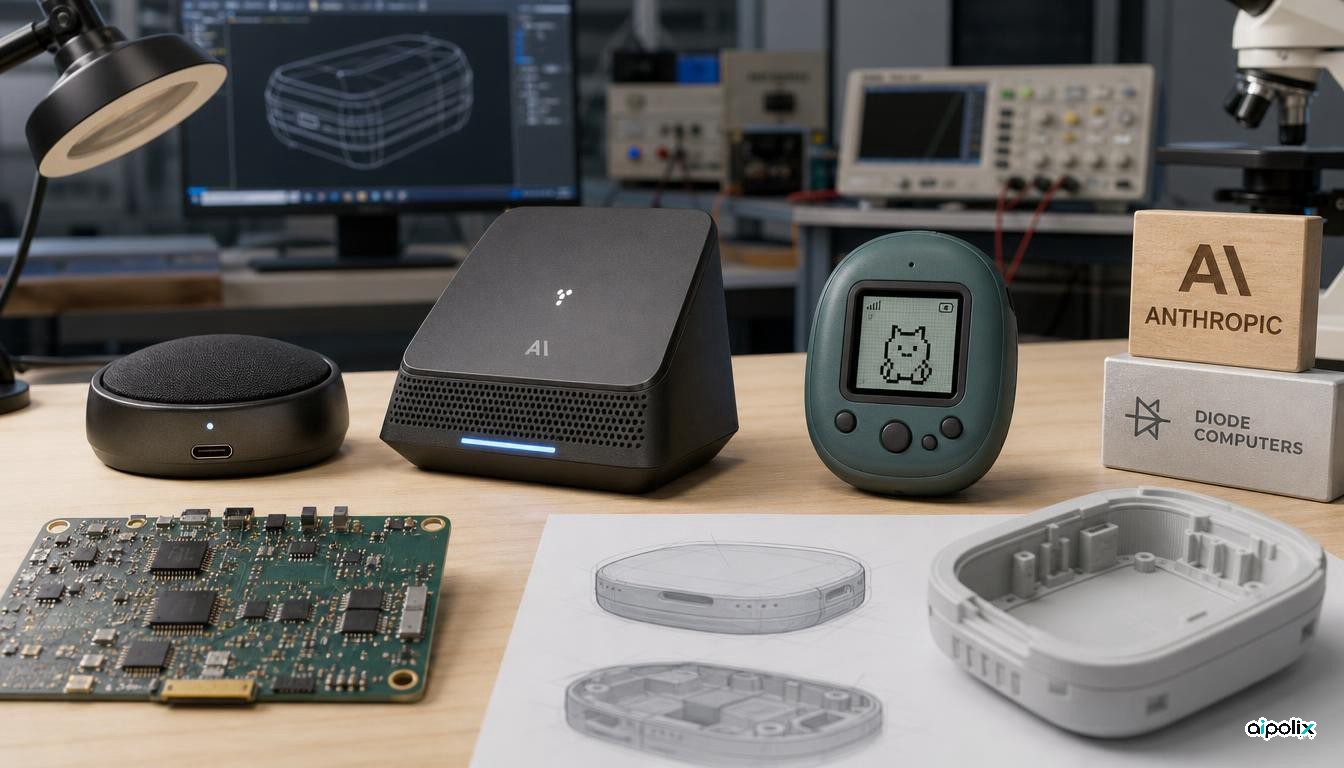
Anthropic on November 9, 2026 published a research post describing tests of Claude Fable 5.2 on real electronics design. The article is credited to Mike Cretella, Connor Jennings and Brent Yi at Anthropic, working with Craig Chen and the team at Diode Computers, a firm that designs and manufactures circuit boards. Editorial support came from Xander Balwit, Tom Chivers, Rebecca Hiscott and Caitlin Love. A footnote states that Anthropic has a commercial relationship with Diode. The authors wrote that a little more than a year earlier, earlier Claude models could not reliably lay out a board or design parts that fit together. In the new tests, they said, Fable 5.2 designed and prototyped three devices from start to finish.
The devices were a USB-C speakerphone puck with microphones, a speaker and Bluetooth on a printed-circuit antenna; a home voice-assistant hub; and a battery-powered handheld virtual pet. For each one the team began with a short prompt that named the kind of device and its main hardware needs. Anthropic said Claude then wrote specifications, drew schematics, placed components on a printed circuit board, routed the copper connections, designed a three-dimensional printable enclosure, wrote firmware and prepared a parts list. Engineers at Diode assembled the boards and ran the firmware under Claude's direction. The company said the prototypes worked without any fixes to their circuitry and were still working after weeks of use.
The largest change from earlier models, the authors wrote, was geometric reasoning: where to put parts and how to route traces. They asked Diode to run PCB Gym, an internal benchmark that scores how well a model can place components and reroute connections on boards whose layouts have been removed. Fable 5.2 scored 69 percent, compared with 25 percent for Fable 5. On BenchCAD 2.1, a public benchmark that asks models to rebuild three-dimensional parts, assemblies and circuit boards from drawings and rendered images, Fable 5.2 scored 83.5 percent, which Anthropic said was nearly double the score of Claude Fable 5.1.
The post also describes the model revising its own work without being told to start over. On the speakerphone's four-layer board, Claude reassigned signals to different pins on two chips so traces under a touch-sensitive control wheel could stay on a single layer without crossing. When the back of that board became crowded, it swapped interchangeable pins and laid out a whole corner again. On the voice-assistant hub it decided the copper was getting too tangled to follow by eye, deleted traces and rerouted them many times. Because the hub had long traces from a 100-pin connector, Claude judged that using KiCad's built-in router one track at a time would be too slow, wrote its own grid-search router in about half an hour, and then used that tool to lay each long track in roughly a second.
Claude also checked manufacturer datasheets and ran design-for-manufacturing and parts-sourcing checks. On the hub it widened six solder-mask slivers that the factory limits flagged as too thin, and it correctly ignored a checker warning about a deliberate connection between two grounds. While designing the speakerphone enclosure it found that the mute switch would hit the back wall if the board were lowered straight in, worked out a tilt of about 25 degrees for installation, tested that motion in its three-dimensional model and added the step to the assembly instructions. For the hub it calculated that a 25-millimeter microphone port would resonate near 3.4 kilohertz, in the voice band, and changed the case to a wedge that shortened the ports to about 10 millimeters and raised the resonance to about 8.9 kilohertz.
Anthropic and Diode presented the three devices as early prototypes. They have not been through electrical validation, antenna tuning, thermal testing or certification, and they were not designed for mass production. Because Claude was not connected to test equipment or to the machines that make and assemble boards, Diode engineers still had to build and test the hardware. The authors said factories made all three boards directly from Claude's design files without rounds of manufacturing changes, which the Diode team told them was unusual. They plan next to test whether Claude can design denser, faster and more complex boards, check them in simulation and learn from measurements on finished devices. The post notes that OpenAI has also written recently about using its models to design a handheld device.