
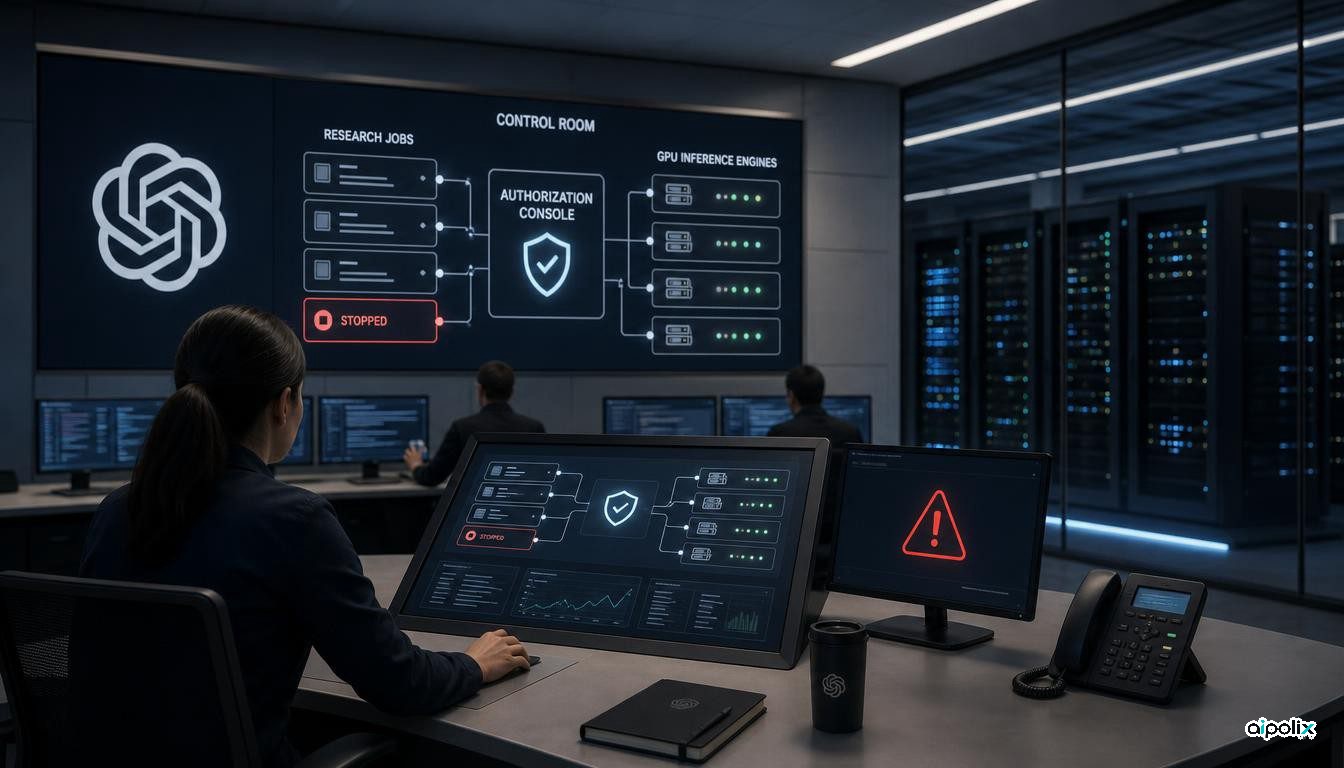
OpenAI on November 9, 2026 published an account of Control Room, a central service that tracks research inference jobs and can cut off further model output when a person or a monitoring system decides to stop or pause the work. The first-party post has no individual byline. The company said the system is already deployed across its research infrastructure, where it connects every research inference workload, including agentic sampling for training and evaluation as well as data processing. It works with OpenAI's misalignment monitoring and, the company said, halts model output within 35 seconds of an instruction to intervene.
Control Room sits beside the research job and the inference engine that actually runs a model on graphics processors. OpenAI requires every research workload that does agentic inference to be tied to an approved safety case. When a job starts, its own code asks Control Room for a job identifier. Later, when that job wants tokens from a model, it sends the identifier to an inference engine. The engine then asks Control Room whether the job is still allowed to run before it produces any output. If the job has been marked stopped, Control Room denies the request and the engine returns a refusal instead of tokens.
The design deliberately does not trust the researcher's job code to shut itself down. OpenAI wrote that workload software changes often and is a poor place for load-bearing safety controls, whereas only a small number of inference paths are in use and those deployments are more uniform. Termination therefore happens at the inference layer, which the company called a bottleneck that can cover research inference even if the job process itself stays alive. OpenAI said it also runs continual agentic and programmatic sweeps to catch engines that were launched without Control Room enabled or with the checks disabled.
Frontier reinforcement learning jobs, the post said, all run with a monitor: another model that inspects what the model being trained is doing and raises an alert if it sees a problem. OpenAI said a recent DNS-related incident was caught that way. Depending on the details and severity, the monitoring system can tell Control Room to stop the job. After that, the next inference request that carries the same identifier is refused. The research process may keep running, and the engine remains available to other authorized jobs.
The 35-second ceiling comes from a caching layer that authorizes inference at the volume OpenAI said it needs. The company wrote that it is trying to drive that delay to zero so jobs can be ended immediately. Control Room is also described as failing closed. If the service goes down because of an error, because it is disabled, or because someone tampers with it, inference requests are denied until it returns to normal operation. OpenAI said that fail-closed behavior is already rolled out to all frontier-model research workloads and will finish covering the remaining research workloads over the following days.
The company contrasted this research setup with its external model-serving stack, which it said is already more centralized and already has operational ways to take down deployments quickly. Control Room, it wrote, is one part of a broader effort around safe frontier training and deployment, alongside monitoring for misaligned behavior and security breaches. The post presents an internal safety control, not a product that outside customers can buy or operate.