
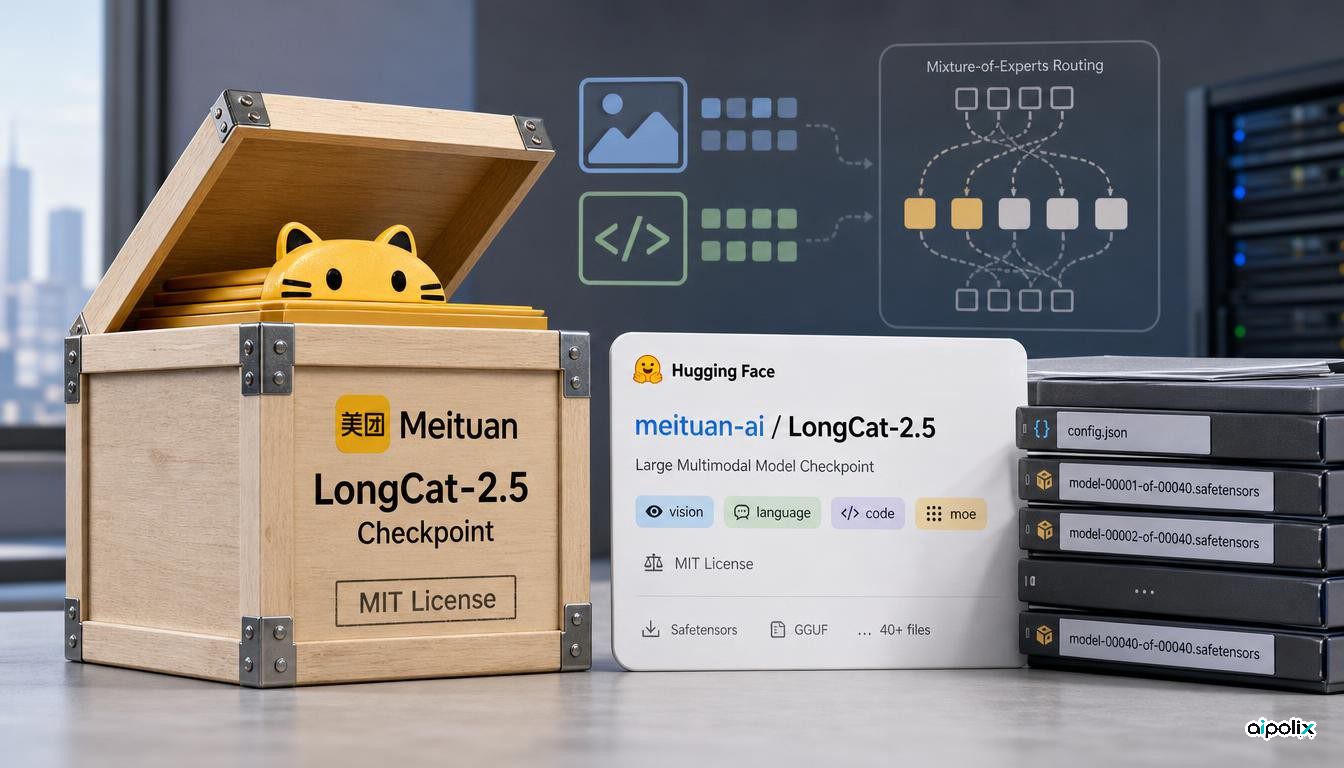
Meituan on November 9, 2026 published the weights of LongCat-2.5 on Hugging Face under the MIT License, according to a VentureBeat report by Carl Franzen. The Chinese company, best known for food delivery and e-commerce, had introduced the model about a week earlier. The downloadable checkpoint is what makes the model newly usable outside Meituan's own hosted service. The official model card describes LongCat-2.5 as a native multimodal mixture-of-experts system built for long-horizon agentic work, with 1.6 trillion total parameters and about 48 billion activated per token.
The model card says LongCat-2.5 builds on LongCat-2.0 by combining visual understanding with agentic coding for large codebases, full-project builds, creative design and three-dimensional tasks. Visual information is converted into discrete tokens and processed with text in a shared semantic space, rather than handled by a bolted-on vision module. Training notes on the card mention long-sequence work, large-scale reinforcement learning, multi-teacher learning and infrastructure optimizations on domestic AI accelerators. The card also describes W4A4 quantization of expert weights and activations so the model can run native four-bit computation on those accelerators.
The license file in the same Hugging Face repository is an MIT License with a 2026 Meituan copyright notice. It grants permission to use, copy, modify, merge, publish, distribute, sublicense and sell copies, subject to keeping the copyright and permission notices, and it disclaims warranties. That matches VentureBeat's description of a permissive license that allows commercial use, modification and redistribution if the notice requirements are met. Hugging Face's repository metadata displays a model size of 1.8 trillion parameters, while Meituan's technical description says 1.6 trillion. VentureBeat flagged the same mismatch and advised readers to size a deployment from the actual files and serving format.
Meituan published an extensive in-house evaluation table on the model card and asked readers to treat unmarked scores as indicative only. It reported that LongCat-2.5 scored 88.4 on Terminal Bench v2.1, compared with 70.8 for LongCat-2.0, 64.6 versus 9.7 on DeepSWE v1.1, and 58.3 versus 33.1 on the SWE Atlas codebase question-answering test. On Terminal Bench v4.0 it listed 38.5 for LongCat-2.5 against 53.9 for Claude Opus 5. Other claimed scores include 78.6 on Vision2Web and 55.4 on 3DCodeBench. Those figures are Meituan's own measurements or citations of public reports, often using specific agent harnesses, and they are not independent third-party results.
VentureBeat wrote that Meituan's rate card lists a limited-time hosted price of 30 cents per million uncached input tokens and 1.20 dollars per million output tokens, plus 0.006 dollars per million cached input tokens. The model card says the system can be deployed on neural processing units and points readers to an SGLang-FluentLLM guide. A chat demo is offered at longcat.ai. Because only a subset of experts fire for each token, serving still requires making the full checkpoint available. VentureBeat noted that a simple 16-bit estimate of 1.6 trillion parameters would imply about 3.2 terabytes for weights alone, and called that arithmetic illustrative rather than a measured footprint.
Franzen also wrote that, as of November 9, VentureBeat found no publicly disclosed United States federal procurement restriction that specifically names Meituan or LongCat-2.5, while pointing to separate recent limits on other Chinese models as a reminder that the rules can change. The model card warns that the system has not been comprehensively evaluated for every downstream use and that developers must assess accuracy, safety and legal requirements themselves. Questions can be sent to [email protected]. The in-window news is the opening of the weights under the MIT License, not the earlier introduction of the model itself.