Apple has started rolling out Siri AI with iOS 27 and its other 2027-generation operating-system releases, finally moving the long-delayed Siri overhaul from previews into a public beta. The headline capabilities are substantial: personal-context retrieval across messages, email and photos, awareness of what is on screen, web-grounded answers, deeper app actions and a dedicated Siri app that can carry conversation history across Apple devices.
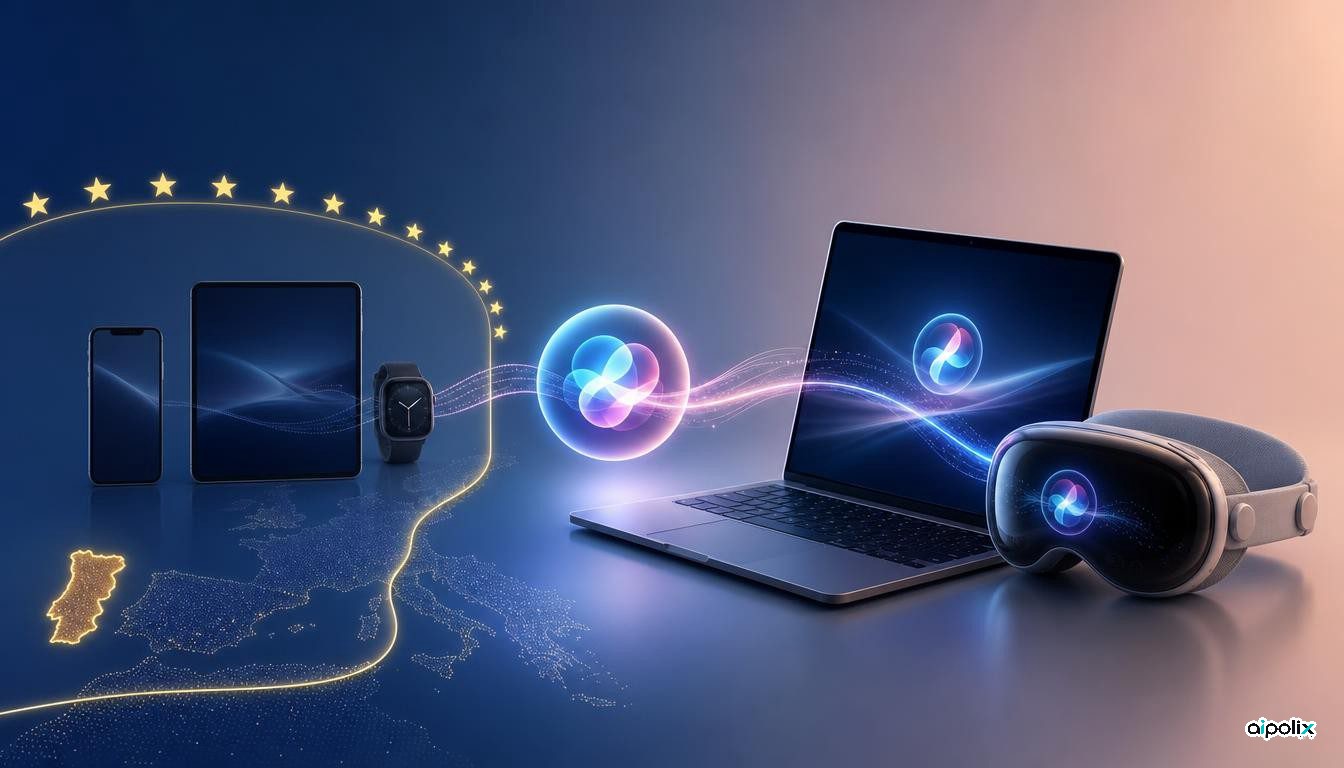
For users in Portugal and the rest of the European Union, however, the launch is not one uniform product. Apple says Siri AI is initially unavailable in the EU on iOS, iPadOS and watchOS, while Mac and Apple Vision Pro users in the EU can access it when their device is set to a supported language. Portuguese language support is due in October rather than at launch.
That split is more important than a footnote. Apple is presenting Siri AI as a systemwide assistant whose value comes from moving across devices, apps and personal context. In Portugal, the first rollout breaks that continuity by device class.
A major Siri upgrade finally ships
Apple describes Siri AI as a rebuilt assistant rather than an incremental Siri feature. It can use personal context from a user's own communications and photos, reason about material shown on screen, search the web for current information and trigger a wider set of actions inside apps.
Apple's examples include drafting email, editing and sharing groups of photos, answering questions about on-screen content and acting on what the iPhone camera sees. The company is also opening more of the action layer to third-party apps, with examples involving Outlook, Notability, Tripsy, WhatsApp and Audible.
Independent hands-on testing from TechCrunch adds useful context. Its reviewer reports that the beta can handle multi-step requests, use on-screen context and retrieve information from files, messages and email, while still showing consistency problems in some app interactions. That is evidence of a meaningful capability step, but not evidence that every advertised workflow is reliable.
The correct status is therefore beta, not a finished replacement for every assistant workflow.
Portugal gets a fragmented launch
Apple's regional availability rules create an unusual situation for Portuguese users.
Siri AI begins in English and Apple says French, Japanese, Korean, Portuguese and Spanish support will arrive in October. But language availability and device availability are separate constraints. Apple's September 14 release notes state that Siri AI will not initially be available in the EU on iOS, iPadOS or watchOS. Mac and Apple Vision Pro users in the EU can use it when configured with a supported language.
That means adding Portuguese in October does not, by itself, imply that a user in Portugal will suddenly receive Siri AI on an iPhone, iPad or Apple Watch. Apple would also need to change the EU device availability restriction.
This distinction matters because much of Siri AI's pitch depends on continuity. Apple says a dedicated Siri app can privately synchronize conversation history through iCloud so a user can start on one device and continue on another. A Portuguese user may therefore have access on a Mac while the same assistant remains unavailable on the iPhone that supplies much of the everyday personal context.
Aipolix's analysis is that the EU restriction turns what Apple markets as one cross-device assistant into two practical product tiers: devices where the new assistant can execute, and devices where the operating-system upgrade arrives without that assistant.
The cloud layer also introduces a quota boundary
A second limitation sits in Apple's fine print. Some Apple Intelligence features that depend on server-side models are subject to daily usage limits. Apple explicitly includes Siri AI, intelligent photo editing, Image Playground and AFM 3 Cloud models in Shortcuts in that category.
Apple has not published one fixed quota in the release material. It says limits may vary by feature, request complexity, system demand and policy. It also says expanded access will be available for a fee in the future.
This changes how developers and power users should interpret Siri AI. A system action may look like a native operating-system capability, yet its availability can depend on a remote model quota. That is a different reliability boundary from classic Siri commands that are simply present or absent on the device.
It also creates a future pricing boundary inside the assistant. Apple has not announced the price, package or date for expanded access, so it would be premature to call Siri AI a subscription product. But the company has now established that at least some cloud-backed intelligence will have metered access beyond a free allowance.
Systemwide action makes permissions more consequential
Siri AI's value proposition is not just better answers. It is the ability to act across apps and personal data.
That increases the importance of authorization boundaries. An assistant that can locate a reservation number is useful; an assistant that can also draft a message, manipulate photos or trigger app actions has a larger execution surface. Apple says its architecture is designed around privacy, and many experiences use on-device processing or Apple's privacy infrastructure, but the launch materials do not amount to an independent security evaluation of every cross-app action.
The practical question is therefore not whether Siri AI is “private” in the abstract. It is which data each action can read, which operation it can execute, whether the user can see the intended action before it occurs and how third-party app integrations preserve those boundaries.
This is especially relevant as developers add more Siri actions after the operating-system launch.
What to watch next
Three milestones will determine whether the launch becomes genuinely systemwide in Portugal.
First is October's promised Portuguese-language support. Second is any change to the EU restriction on iPhone, iPad and Apple Watch. Third is disclosure of the actual daily limits and paid expanded-access model for cloud-backed features.
If Apple resolves only the language gap, Portuguese-speaking Mac users may gain a native Siri AI experience while mobile users remain on the old availability boundary. If the EU restriction is lifted as well, the cross-device design becomes much closer to the product Apple is advertising globally.
The launch is therefore significant for two reasons at once. Apple has finally shipped a materially more capable Siri with personal context and action-taking features, and it has exposed the policy and infrastructure constraints that determine whether that assistant is truly ubiquitous.
For Portugal, the most important detail is not that Siri AI “supports Portuguese soon.” It is that language support, device eligibility, regional regulation and cloud quotas are four separate gates. The user experience will depend on all four.