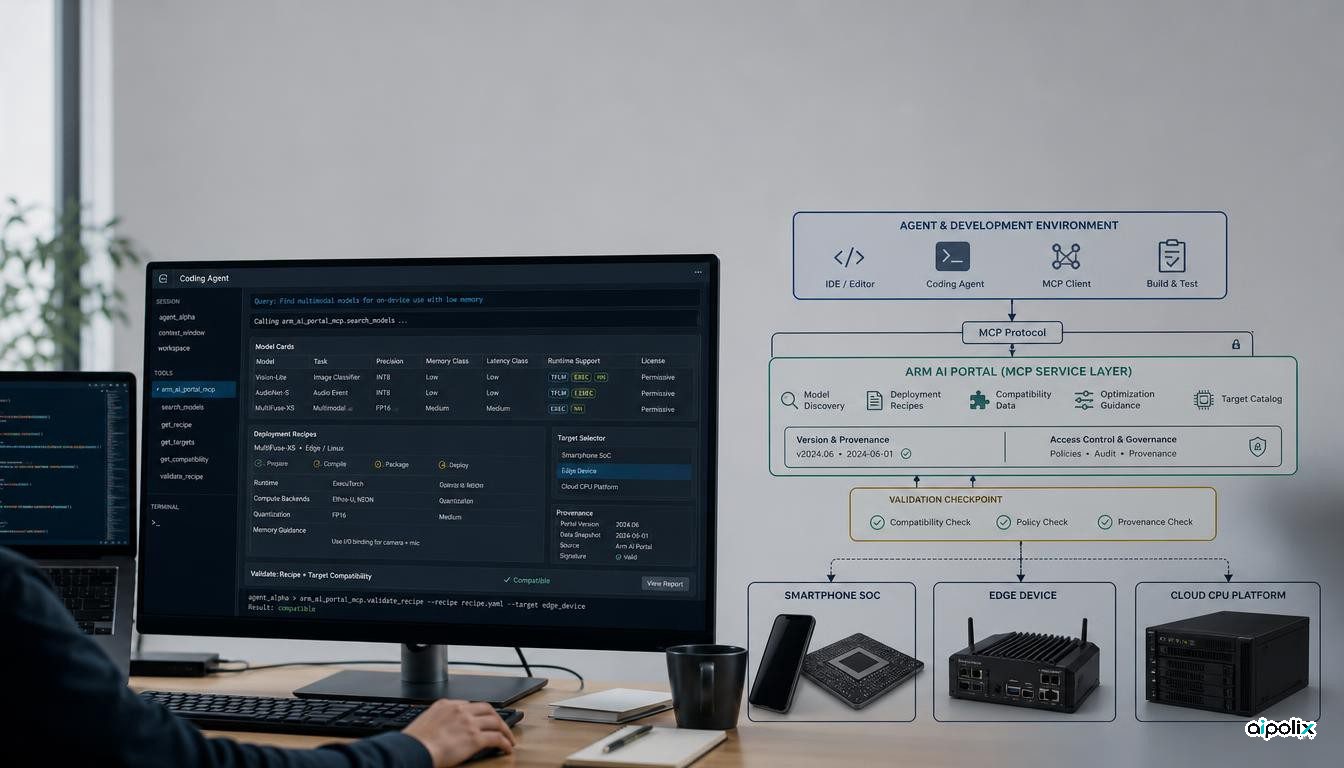
Arm has launched Arm AI Portal, a developer service that puts optimized AI models, performance information and deployment guidance behind one discoverable interface for Arm-based systems. The more consequential part is not the catalog itself: Arm is also exposing portal resources to coding agents through a Model Context Protocol (MCP) server, so an agent can query model options and deployment guidance directly from its development environment.
Arm says the portal is available now, while agent-ready resources are in early access. At launch it includes optimized models from projects such as Qwen, Gemma and YOLO, with runtimes including ExecuTorch, LiteRT and ONNX Runtime. The company also says developers will be able to bring proprietary models for analysis and optimization in a future phase.
The portal turns hardware optimization into a machine-discoverable service
The usual Arm optimization workflow is fragmented across model repositories, runtime documentation, hardware-specific guidance and benchmark material. AI Portal attempts to collapse part of that search problem into a structured service. Arm's own Learning Path shows the MCP endpoint being added directly to Codex, Claude and GitHub Copilot command-line environments.
That changes the integration boundary. Instead of a developer manually searching for an Arm-compatible model and then translating hardware guidance into build steps, an agent can query the portal as part of its planning loop. The immediate value is workflow compression: discovery, compatibility checking and deployment guidance become callable resources rather than separate browsing tasks.
The important architectural shift is not another model hub
A model catalog alone would be incremental. The stronger development is that Arm is treating optimization metadata as something software agents should be able to consume programmatically. That matters because deployment decisions increasingly depend on more than model identity. Developers need to compare latency, memory use, model size, runtime support and target hardware characteristics.
Arm says the portal exposes performance and accuracy data alongside deployment resources. If that information remains sufficiently structured and current, it can become part of an automated decision path. An agent could, for example, select among supported variants for a mobile CPU target, then retrieve the associated runtime and deployment guidance without leaving the coding environment.
This does not mean the agent can independently guarantee that the chosen model is optimal. Performance claims remain hardware-, configuration- and workload-dependent, and Arm's published examples are vendor measurements. The portal reduces search and integration friction; it does not remove the need to validate latency, memory and accuracy on the actual target device.
MCP makes vendor infrastructure part of the coding-agent toolchain
The MCP server is the clearest operational signal. Arm documents direct connection commands for Codex, Claude and Copilot. That means Arm optimization guidance can now sit inside the same tool layer that coding agents already use for repositories, terminals and development services.
The Aipolix analysis is that this moves a hardware vendor one level upward in the developer stack. Arm is no longer only supplying instruction sets, CPU and GPU IP, libraries and optimization documentation. It is exposing a machine-readable decision surface that agents can consult while planning software changes. If this pattern spreads, hardware and cloud vendors may increasingly compete on how well their capabilities can be discovered and invoked by agents, not only on benchmark results or SDK quality.
That creates a new dependency question for engineering teams. If a coding agent begins to rely on vendor-provided MCP services for model selection or deployment guidance, teams should treat those services as external technical inputs. Versioning, provenance, availability and policy controls become relevant because a change in the service can alter the advice an agent receives.
Arm ties the portal to its new mobile AI platform
The launch comes alongside Arm CSS for Mobile 2, which combines new C2 CPU cores, SME2 support and the Mali G2-Ultra NX GPU. Independent technical coverage from CNX Software confirms the new mobile platform and its AI-oriented CPU and GPU components. Arm positions AI Portal as the software-discovery layer that connects optimized models with such hardware capabilities.
The practical consequence is straightforward: Arm is trying to shorten the path from 'I need an AI function on this device' to a tested implementation path. For developers, the useful question is not whether the portal contains many models, but whether its performance metadata, runtime compatibility and deployment recipes remain trustworthy enough to automate.
What teams should verify before relying on it
Teams evaluating Arm AI Portal should treat it as an accelerator for discovery and integration, not as a substitute for their own acceptance tests. Benchmark context matters, particularly when comparing quantized variants or different execution paths. The portal's future bring-your-own-model workflow will also be worth watching because proprietary-model analysis introduces additional questions around data handling and reproducibility.
The launch is significant because it converts a part of hardware-specific AI optimization into an agent-callable service. That is a concrete developer-workflow change, but its long-term value will depend on the quality, freshness and governance of the metadata the agents consume.