Atlassian is extending Jira from a place where engineering work is tracked into a system that can continuously decide which backlog items are ready for a coding agent, dispatch them, run tests and return a pull request for human review. The new Agent loops capability is part of a wider package that also includes repository-aware context, agent access controls, organization-wide coding standards, AI-assisted review and usage measurement.
The important change is not that Jira can invoke a coding agent. Atlassian already described Jira Automation as an open control plane for third-party coding agents in July. The September release moves that idea toward a persistent execution loop: Jira can repeatedly scan for eligible work instead of waiting for a person to trigger each session. That shifts the design question from “can an agent write this code?” to “what work is allowed to enter an unattended loop, what context can the agent see, and which actions still require a person?”
The loop starts with backlog eligibility, not code generation
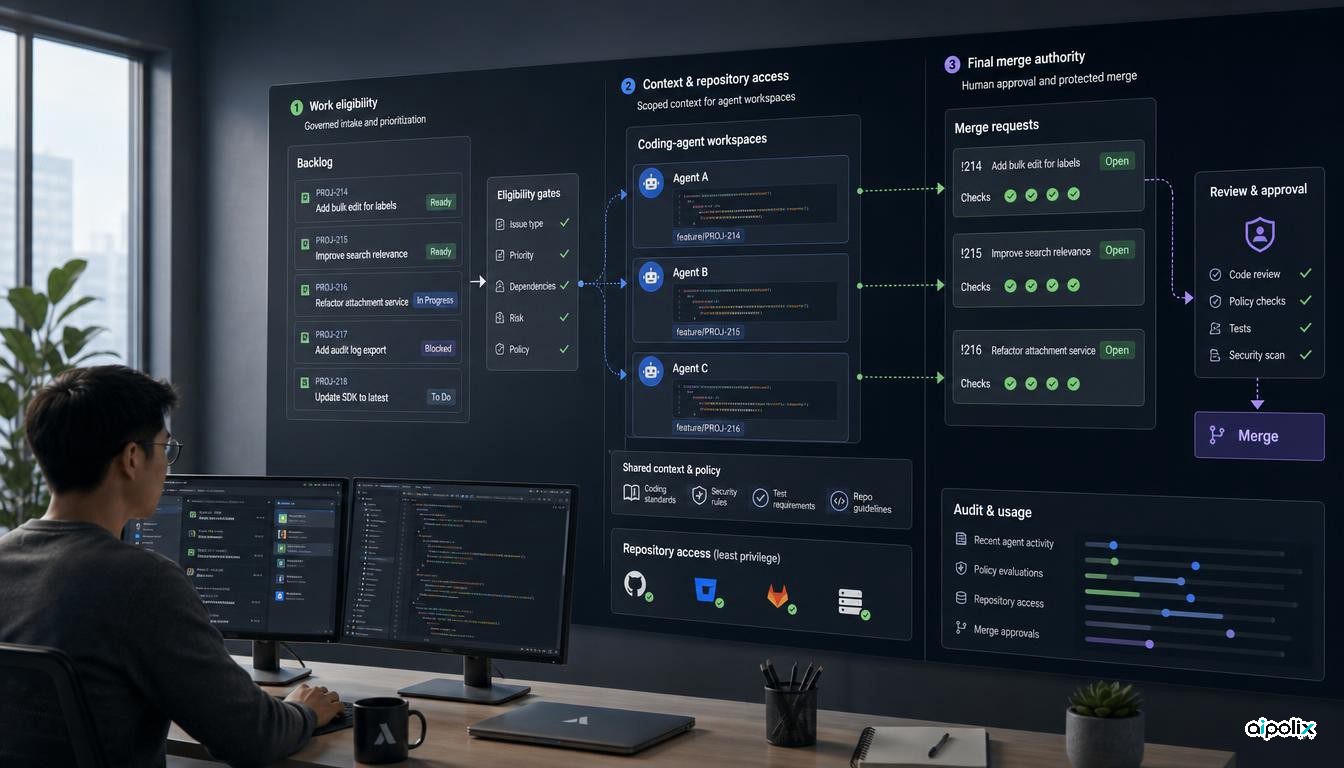
In Atlassian’s September announcement, Agent loops continuously looks for “well-defined” unassigned work, delegates it to Jira Coding Agent, runs execution and testing, and opens a ready-to-review pull request. Developers and product managers still decide what is merged.
That detail matters because the first control boundary now sits before the agent starts coding. A work item must be sufficiently specified to enter the loop. If teams treat backlog labels or issue states as administrative metadata rather than executable policy, they can accidentally turn vague work into autonomous work.
The earlier Jira Automation announcement already supported event-driven delegation to GitHub Copilot, Cursor and Claude. Agent loops adds a persistent dispatcher that can keep finding work without a fresh prompt. Operationally, that makes backlog hygiene, eligibility rules and exception handling part of the agent safety model.
Context and permission are becoming separate controls
Atlassian is also separating what an agent knows from where it may operate. Code Context, built on the Teamwork Graph, is intended to give Rovo and coding agents cross-repository information. Agent Context Controls are intended to let platform teams decide which agents may operate in a space and what they are allowed to see.
That separation is useful. Better context can improve planning and reduce needless exploration, but broader context also increases the amount of code, documentation and organizational knowledge exposed to an agent. A governed system therefore needs two independent questions: which context is useful for the task, and which context is authorized for this agent.
Atlassian cites an internal DX analysis saying teams using more Teamwork Graph context shipped roughly 64% more per developer. That is a vendor-reported correlation, not proof that additional context caused the productivity difference, so it should not be treated as an established performance gain.
Standards and AI review add checks before the human merge gate
The same package includes Standards, which lets platform teams map coding standards to repositories, and AI Review, which checks pull requests against those standards before they reach a person. A Jira Agent Usage Dashboard is intended to show which agents are active in workflows, while DX for Agentic Development measures adoption, cost, throughput and quality signals.
The resulting control chain is more interesting than any single feature. Jira determines which work can be dispatched; context controls constrain what the agent can see; repository standards define expectations; an AI reviewer checks the proposed change; and a human remains responsible for the merge decision.
That does not make the loop safe by itself. If the same policy mistake is shared across dispatch, standards and review, multiple automated checks can agree on the wrong thing. The architecture reduces reliance on one agent session, but it also creates a new need for independent policy ownership, audit trails and escalation paths when automated stages disagree.
Availability is still fragmented
The product maturity is important. Atlassian says Code Context is rolling out through open beta to paid customers. Agent loops, Standards and AI Review are in private early access. Agent Context Controls and the Agent Usage Dashboard are expected to become generally available to paid Jira customers in coming months, and DX for Agentic Development is expected to reach general availability this quarter.
Independent IT Pro coverage confirms the same staged availability. That means the announcement should be read as a control architecture that Atlassian is assembling, not as evidence that large engineering organizations can already run the full loop in production at scale.
For teams evaluating the design, the most useful question is not whether Jira can create pull requests automatically. It is whether the organization can express three boundaries clearly enough to automate them: which work is eligible, which resources an agent may use, and which effects remain human-authorized.
If those boundaries are explicit and independently observable, persistent agents can remove repeated coordination work without quietly turning the backlog into an execution queue with unclear authority. If they are not, “always on” simply makes a weak control model run more often.