OpenAI has released ChatGPT Images 2.5, a new image model and editing workflow available across ChatGPT, ChatGPT Work and Codex, alongside two API models: GPT-Image-2.5 Flare and GPT-Image-2.5 Sunburst. OpenAI says the release improves subject fidelity, precision editing and multi-turn consistency while reducing generation latency by up to 50% compared with Images 2.0.
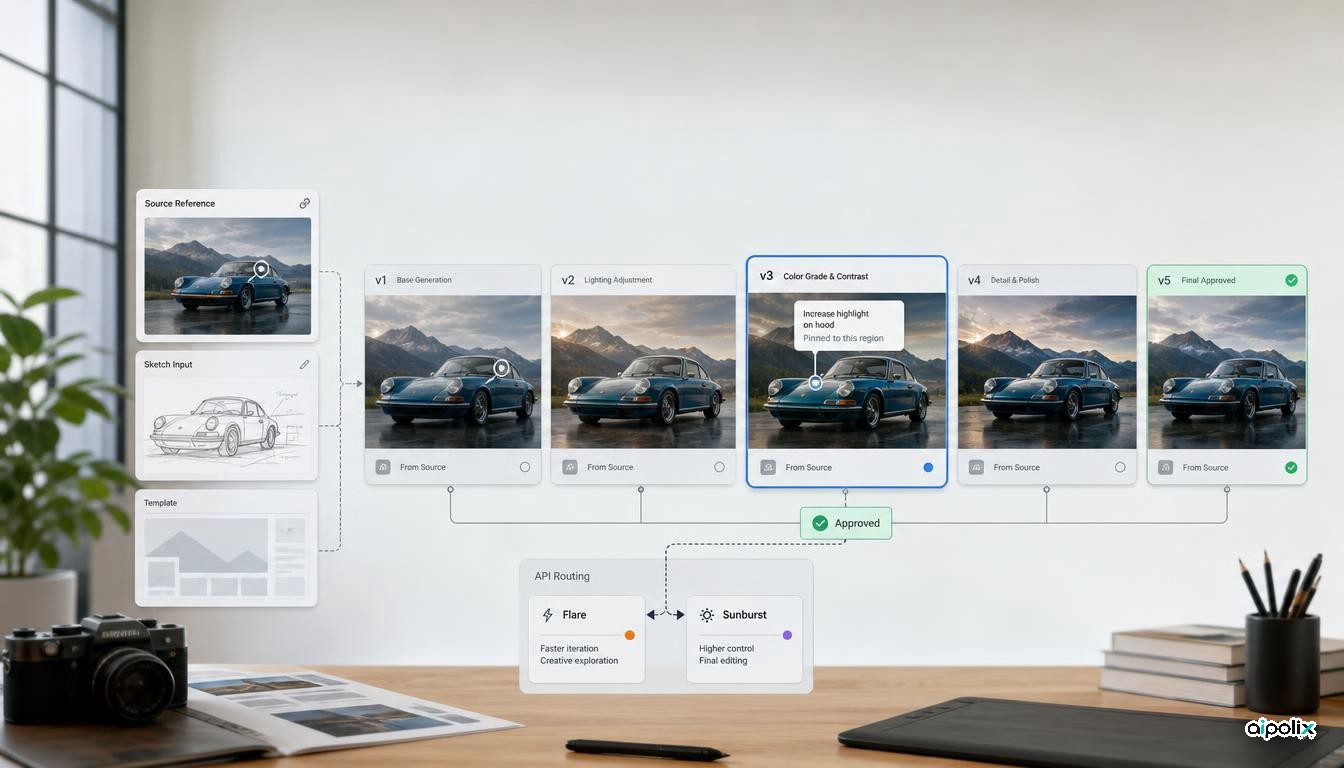
The product update also adds several workflow features inside ChatGPT: users can draw a rough reference with Sketch, start from templates, place comments directly on images to request targeted changes and share prompts with other people. For developers, Flare is positioned as the default model for most applications, while Sunburst is aimed at higher-precision creative and editing workflows with longer generation times.
The bigger change is persistent editing, not a single better generation
Image-generation products are often evaluated as one-shot systems: send a prompt, receive an asset, then start again when the result is wrong. Images 2.5 moves further toward a stateful production workflow. OpenAI says earlier edits are more likely to remain stable across later turns, and targeted instructions are less likely to alter unrelated parts of the image.
That matters because production image work is usually iterative. A marketing team may need to change one product, one line of copy or one background without losing the composition, subject identity or brand treatment already approved. A designer may want to explore several variants while preserving the same person or object. If the model can retain those constraints more reliably, the unit of work shifts from “generate an image” toward “maintain and revise an asset.”
The Aipolix analysis is that this change makes image-generation APIs resemble collaborative design tools more than stateless media endpoints. Once users expect an image to survive multiple edits, systems need to track asset lineage, edit history and which parts of the image were intended to remain fixed.
Comments and Sketch create new input surfaces
OpenAI has added two interaction modes that reduce dependence on natural-language prompting. Sketch lets a user draw a rough visual reference, while comments can be placed directly on an image to point at the area that should change.
These controls matter because many visual instructions are spatial rather than verbal. “Move this element here” or “change only this region” is often easier to express through a mark on the image than through a long text description. For product teams, that means the interface can collect structured visual intent instead of forcing every instruction through a prompt box.
Templates add another layer of structure. Instead of beginning from a blank prompt, users can start from common formats such as posters or merchandise and then customize them. This reduces prompt-design work and makes the workflow more repeatable for non-specialists.
Flare and Sunburst split the API around latency and precision
OpenAI is releasing two API models rather than one. Flare brings the main quality, editing and speed improvements and is described as the default choice for most uses. OpenAI says it provides higher quality than GPT-Image-2 with 50% lower latency. Sunburst is designed for premium workflows where tighter control over detailed edits is more important than generation time.
The useful developer implication is not simply that there are two models. The split makes model selection part of application architecture. High-volume previews, social content or rapid prototyping may prefer the faster path, while final campaign assets or detailed product imagery may justify a slower, higher-control path.
Teams should still benchmark their own workloads. OpenAI's latency and quality statements are vendor claims, and performance can vary with resolution, edit complexity, references and application design.
Better consistency increases the need for asset provenance
OpenAI says the model is better at preserving subjects from reference images and maintaining earlier changes through longer conversations. That is useful, but it also raises a governance question for teams that produce commercial assets.
When an asset is edited repeatedly, teams need to know which source image it came from, which prompts or comments changed it, whether a reference image carried usage restrictions and which version was approved for publication. Multi-turn consistency makes the workflow more powerful, but it also means a generated asset now has a longer history.
A production system should therefore treat each edit as a versioned operation rather than overwriting a single anonymous image. That becomes especially important when reference photos, brand assets or regulated content are involved.
Safety and provenance remain part of the release
OpenAI says Images 2.5 continues to use prompt and image safeguards, C2PA metadata and invisible watermarking. A separate system card describes safety evaluations and limitations for the release.
Those mechanisms are relevant, but they do not replace internal controls for organizations. Teams still need policies around reference-image rights, approval of sensitive edits, retention of source material and disclosure requirements in the markets where generated media is used.
What changes for developers and creative teams
The practical shift is toward a more continuous creative loop. Sketch provides a spatial starting point, comments make local edits easier to express, templates make common formats repeatable, and multi-turn consistency reduces the need to rebuild assets from scratch.
For developers, Flare and Sunburst add an explicit speed-versus-control choice at the API layer. For creative operations, the more important consequence is that image generation is becoming an editable, versioned workflow rather than a one-off generation endpoint.
That makes the next engineering problem less about producing a single impressive image and more about preserving intent, identity and provenance across a sequence of changes.