
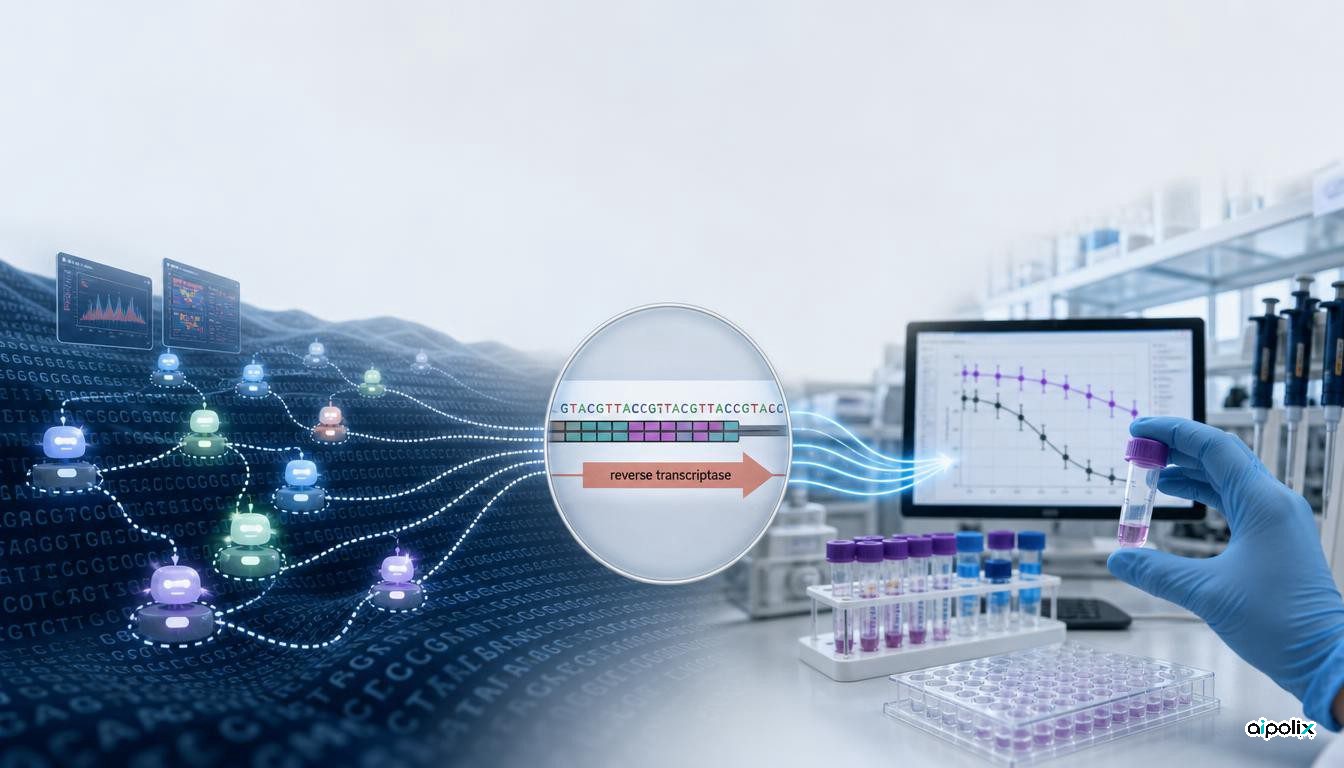
Anthropic has reported an early result from its new life-sciences research group: Claude agents searching a large DNA-sequence database identified an unusual reverse-transcriptase system associated with long arrays of repeated DNA. The company calls the system array-associated reverse transcriptases, or ARTs.
The repeat organization is reminiscent of CRISPR arrays, which makes the finding scientifically interesting, but the comparison needs a hard boundary. Anthropic says it still does not know ART's primary function. The evidence published so far does not establish that ART is a programmable gene-editing system or that it operates through the same mechanism as CRISPR.
About 950 agents searched the sequence space
Anthropic says it gave Claude a high-level instruction to look for interesting examples of reverse transcriptases. Roughly 950 agents then spent 21 hours exploring the data, using about 210 million tokens.
The agents gathered more than 200,000 reverse transcriptases, identified thousands of candidate systems and narrowed them to a smaller set for closer analysis. One agent noticed a regular DNA repeat pattern next to an unusual reverse-transcriptase gene. Further analysis led the team to a system found mainly in bacteriophages, the viruses that infect bacteria.
Anthropic describes three recurring components: the reverse transcriptase, a neighboring partner gene and a long array of evenly spaced DNA repeats. The important point is not merely that a model produced a plausible hypothesis. The workflow used many agents to explore different branches of a very large search space and surface anomalies for expert review.
The laboratory step changes the quality of the evidence
A computational pattern can be novel without being biologically important. Anthropic therefore moved the candidate into physical experiments in its laboratory.
The company reports that the ART repeat array is expressed as a set of distinct short RNAs. That observation gives researchers a measurable biological signal associated with the genomic structure and makes the candidate more than a pattern spotted in sequence data.
Aipolix's analysis is that this division of labor is more important than the immediate comparison with CRISPR. Agent swarms are well suited to scanning large datasets, comparing families, following many leads and ranking unusual structures. Wet-lab experiments answer a different question: does the predicted system actually produce a biological phenomenon that can be measured and reproduced?
For scientific organizations, that suggests an architecture in which AI is a hypothesis-expansion layer rather than the final authority. The handoff from computational discovery to experiment becomes the critical control boundary.
Why the CRISPR resemblance should not be overstated
CRISPR systems are famous because repeated DNA sequences and associated proteins can participate in programmable targeting. Anthropic notes that ART has a repeat layout reminiscent of a CRISPR array and that the array produces distinct short RNAs.
Those observations are strong reasons to investigate the system. They are not enough to conclude that ART has a comparable immune role, uses the same targeting mechanism or can be turned into a gene-editing platform.
Anthropic explicitly says work to determine ART's primary function is ongoing. TechCrunch also frames the announcement as an early discovery whose importance and novelty will need broader scientific validation.
That distinction matters because an AI-generated hypothesis can become news before the biology is settled. A useful reporting standard is to separate three levels: what the agents noticed in sequence data, what Anthropic's laboratory measured, and what researchers still do not know.
AI changes the economics of looking, not the standard of proof
The 950-agent search points to a practical change in scientific computing. When model inference is available at scale, researchers can allocate many agents to inspect different branches of a large dataset, compare families, search literature and prepare candidate reports.
That can make hypothesis generation broader and faster. It can also produce a flood of plausible-looking patterns. The cheaper it becomes to generate hypotheses, the more important prioritization, provenance and experimental validation become.
ART illustrates that asymmetry. AI may reduce the cost of finding anomalies faster than it reduces the cost of proving what those anomalies mean. Laboratories using similar workflows need to preserve a trace from the agent's observation to the underlying sequence evidence, human review, experimental design and final measurement.
What would strengthen the finding next
The next important evidence is functional. Researchers need to determine what the reverse transcriptase, partner gene and RNA products actually do in bacteriophages and whether the repeated organization has any programmable role.
Independent reproduction will matter as well. Anthropic is sharing the finding while experiments continue, so the broader community has not yet established a consensus about ART's function or technological potential.
The strongest conclusion today is narrower and still significant: a large agent-based search surfaced a previously uncharacterized biological system, and wet-lab work produced an initial experimental signal worth following. That is evidence for a productive AI-assisted research workflow. It is not yet evidence for a new CRISPR.