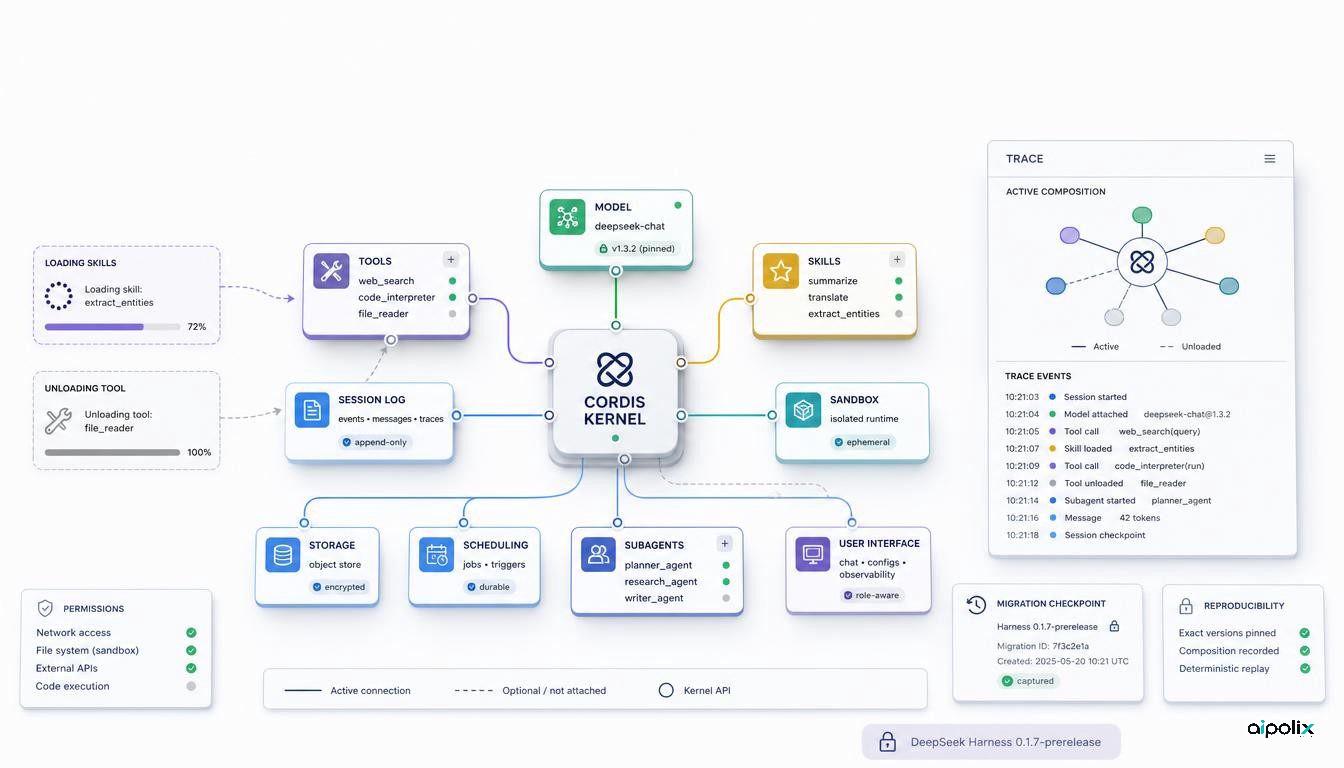
DeepSeek Harness is moving from a conventional agent application toward a composable runtime in which models, tools, skills, sessions, sandboxes, storage, loops, scheduling and the user interface are all plugins. The project remains in developer preview, but the 0.1.7 alpha line makes that architecture more operational by resolving plugin dependencies at runtime, supporting runtime unloading and shifting Creator mode toward persistent plugins managed by the Plugin Manager.
That matters because an agent harness increasingly behaves like an operating environment rather than a fixed chat application. If capabilities can be installed, removed or recomposed while the system is running, developers gain flexibility, but compatibility, provenance and lifecycle management become part of the control plane.
Everything is a plugin is now more than a design slogan
DeepSeek describes Harness as a Cordis-based runtime where every major agent capability is supplied by plugins. Standard mode includes the full coding-agent toolset. Code mode exposes tools through a TypeScript-oriented SDK so a model can combine multi-step operations. Minimal mode keeps the environment intentionally small for benchmarking. Creator mode is designed for inspecting the runtime and building new compositions.
The 0.1.7 alpha releases move this model further into day-to-day use. Release notes say plugin dependencies now use runtime resolution and the Plugin Manager supports unloading at runtime. Creator mode no longer relies on the previous dynamic-definition execution tools and instead uses Plugin Manager to install persistent plugins. The CLI can also launch a named profile directly.
These changes make the harness easier to treat as a configurable platform rather than a single bundled agent.
Runtime composition changes the failure model
A static agent package has a relatively simple startup contract: its dependencies either load or the application fails. A runtime-composable harness has more states. A plugin can be present but inactive, loaded later, unloaded while other services remain active or depend on another plugin whose version changed.
Aipolix's analysis is that teams extending DeepSeek Harness should treat the plugin graph as production state. They should record which plugins and versions were active for a run, validate dependency changes before rollout and make plugin load/unload events visible in logs. Otherwise two sessions with the same model and prompt can behave differently because the harness composition changed underneath them.
This is especially relevant for reproducibility. DeepSeek says every run is recorded in an append-only session log and its Trajectory view can inspect model-visible information, tool results, subagent scheduling and context injection by source. That traceability is useful only if the runtime configuration that produced the trace is also recoverable.
Session and subagent changes show the cost of a moving platform
The same release family includes changes to session formats, subagent behavior and plugin APIs. The project documents migration to newer session formats and notes that some plugin-facing APIs have changed. Continuable subagent chains also receive default limits on live children and delegation depth.
These are reasonable changes for a developer preview, but they are a reminder that the extension surface is not stable yet. A plugin ecosystem becomes harder to operate when stored sessions, presets, profile definitions or extension APIs move at different speeds.
For teams experimenting with Harness, version pinning is therefore important. Test upgrades against real session data and custom plugins before moving shared environments. A developer preview can be the right place to explore architecture, but it is not the right place to assume compatibility across alpha releases.
The architecture creates a useful separation of model and harness
The strongest idea in DeepSeek Harness is the explicit separation between model capability and the machinery that lets the model act. Tools, sandboxes, session state, scheduling and orchestration are not baked into a single model-specific implementation.
That can make it easier to compare models under the same harness or swap infrastructure components without rewriting the entire agent. It also creates a clearer place to enforce policy: permissions, storage, networking and tool exposure can be handled by runtime components rather than hidden inside prompts.
The trade-off is that a more powerful harness becomes a larger trusted computing base. A plugin that can affect tools, storage or scheduling can materially change what an agent is allowed to do. Plugin provenance and permission boundaries therefore matter as much as model selection.
0.1.7 is still a pre-release, not a production-stability signal
The GitHub releases mark the 0.1.7 line as pre-release. The latest alpha includes fixes for model discovery, web reconnection and persistent speech-recognition settings, while the earlier alpha introduces broader runtime and plugin changes.
Teams should read that status literally. The project is useful for evaluating a composable agent runtime, building experimental plugins and studying how session traces and orchestration can be separated from the model. It should not be treated as evidence that the APIs or migration behavior are frozen.
What developers should test
A practical evaluation should create a small pinned profile with a known model, tools and storage plugins, then verify that the same task produces comparable traces before and after a controlled plugin change. Test load and unload behavior, restart recovery, session migration and permission boundaries.
DeepSeek Harness 0.1.7 is interesting because it makes the harness itself programmable and composable. The opportunity is faster experimentation with agent architecture. The engineering requirement that follows is equally clear: runtime composition needs the same discipline around versioning, observability and change control that teams already apply to application dependencies.