
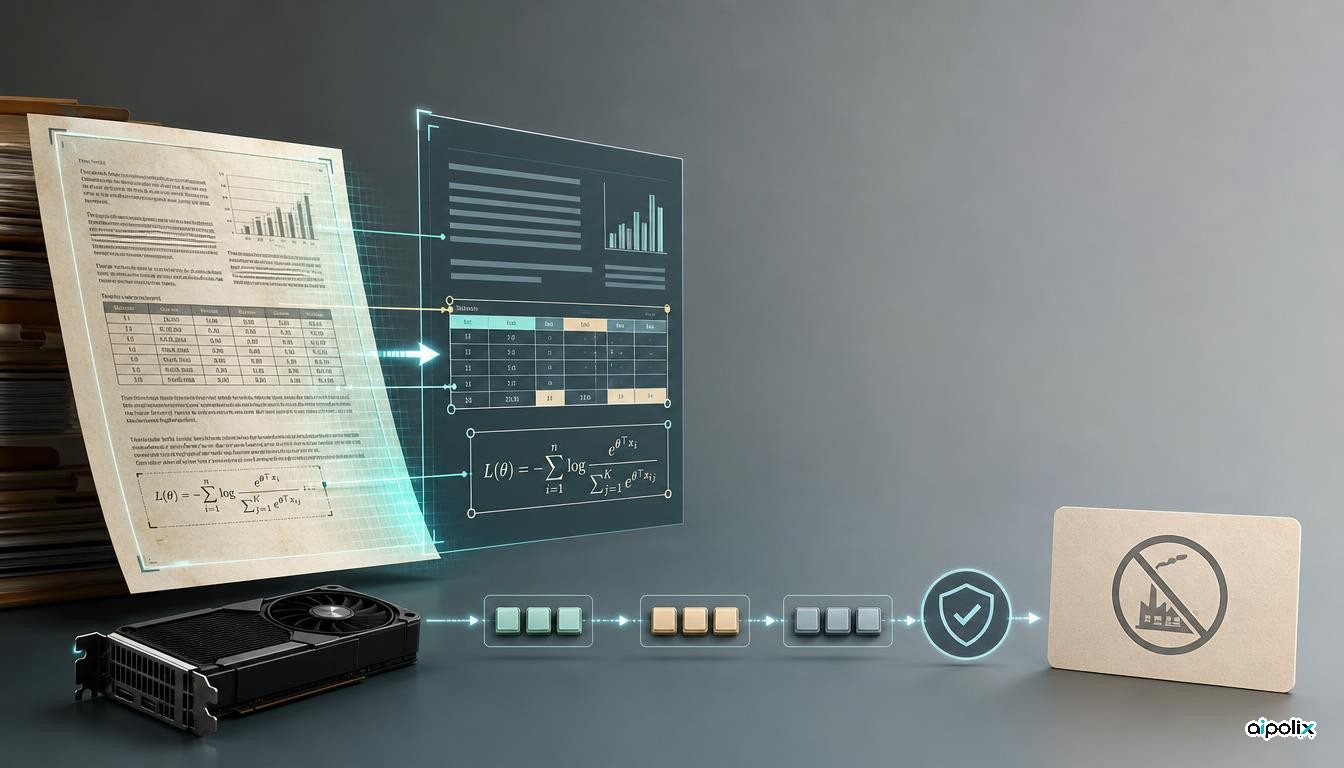
Jina AI has published a September 17 technical introduction to Jina-OCR-v1, a document-reading model whose weights and loading code are available on Hugging Face. It is designed to turn document images into text while retaining reading order and structured elements such as tables and mathematical formulas. For teams processing reports, scanned pages or research papers, the important question is not whether a model can recognize a line of text. It is whether it can recover useful structure at a cost that makes sustained processing practical.
The underlying research was posted to arXiv on September 2, before the new technical introduction. Its measurements are the authors' results, not an independently verified guarantee for a customer's scans. There is also a deployment constraint beyond GPU capacity: the released weights carry a CC BY-NC 4.0 license, with commercial use requiring a separate arrangement. Public access to weights should therefore not be confused with permission to integrate them into a commercial service.
A document parser, not just a text recognizer
According to its model card and research paper, Jina-OCR-v1 builds on DeepSeek-OCR's compressed vision encoder and mixture-of-experts decoder. The encoder represents a global 1,024-by-1,024 view of a page with 256 visual tokens and can add local image tiles when needed. Its decoder has around three billion parameters in total, but activates roughly 570 million for each token. These are architectural specifications, not evidence that every document will fit a particular memory budget or process at the same speed.
The model can produce natural reading-order text, Markdown, HTML tables and LaTeX expressions, depending on instructions. Preserving these distinctions matters downstream: a table flattened into an arbitrary line of numbers is difficult to search or verify, while a formula with damaged notation can change its meaning entirely. Developers should select the requested output format and judge the result at the element level rather than relying on an overall text-recognition score.
Jina publishes model weights and custom loading code. The model card documents a Transformers example, a vLLM route requiring architecture registration and an OpenAI-compatible hosted endpoint. The Transformers example uses trust_remote_code=True, which means the model repository's custom code is part of the execution path. A team handling sensitive documents should review and pin that code, its dependencies and the model revision before running it on confidential input. The published card is documentation of supported paths, not a security certification.
What the speed claims actually measure
The authors describe FastMTP, a speculative decoding mechanism that drafts three token positions using a shared block and checks them against the main decoder. Their verification procedure preserves the same output token sequence as greedy decoding, according to the paper. That is a claim about agreement between two decoding procedures, not a promise that the recognized text is error-free or that every deployment doubles end-to-end throughput.
In the authors' comparisons, the model reaches 2.57 pages per second under the stated benchmark setup and scores 91.14 on OmniDocBench v1.6 and 83.4 on olmOCR-Bench. They report approximately twice the decoding speed of conventional greedy generation with FastMTP on an NVIDIA L4. A page-per-second result and a decoding-only speedup measure different portions of the workload. Image loading, page resolution, tiling, batching, output length and post-processing can all alter the time a customer ultimately pays for.
The paper also reports post-training using verifiable checks for the accuracy and structure of formulas, tables and other output, with partial credit rather than a single pass-or-fail signal. Its training data mixes cleaned public sources and targeted synthetic pages. That design may help a model learn formatting as well as transcription, but the reported scores cannot substitute for an evaluation on a company's own page types, languages, scan quality and error tolerances.
The metric buyers should calculate is usable pages per euro
The most useful comparison for a production pipeline is not generated tokens per second in isolation. A model that produces more tokens for the same page can look fast by that metric while taking longer to deliver a usable structured result. The paper's page-throughput measurements offer a better starting point, but even pages per second misses the cost of correcting broken tables, unreadable scans or misread symbols.
A practical evaluation should take a representative, permission-cleared document set and record three things together: the share of pages that meet a predefined quality threshold, end-to-end processing time including retries, and compute cost. For tables, verify row and column relationships; for mathematics, compare exact expressions; for prose, assess reading order and omission rates. Calculate cost per accepted page, not just cost per attempted page. This is Aipolix's deployment analysis derived from the architecture, benchmark definitions and documented output formats; it is not a vendor-published business result.
The distinction is particularly important for retrieval-augmented applications. A wrong cell association or omitted negation may pass through indexing into an answer that appears properly cited. That consequence follows from how structured extraction feeds retrieval; Jina AI has not published an independent guarantee about downstream retrieval quality. Developers should retain the page image or provenance alongside extracted elements so suspicious answers can be traced back to the original document.
The license changes the deployment decision
The Hugging Face model card labels the weights CC BY-NC 4.0 and explicitly asks interested parties to make contact for commercial use. That is not an unrestricted open-source license. Businesses evaluating a locally hosted OCR pipeline must resolve the licensing route before building a paid product or commercial internal deployment around the weights. The existence of a separately hosted API should not be taken to grant commercial rights to the downloadable weights; API access and self-hosting operate under different terms.
Teams should also distinguish the model's stated support for multiple document styles and languages from verified performance on their own materials. Printed text, handwriting, small footnotes and dense technical tables can have different failure modes. The defensible first step is a trial on actual documents with human-checked references, measured across several formats and run settings.
Jina-OCR-v1 adds a concrete efficiency technique to an existing OCR architecture and provides downloadable artifacts that engineers can inspect. Its published benchmark results make it worth testing, while its decoding claims, real-world extraction quality and commercial permissions must be evaluated separately. A deployment decision should turn on verified document quality, total processing economics, security review of custom code and the correct license, rather than a headline benchmark score alone.