
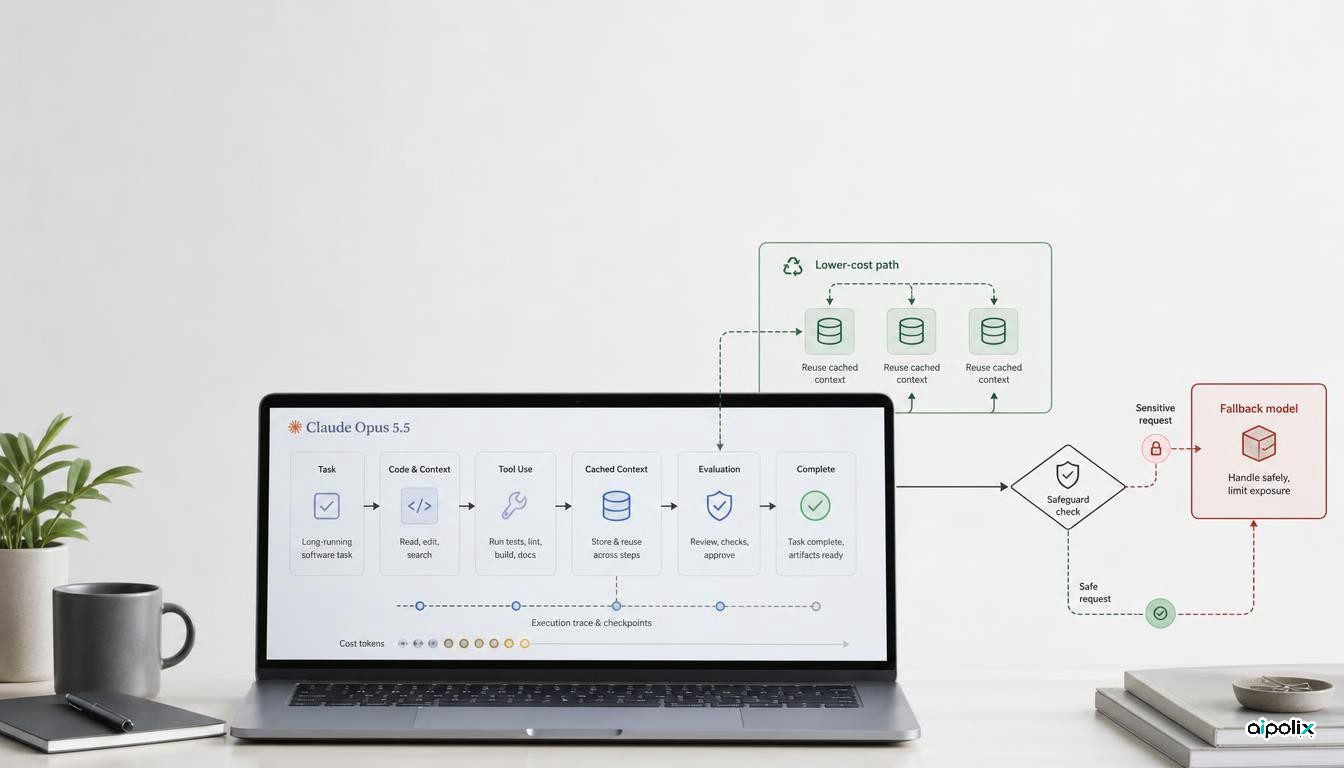
Anthropic released Claude Opus 5.5 on September 22 as the first model in its Claude 5.5 family. The release combines lower token prices with fewer tokens used on typical long-running work, while also introducing an operational detail that matters for agent evaluation: some sensitive requests can be transparently handled by fallback models under Anthropic's safeguards.
Opus 5.5 costs $4 per million input tokens and $20 per million output tokens, with cache reads at $0.20 per million tokens. Anthropic says those token rates are 20% below Opus 5 and that typical token-billed workloads cost about 40% less overall because Opus 5.5 also uses fewer tokens per task. Fast mode is priced at $8 per million input tokens and $40 per million output tokens.
The important metric is cost per completed task
For teams running coding agents, the headline token price is only the first layer of the economics. A model that needs fewer turns, fewer tool calls or less output can reduce the cost of a completed task by more than the nominal token discount. Conversely, a model that retries or produces unusable intermediate work can erase the savings.
Anthropic reports that Opus 5.5 completes typical workloads for about 40% less than Opus 5. It also says the model generates output more than 30% faster. Several launch benchmarks and customer evaluations point in the same direction, but those numbers should be treated as vendor-reported or partner-reported evidence rather than universal performance guarantees.
The practical evaluation method is therefore straightforward: keep tools, permissions, prompts and acceptance criteria fixed, then measure cost per accepted task, wall-clock time, number of tool calls, retries and human review. That gives engineering teams a better answer than comparing token prices or benchmark scores in isolation.
Safeguard routing changes what model identity means
The most interesting systems detail in this release is Anthropic's safeguard routing. Opus 5.5 launches with a class of safeguards similar to Claude Fable 5.1 for cybersecurity, biology and distillation-related risks. Anthropic says most cybersecurity tasks are transparently rerouted to Claude Opus 4.8, while verified programs can provide broader access for approved practitioners.
This means that the model named in an application configuration is not necessarily the model that resolves every request. For ordinary application development that may be invisible. For benchmarking, regulated workflows and production observability, it matters.
Aipolix's analysis is that teams evaluating Opus 5.5 should record not only requested model, latency and token use, but also any available routing or safeguard outcome. Otherwise a benchmark can mix behavior from different execution paths while attributing all results to one model label. The same issue applies to incident analysis: a failure or refusal may be caused by routing policy rather than the underlying model alone.
Preserved thinking can affect API integration behavior
Opus 5.5 also launches with preserved thinking for newer API accounts, an anti-distillation measure Anthropic introduced with Fable 5.1. Anthropic says the safeguard prevents API users from editing Claude's prior reasoning context in ways that could be used to extract model capabilities. It applies to Opus 5.5 and Fable 5.1 for API accounts created on or after August 31, 2026.
For developers, this is not just a safety-policy footnote. Any integration that assumed it could freely rewrite or replay prior hidden reasoning state needs to be tested against the current API behavior. Applications should treat the model's internal reasoning state as controlled by the provider and keep their own durable workflow state in explicit application data, tool results and user-visible messages.
Anthropic also says Opus 5.5 remains available with zero data retention and includes watermarking measures intended to support EU AI Act compliance.
Lower prices make long-running agents easier to justify
The combination of lower input/output pricing, much cheaper cache reads and fewer reported tokens per task is especially relevant to long-running agents. Cached context can be a large share of repeated coding and research workflows. Dropping cache-read pricing from Opus 5's $0.50 to $0.20 per million tokens changes the cost profile of sessions that repeatedly reuse large working contexts.
That does not eliminate orchestration costs. Long-running agents still need permission boundaries, tool controls, checkpointing, evaluation and failure recovery. But the economic threshold for using a top-tier model on a difficult multi-hour task becomes lower.
Teams should therefore separate two questions: whether Opus 5.5 is capable enough for a workload, and whether its full workflow cost is better than alternatives. The second question requires production-like measurements, not launch benchmarks alone.
What to test before switching production traffic
A controlled rollout should compare Opus 5.5 with the model currently in production on representative tasks. Track accepted-task rate, tool calls, output tokens, cache usage, elapsed time, fallback or safeguard interventions, and reviewer effort.
The release is meaningful because it changes both price and execution behavior. Lower cost per token is easy to see; lower cost per reliable outcome must still be demonstrated in each application. Safeguard routing adds another reason to measure the full execution path rather than treating a model name as the entire system.