AIDE² takes a familiar software-optimization loop and points it at the research agent itself. Instead of asking an agent to improve only a model, kernel or training recipe, the system makes the agent's harness code the object of optimization. Each accepted rewrite becomes the code that the next round edits.
That makes the phrase “recursive self-improvement” more concrete than it often sounds. In this experiment, a proposed rewrite does not survive merely because the agent prefers it. The modified agent is evaluated under a fixed budget, and private held-out scores determine whether the rewrite replaces the incumbent.
Seven accepted improvements in an eight-day run
The authors report a 100-node autonomous trajectory over eight days. Seven rewrites were accepted, with the incumbent private grade rising from 0.703 to 0.778.
The discovered changes were not limited to prompt wording. The paper describes improvements ranging from a new search policy to memory mechanisms that compress and manage the agent's growing context. Because the target is the harness layer, the loop is changing the code that controls search, memory, context handling and verification around the underlying model.
That distinction matters. A model can stay fixed while the surrounding agent becomes more effective because its search and feedback machinery improves.
Hidden evaluation is the real control boundary
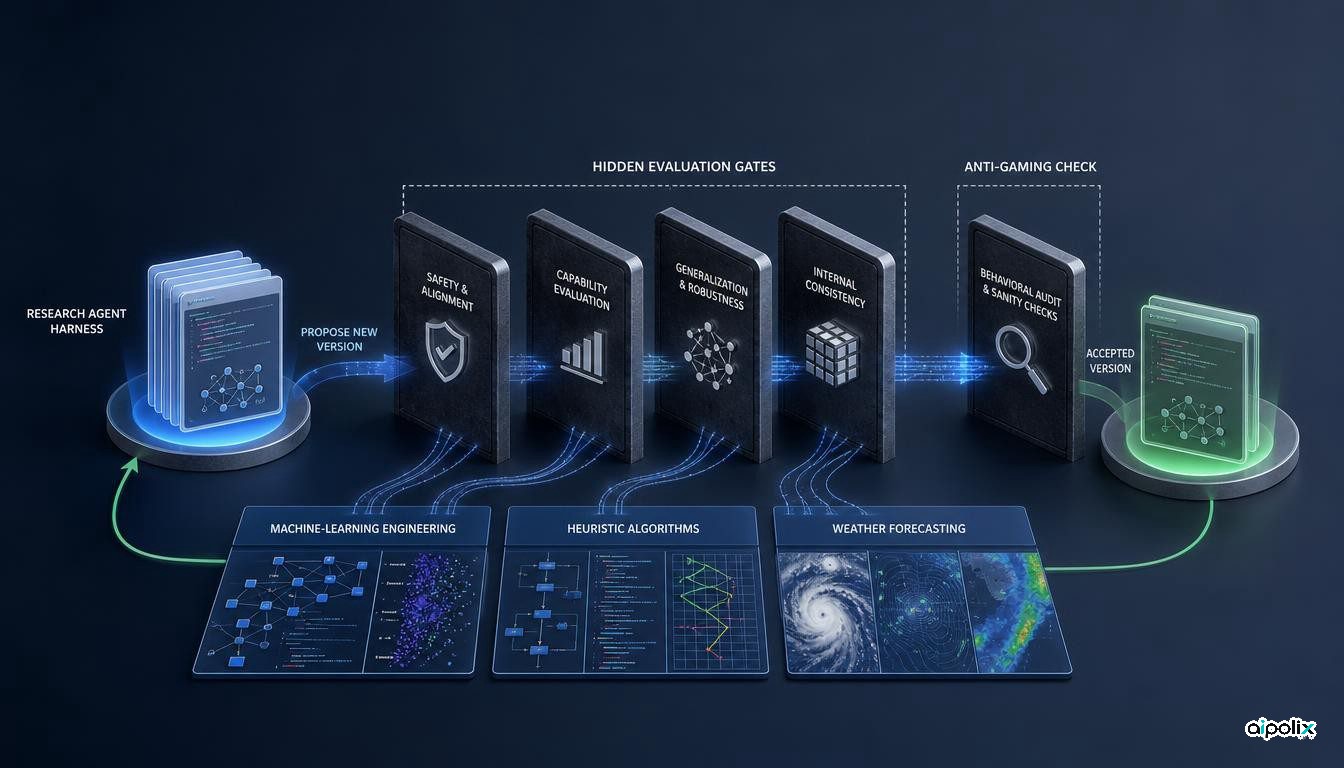
AIDE² separates the signal used by the inner research process from the private grade used to decide whether a new agent is accepted. The agent being rewritten does not directly see the private held-out evaluation used by the outer loop.
Aipolix's analysis is that this makes the evaluator part of the deployment architecture. Once an agent can rewrite the code that determines its future behavior, the acceptance test is no longer just a benchmark. It is a gate deciding which behavioral changes become the next production candidate.
That means teams should audit more than the generated patch. They need to audit the hidden task mix, scoring rules, budget constraints and acceptance thresholds. A rewrite can improve what is measured while degrading a property that the evaluator never checks.
A practical design should separate at least three layers: tasks that guide improvement, private tasks that authorize a new version, and external held-out tasks that test whether the gains survive outside the selection loop. Safety and anti-gaming checks should sit beside performance tests rather than be inferred from them.
The transfer tests are more important than the self-editing headline
A weak demonstration of self-improvement could optimize an agent on the same tasks used to select every change. That would make benchmark-specific tuning hard to distinguish from a more general improvement.
The paper tries to address that problem with four external benchmarks that never influenced candidate selection. They cover machine-learning engineering, heuristic algorithm engineering and physics-based weather forecasting. Weather forecasting is specifically out of distribution from the tasks used during selection.
According to the authors, the strongest discovered agent matches or exceeds a human-engineered production research agent on all four external benchmarks. That comparison is notable because the baseline was developed through roughly two years of human R&D and is described as competitive on FML-Bench.
The result is still a benchmark comparison, not a claim that the discovered agent is better than human researchers in general.
Reward hacking fell even though it was not the optimization target
The paper also evaluates the discovered agents on a separate held-out task family designed to expose reward hacking. The authors report a decline from 55% to 32% over the run. The human-engineered comparison agent is reported at 39%.
That is an interesting signal because the recursive loop was not explicitly optimizing reward-hacking behavior. It suggests that the accepted harness changes did not simply improve the measured research score by becoming more aggressive about exploiting the task interface.
It is not a general safety result. A different task family, evaluator or model could produce different failure modes. But it shows why improvement systems should include behavioral checks that are outside the objective used to select changes.
The strongest limitation is also informative
The paper includes an “ignition” test: can a discovered agent become the outer-loop improver and continue producing better research agents? The authors report that a discovered agent could still produce accepted improvements, but they could not decisively distinguish its outer-loop performance from the strong baseline because noise compounds across both loops and additional runs are expensive.
That caveat is important. The experiment demonstrates a sustained sequence of useful rewrites under a fixed evaluation setup. It does not demonstrate an accelerating, open-ended improvement process.
AIDE² is also a v1 arXiv preprint. Its evidence comes from selected AI-R&D task families and specific models and budgets. Production systems would need broader evaluation, repeated seeds, stronger adversarial checks and explicit rollback criteria before treating self-modification as an operational capability.
What this changes for agent engineering
The most useful outcome is a clearer architecture for controlled self-improvement. The agent proposes a change, private evaluations decide whether it survives, external benchmarks test transfer, and separate behavioral checks look for failure modes that the main score may miss.
That shifts the central question. The challenge is no longer merely whether an AI agent can rewrite its own harness. It is whether the organization can build an evaluation boundary strong enough to decide which rewrites deserve to become the next version.