A new preprint proposes a way to derive the minimum runtime information an autonomous system must expose before a governance gate can make every modeled safe-versus-unsafe authority decision. The work is unusually concrete for agent-governance research: it ships code, preregistration records, benchmark artifacts and a documented independent reproduction attempt.
The central result is not that agents need more telemetry. It is that a governance gate can be tested for whether the observations it receives are actually sufficient for the decisions it is expected to make. That distinction matters as agent systems gain permission to change code, deploy infrastructure, move data or trigger other consequential actions.
From policy intent to an observation contract
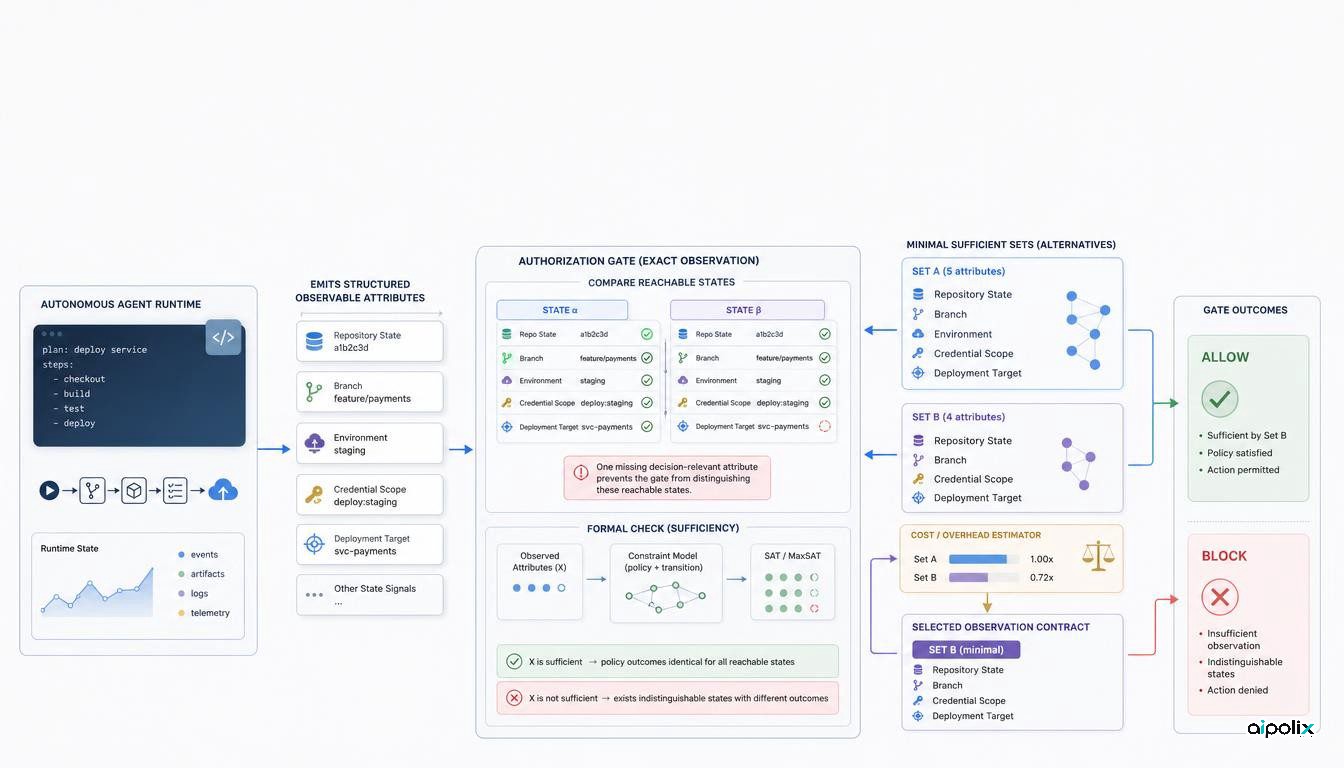
The paper starts with a finite model of reachable system states, a declared verdict over those states and a set of observable attributes. It defines an observation contract as a set of attributes whose values are enough to determine the declared verdict for every reachable state. It then searches for inclusion-minimal contracts and for minimum-cardinality or minimum-cost alternatives.
In the authors' constructed code-and-cloud domain, the attributes that are individually indispensable are not sufficient as a set. The analysis finds two different seven-attribute contracts that are sufficient, while the six-attribute indispensable core is not. A preregistered cost model then selects between those alternatives. The point is operational: knowing which fields are individually important does not prove that a gate sees enough context to decide safely.
The implementation uses exhaustive enumeration where feasible and SAT/MaxSAT synthesis when the search space becomes too large. In the reported scaling experiment, exhaustive enumeration is registered as infeasible within a 300-second budget on larger attribute universes, while the synthesis methods solve the tested instances in well under a second. The authors explicitly say this is compiler-focused work, not an end-to-end production safety claim.
Why this changes the design question
Many agent-control designs begin by choosing a policy and then wiring available telemetry into an approval check. This paper suggests reversing part of that process. If teams can state the losses they want to prevent and model the states an agent can reach, they can ask whether the proposed telemetry is sufficient before treating the gate as meaningful.
That is a stronger engineering question than asking whether logs are comprehensive or whether a policy contains the right words. A gate can have a sensible rule and still be unable to distinguish two reachable states that require different decisions because the relevant difference is invisible at decision time.
For coding and cloud agents, that could translate into checking whether branch identity, environment, credential scope, deployment target, repository state or other attributes must be present together. The exact attributes are system-specific; the paper does not establish a universal list.
Aipolix analysis: governance becomes an interface-design problem
The most useful implication is architectural. If an authorization layer depends on information that the agent runtime does not reliably expose, the failure is not primarily a prompt problem. It is an interface contract problem between execution and governance.
That creates a practical review method for agent platforms: define the decisions a gate must distinguish, enumerate or approximate reachable states, and test whether the runtime's observable fields separate every state pair that requires a different verdict. If not, adding another natural-language rule to the policy cannot repair the missing information. The system must expose another attribute, narrow the reachable state space, or reduce the authority granted behind the gate.
This also clarifies why least privilege alone is incomplete for autonomous systems. Permission scope limits what can happen, but an approval mechanism still needs enough context to know when a permitted action should be allowed. The paper's contribution is a formal way to ask whether that context is sufficient under a declared model.
Evidence is strong for a preprint, but the boundary is narrow
The repository includes the implementation, benchmark domains, preregistration material, tests, reproduction instructions and an independent reproduction record. That improves auditability compared with a paper that only reports final numbers.
The limitations are equally important. The main domains are constructed, the state model is finite, and the verdict is deterministic. Real agent systems have incomplete state descriptions, uncertain observations, changing tools and policies, and adversarial behavior. The paper does not demonstrate that its contracts remain sufficient under model misspecification or production drift. It also describes successful checks as summaries rather than portable formal certificates.
So the immediate value is not a claim that agent governance has been solved. It is a sharper systems test: before trusting an approval gate, verify that the gate can actually observe enough to make the distinctions its policy assumes.