Google has released Gemini 3.8 Live and Gemini 3.8 Live Extended Thinking, two real-time audio models built on Gemini 3 Pro. The important engineering change is not simply better voice output. Extended Thinking lets a live voice agent continue a conversation while it performs background reasoning and asynchronous tool calls, changing how client applications decide when a user interaction is actually finished.
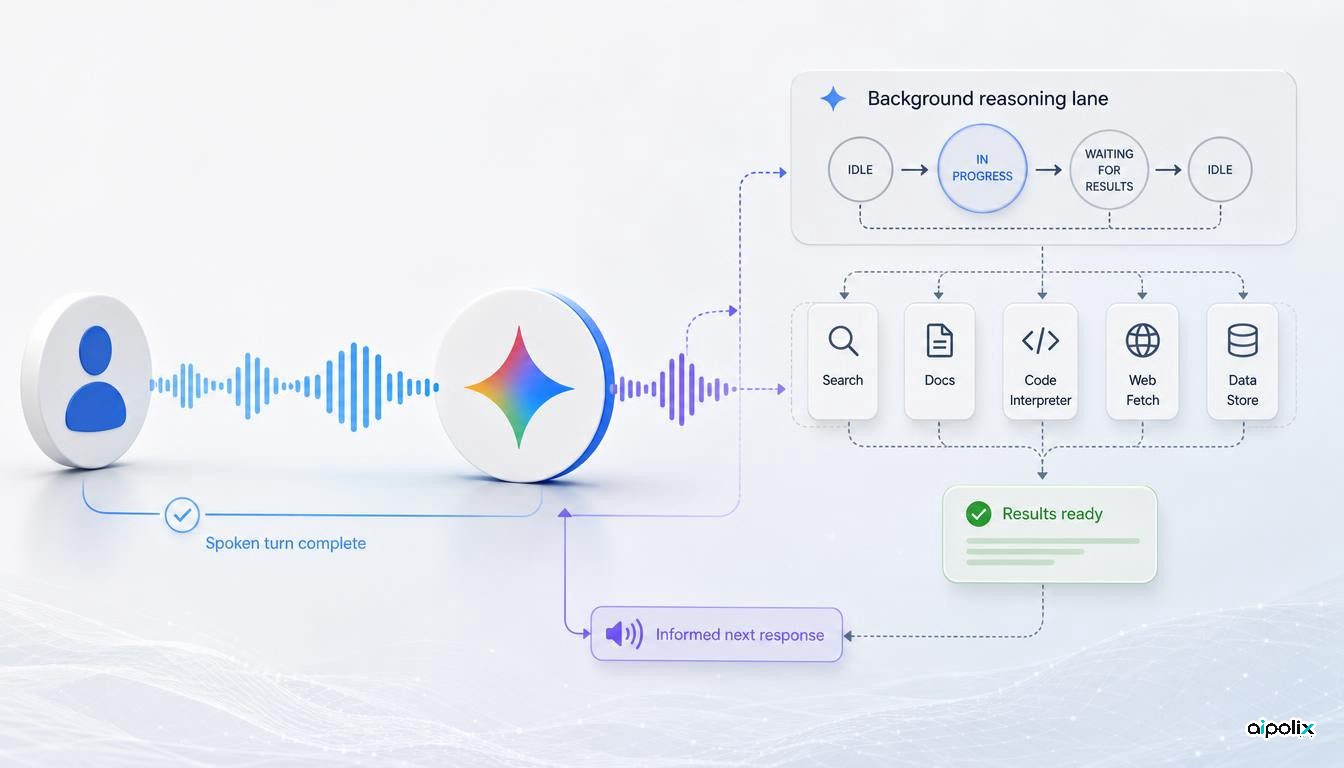
Google's developer documentation makes that lifecycle explicit. With the standard Gemini 3.8 Live model, turnComplete: true still means the spoken turn is over and the session can return to idle. With Extended Thinking, the same signal can arrive while reasoning or tools are still running. Clients instead need to follow interaction_status, treating IN_PROGRESS as active work and IDLE as the point at which the full interaction has completed.
Voice agents no longer have to equate silence with work
Traditional real-time assistants face a trade-off when a request needs several seconds of planning or external API work. They can pause while the tool runs, or answer quickly without doing the deeper work. Gemini 3.8 Live Extended Thinking introduces a third pattern: the model can stream conversational updates while background reasoning and tool execution continue.
Google describes these intermediate responses as conversational fillers. A travel assistant, for example, can acknowledge that it is checking options while flight or hotel functions execute asynchronously. The architectural consequence is that speech becomes one stream inside a longer interaction rather than the sole marker of task completion.
That distinction matters for product teams. A microphone indicator, listening state, cancel button or follow-up input can no longer be driven only by whether the model just finished speaking. The application needs an explicit interaction state machine.
Extended Thinking changes the client protocol
The new model requires asynchronous function declarations with behavior: NON_BLOCKING. Blocking function calls are not supported and return an error. Developers can configure reasoning depth with thinking_level values of low, medium or high.
This means migration is more than changing a model name. Clients adopting Extended Thinking need to keep listening after turnComplete, process later audio or tool-call messages, execute non-blocking functions, return their results and wait until interaction_status becomes IDLE.
Gemini 3.8 Live keeps the simpler lifecycle and supports both blocking and non-blocking tools. Google positions it for direct, latency-sensitive conversation, while Extended Thinking is intended for multi-step diagnostics, coordinated retrieval, tutoring and other tasks where planning or tools take longer.
The real boundary is interaction state, not model intelligence
The most useful way to read this release is as a protocol change for agentic voice applications. Background reasoning is valuable, but the operational shift is that an utterance and an interaction are now different objects.
That creates concrete design obligations. Applications need to decide whether users can interrupt background work, how a new utterance affects an active task, what happens when a tool times out, and which UI state is shown after an intermediate spoken update. Observability also needs to separate audio turns from the longer reasoning-and-tool lifecycle.
This is an Aipolix analysis derived from Google's documented protocol. It does not imply that the model is autonomous or that background reasoning guarantees correct results. It means developers now have a first-party state signal for work that can outlive a spoken turn.
Multimodal input and a 128K context window
Google DeepMind's model card says both Gemini 3.8 Live variants accept audio, images, video and text and can return audio and text. The models are based on Gemini 3 Pro, with an input context window of up to 128K tokens and output up to 64K tokens.
The model card also preserves familiar foundation-model limitations. Google says the models can hallucinate and may occasionally be slow or time out. Extended Thinking therefore should not be treated as a reliability guarantee. Longer-lived interactions can actually make failure handling more important because more reasoning and external operations may happen before the session reaches idle.
What developers should test before switching
Teams evaluating Extended Thinking should test the whole interaction lifecycle rather than only voice quality. A useful test matrix includes tool latency, interruption during IN_PROGRESS, repeated turnComplete events, tool failure, cancellation, user follow-ups before IDLE, and whether the UI accurately represents ongoing work.
The release also suggests a clean model-selection rule. Use Gemini 3.8 Live when immediate turn-taking is the priority and work is simple or tools are fast. Use Extended Thinking when a request benefits from multi-step reasoning or slower asynchronous tools and the application is prepared to manage a longer stateful interaction.
The significance is therefore less about adding "thinking" to speech than about making background work a first-class part of the Live API contract. For voice-agent developers, that changes the client architecture they need to build around the model.