
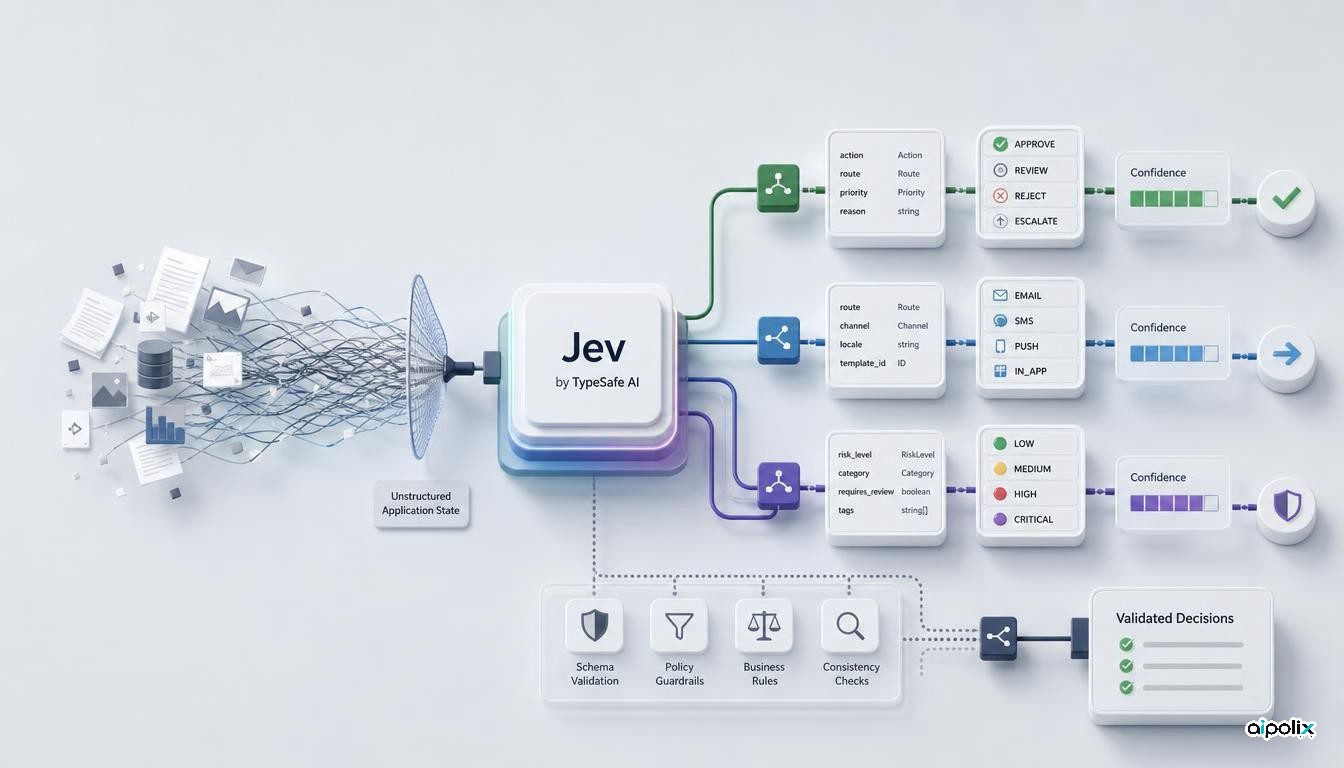
TypeSafe AI has introduced Jev, the first public model in a class it calls “System One Models,” aimed at fast structured decisions inside software rather than open-ended text generation. Jev is in early access. The company says it returns typed probabilistic outputs in parallel, with response times of roughly 70 to 500 milliseconds and pricing of $0.042 per million input tokens, while output decisions are described as too cheap to meter.
The important change is not another chatbot benchmark. TypeSafe is proposing a narrower interface for machine intelligence: software defines the possible output structure in advance, the model consumes unstructured state, and the result is a typed decision with probabilities and confidence. That trades the flexibility of free-form generation for a boundary that ordinary programs can validate and compose.
A model designed to sit inside code
Jev does not generate arbitrary strings. TypeSafe describes it as a “frontier-intelligence function call”: unstructured state goes in and typed probabilistic decisions come out. The company says all outputs are produced in parallel rather than token by token.
That design targets classification, routing, scoring, extraction and branching workloads where an application needs a bounded answer rather than prose. A conventional LLM can also be constrained to JSON or a schema, but it still generates tokens sequentially and the application normally has to validate the result. Jev makes the output domain part of the model interface itself.
TypeSafe says Jev supports choices with cardinality up to 255. For higher-cardinality examples in its Wikiracing demo, the company uses a two-stage process that first scores options independently and then makes an explicit choice. That detail matters because it shows the model is specialized, not a drop-in replacement for every generative task.
The speed and cost claims need careful reading
TypeSafe reports end-to-end latency of 70 to 500 milliseconds and says Jev can be 40 to 200 times faster than frontier LLMs on what it defines as System One-shaped queries. Its workflow evaluations produce even larger headline figures, including 193.6 times faster and 444.6 times cheaper in one comparison.
Those numbers are vendor measurements, not independent benchmarks. TypeSafe itself discloses several limitations. Its workflow evaluations use the average predictions of large external models as reference probabilities rather than an independently established ground truth. The workflows were produced by members of its model-capabilities team, which the company acknowledges may introduce bias. It also says the largest published gains are likely toward the high end of real-world improvements.
The company prices Jev input at $0.042 per million tokens and says output decisions are free because their cost is too small to meter. It explicitly notes that public pricing cannot prove the service is not subsidized, so long-term economics remain unverified.
“No hallucination” is really a narrower guarantee
TypeSafe says Jev “can’t hallucinate,” but the useful engineering interpretation is more specific. Because Jev can only return values allowed by a predefined type, it cannot invent an out-of-schema field or arbitrary textual tool call. That is a strong structural guarantee.
It is not the same as guaranteeing that every permitted decision is correct. A classifier can return a perfectly valid enum value and still choose the wrong class. TypeSafe addresses this distinction by emphasizing calibrated probabilities and confidence, but the accuracy and calibration claims still depend on its evaluations and need broader independent testing.
For developers, the distinction is important: type safety can eliminate one failure class while leaving semantic error intact. Systems using Jev would still need thresholds, fallbacks, monitoring and domain-specific acceptance criteria where wrong decisions carry cost.
Why this architecture could matter for agents
The most interesting implication is architectural. Many agent systems use a large generative model for every step, including small decisions such as whether to route a request, approve a candidate action, classify state or select among known tools. That makes latency and token cost accumulate across long workflows.
A specialized decision model creates another option. Generative models can remain responsible for tasks that genuinely require synthesis or open-ended reasoning, while a bounded model handles frequent low-latency decisions. If Jev’s calibration and economics hold up outside TypeSafe’s own evaluations, this could make mixed-model agent architectures more practical.
It also changes the control boundary. A program that defines the allowed output space before inference can enforce some constraints structurally rather than asking a model to obey them in natural language. That does not make an autonomous system safe by itself, but it can reduce the amount of authority delegated to unconstrained generation.
Early access leaves the biggest questions open
Jev is available in early access, so production evidence is still limited. TypeSafe has published workflow evaluations and demonstrations, including Doom and Wikiracing, but there is not yet broad independent evidence for reliability, calibration, sustained pricing or behavior across unfamiliar domains.
The release is therefore best read as a concrete architecture proposal rather than proof that general-purpose LLMs are obsolete. Jev deliberately gives up text generation to optimize a narrower job. The key question is whether that narrower job occurs often enough in real software, and whether the model remains accurate and calibrated when developers bring workloads that were not designed by TypeSafe.
For AI engineers, that is testable. The relevant comparison is not “Jev versus an LLM” in the abstract. It is whether a bounded decision layer can replace expensive generative calls in specific workflow nodes without increasing semantic error or operational complexity.