DeepSeek has officially released DeepSeek V4.1 Flash, moving the company’s Flash line onto a new architecture and making native visual understanding part of the production API rather than a separate experimental path. DeepSeek describes V4.1 Flash as the smallest member of a new architecture family designed for higher capability, faster inference and higher throughput. Reuters independently confirmed the launch on September 10.
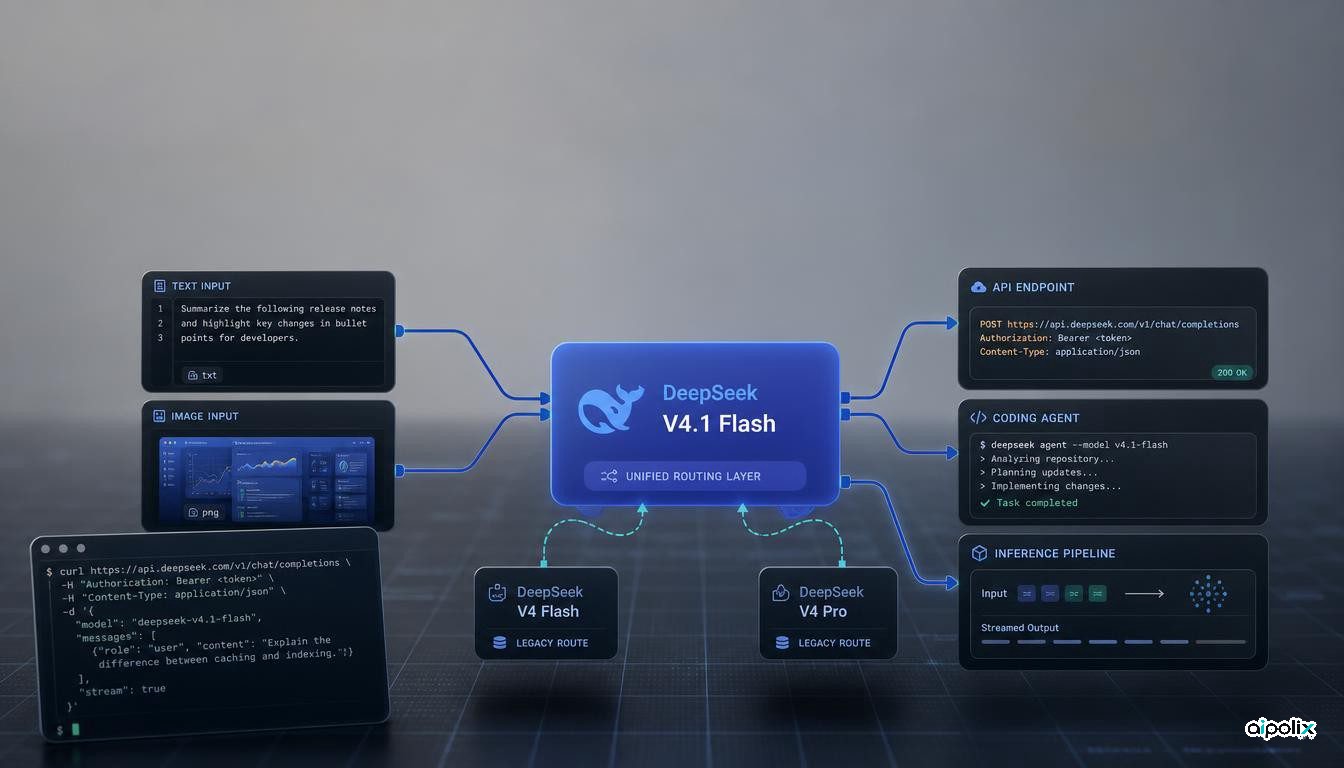
The release matters for developers for reasons beyond benchmark positioning. DeepSeek is changing the operational surface around the model at the same time: the API now exposes V4.1 Flash through deepseek-flash, older V4 Flash and V4 Flash Vision Exp names are being routed to the new model for compatibility, and DeepSeek says V4 Pro requests will temporarily be routed to V4.1 Flash after September 14 until V4.1 Pro arrives. That turns V4.1 Flash from a model option into a migration event.
A new architecture, not just another checkpoint
DeepSeek says V4.1 Flash belongs to a new architecture family rather than being only a post-training refresh of V4 Flash. The company also says the model has native multimodal visual understanding and has published model weights and a technical report alongside the release.
Those are important distinctions because the previous V4 Flash Vision Exp was explicitly experimental and could be treated as a separate modality-specific branch. V4.1 Flash collapses that separation: multimodal capability now sits inside the model DeepSeek is presenting as its primary Flash endpoint.
DeepSeek has published a broad benchmark table covering reasoning, coding, terminal tasks, security and agent-oriented evaluations. Those numbers are vendor-reported results, not independently reproduced measurements, so they should be read as release evidence rather than proof of general superiority. The stronger established fact is the product change itself: V4.1 Flash is now the released model, its weights are available, and the API routing is changing around it.
The API migration is the bigger developer change
The most consequential part of the release may be compatibility behavior. DeepSeek says developers can call the newest V4.1 Flash model using deepseek-flash. It also says requests using the older deepseek-v4-flash and deepseek-v4-flash-vision-exp names will temporarily route to V4.1 Flash.
That reduces immediate migration work, but it also means a model identifier can stop being a reliable description of the exact model serving a request. Teams that care about reproducible evaluations, regression testing or auditability should not assume that retaining an old model name preserves old behavior.
The same issue becomes more visible with V4 Pro. DeepSeek says that after 12:00 Beijing time on September 14, requests to deepseek-v4-pro will be routed to V4.1 Flash until V4.1 Pro is released, with V4.1 Flash pricing applied. For applications using the Pro name as a quality tier or an evaluation baseline, that is a semantic change even if the API request itself continues to succeed.
Compatibility can hide model drift
This is where the release has a broader engineering implication. Compatibility aliases are useful for avoiding outages, but they can weaken provenance when the model behind an identifier changes without the client changing configuration.
Aipolix’s view is that teams using DeepSeek in production should separate “endpoint compatibility” from “model identity.” Logs and evaluation records should capture the resolved model version where the provider exposes it, alongside the requested model name. If the provider does not expose a sufficiently precise resolved identifier, teams should timestamp evaluations and maintain a provider-routing note so later regressions are not incorrectly attributed to application changes.
This is especially important for agents and coding workflows. A model swap can change tool selection, latency, token use, visual understanding and failure patterns while the surrounding application remains unchanged. A compatibility route therefore deserves the same change-management treatment as an explicit model upgrade.
Pricing and performance claims need separate treatment
DeepSeek says V4.1 Flash has lower pricing and that its internal and external testing shows it outperforming V4 Pro across performance, cost, speed and total task time. Those are useful claims for deciding what to test, but they are not a substitute for workload-specific evaluation.
The release creates a straightforward benchmark plan for engineering teams: rerun representative prompts and agent trajectories against V4.1 Flash, compare output quality and tool behavior, measure latency and token usage, and record any regressions before the Pro routing change takes effect. The fact that DeepSeek itself is preparing to route Pro traffic to Flash makes this more than an optional curiosity for existing DeepSeek API users.
Open weights broaden the verification path
DeepSeek has also published V4.1 Flash weights on Hugging Face together with a technical report. That gives researchers and infrastructure teams a path to inspect the model outside the hosted API and, where hardware resources permit, test serving behavior independently.
Open weights do not make the hosted API and self-hosted deployments identical. Serving kernels, quantization, routing, prompt wrappers and runtime settings can all affect observed behavior. But the release does make it easier to distinguish architecture-level properties from provider-specific serving behavior.
For Aipolix readers, the practical takeaway is simple: V4.1 Flash is not merely a faster Flash checkpoint. It changes the model family, brings multimodality into the primary endpoint, alters compatibility routing, and temporarily changes what a request to V4 Pro will mean. Teams using DeepSeek should treat September’s rollout as a version migration and update their evaluation and provenance controls accordingly.