SpaceXAI has opened Grok Bot Galaxy, a three-day event in San Francisco and online that puts its persistent-agent product in front of role-specific workflows rather than limiting the launch story to another chatbot demo. The event runs September 15–17 at The Howard, with livestream access and sessions for engineering, product management, founders, sales, support, marketing operations and post-sales teams.
That format matters because Grok Bot is being sold around a stronger promise than conversational assistance. SpaceXAI describes Bots as persistent agents with their own identity, memory, runtime and tools. Each Bot gets its own cloud computer, can work across apps and websites, and can continue work without the user keeping a chat session open. Galaxy is therefore best read as a public demonstration of whether that product model can survive contact with ordinary organizational work.
Galaxy is organized around jobs, not prompts
The official Galaxy schedule starts with Grok Bot 101 and then moves through department-specific sessions. On September 15, the program includes engineering, product managers and founders. September 16 shifts to sales engineering, sales, SDRs and customer support. September 17 covers marketing operations, post-sales and marketing before a final livestream showcase.
SpaceXAI's event page repeatedly frames the exercise as giving Grok Bot "real work." It says participants will create Bots, teach them a style and goal, and run workflows across the apps, tools and websites they already use. That is more consequential than showing whether a model can answer a difficult question. The relevant test is whether a persistent agent can maintain responsibility across tools, delays, approvals and handoffs.
Independent coverage has also described a parallel challenge in which three SpaceXAI staff members attempt to build a startup over the three-day period using Grok Bot. That should be treated as a demonstration rather than a benchmark: a livestream can reveal workflow strengths and failure modes, but it does not by itself establish comparative productivity or reliability.
The product is designed to keep working after the conversation ends
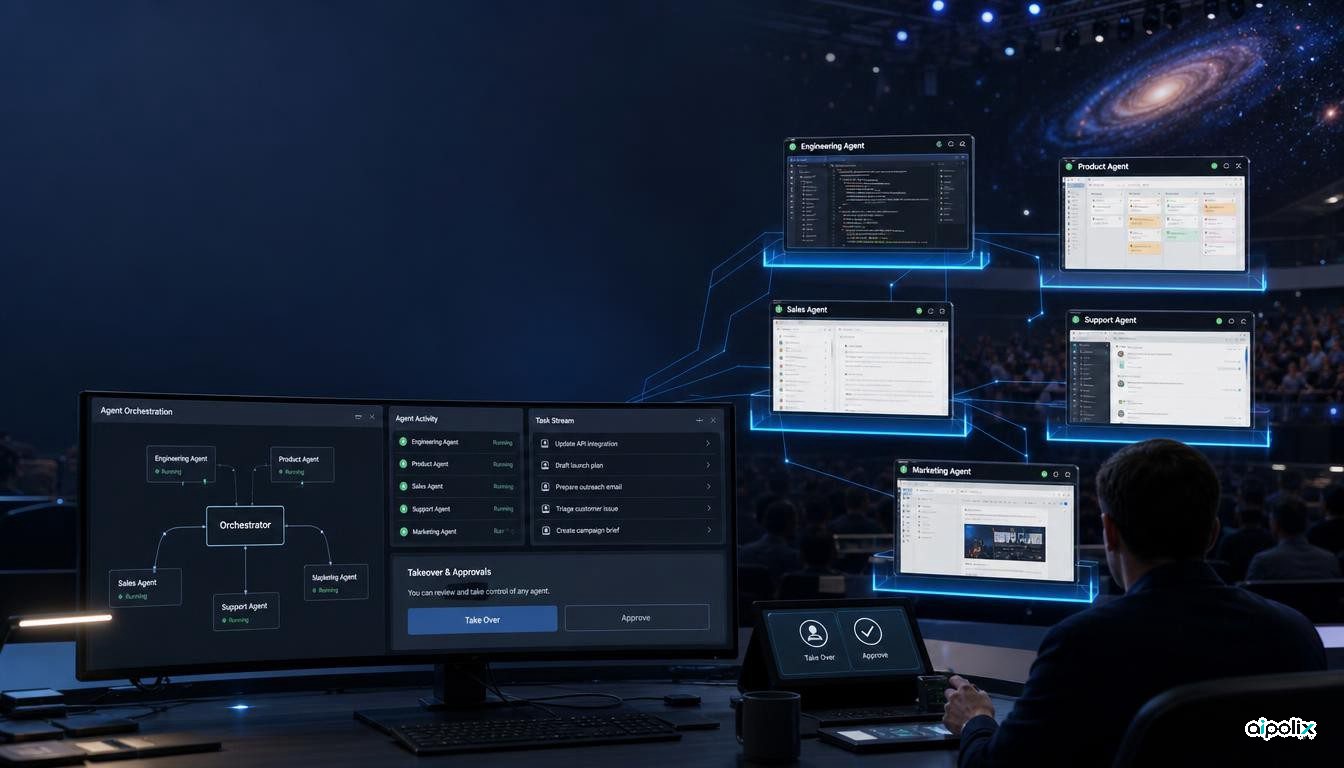
SpaceXAI launched Grok Bot in beta in August as a set of always-on agents. The company says Bots have their own computers, can sign into existing tools, work across inboxes and applications, and return to the user when an approval is required. It also describes multiple Bots working in parallel and messaging one another, with a coordinating Bot able to sit above specialists.
A September design note makes the architecture clearer. SpaceXAI says a Bot persists beyond a single chat and retains an identity, memory, runtime and tools. Prompts can become reusable Skills or Routines, while tools can reach software, APIs, connectors, shells or computer-use interfaces. Routines can activate work on a schedule or in response to an event, meaning a task can begin without a new human prompt.
The same design note also exposes an important control boundary. Users can see status, preview a Bot's computer and take over when intervention is needed. That separation between delegated execution and human takeover is central to whether persistent agents can be trusted with business systems.
The interesting question is coordination, not raw model intelligence
Galaxy's department-by-department structure creates a useful lens for evaluating Grok Bot. If a sales Bot, engineering Bot and operations Bot each work well in isolation, an organization still needs to know what happens when their responsibilities overlap. Persistent agents introduce questions about who owns context, which credentials each role receives, when one Bot may delegate to another, and which actions require explicit approval.
This is where Grok Bot's product design differs from a single-session assistant. A persistent Bot accumulates role-specific memory and routines over time. Group chats can provide shared project context while individual Bots retain specialized memory. In theory, that reduces the need for a person to copy context between agents. In practice, it also creates a governance problem: durable memory and standing routines can preserve a useful workflow, but they can also preserve a bad assumption or an outdated permission unless controls evolve with the role.
For engineering leaders, the practical evaluation should therefore focus less on whether a demo completes successfully and more on the execution boundary. Which systems can the Bot reach? Which actions are reversible? Where is approval mandatory? Can a user inspect what happened after the fact? How are credentials scoped when several Bots collaborate? Those questions determine whether persistent agency becomes operational infrastructure or remains a supervised productivity tool.
A live event is evidence of workflow, not proof of production reliability
Galaxy can provide unusually visible evidence because SpaceXAI is showing the product over three days and across multiple departments. But the evidence has limits. SpaceXAI controls the product, the event environment and the demonstrations. Neither the event page nor the product design material provides an independent reliability benchmark for the workflows shown at Galaxy.
That distinction matters. A successful live build can establish that a workflow is possible. It cannot establish how often the same workflow succeeds across different organizations, permission structures or data conditions. Claims about productivity, reliability or cost savings should therefore remain attributed until they are supported by reproducible measurements or independent deployments.
The strongest signal from Galaxy is not that autonomous digital coworkers have been proven. It is that SpaceXAI is moving the product conversation from chat quality toward persistent responsibility: agents with durable roles, their own computers, event-driven routines and explicit moments for human takeover.
Over the next two days, the most valuable developments will be concrete details that narrow those operational questions: new permission controls, audit behavior, limits on cross-Bot delegation, failure recovery, enterprise deployment constraints, or measured results from the live workflows. Those would turn Galaxy from a showcase into a more informative test of how persistent agents behave when they are asked to do actual organizational work.