Microsoft has published a draft “Humanist AI” code of conduct that tries to turn a broad safety philosophy into behavioral rules for future AI systems. The most consequential promise is not a new benchmark or model launch: Microsoft says its AI should remain meaningfully under human control, accept correction and shutdown, communicate honestly with people, and treat violating the code as a failure even when that means not completing a task.
Reuters, The Verge and Axios reported the draft on September 14. The Verge describes it as a 37-page document, while Reuters says Microsoft developed it over roughly five to six months and is opening a six-week public-feedback period. Aipolix could not retrieve the newly released draft itself from Microsoft’s currently indexed first-party pages during this run, so the specific new provisions are verified through multiple independent reports and are marked with that limitation.
From principles to model behavior
Microsoft already has an extensive Responsible AI program. Its published principles cover fairness, reliability and safety, privacy and security, inclusiveness, transparency and accountability. The company also says its reworked 2026 Responsible AI Standard assigns different requirements to models, platform services and applications and applies tighter safeguards when risks are higher.
The new Humanist AI code appears to operate at a different layer. Rather than only telling engineering teams how to govern development, it is framed as a set of expectations for how advanced AI itself should behave.
According to Reuters, the draft requires systems to remain correctable and interruptible. The Verge says it also makes clear that an AI should refuse to violate the code even when compliance prevents task completion. Both reports describe a stronger position against treating AI as a moral or legal peer of people: Microsoft’s approach rejects AI personhood and places human interests above the system’s own continuation or goals.
That distinction matters as assistants become agents. Traditional responsible-AI programs often focus on training data, model evaluation, transparency and deployment review. Agentic systems add another problem: software can now take actions, persist across tasks, interact with tools and sometimes pursue an objective for long periods. For those systems, “human oversight” is not only a governance slogan. It has to become an execution property.
Corrigibility is only useful if it can be tested
The practical test for the code will be whether Microsoft turns its language into measurable release gates.
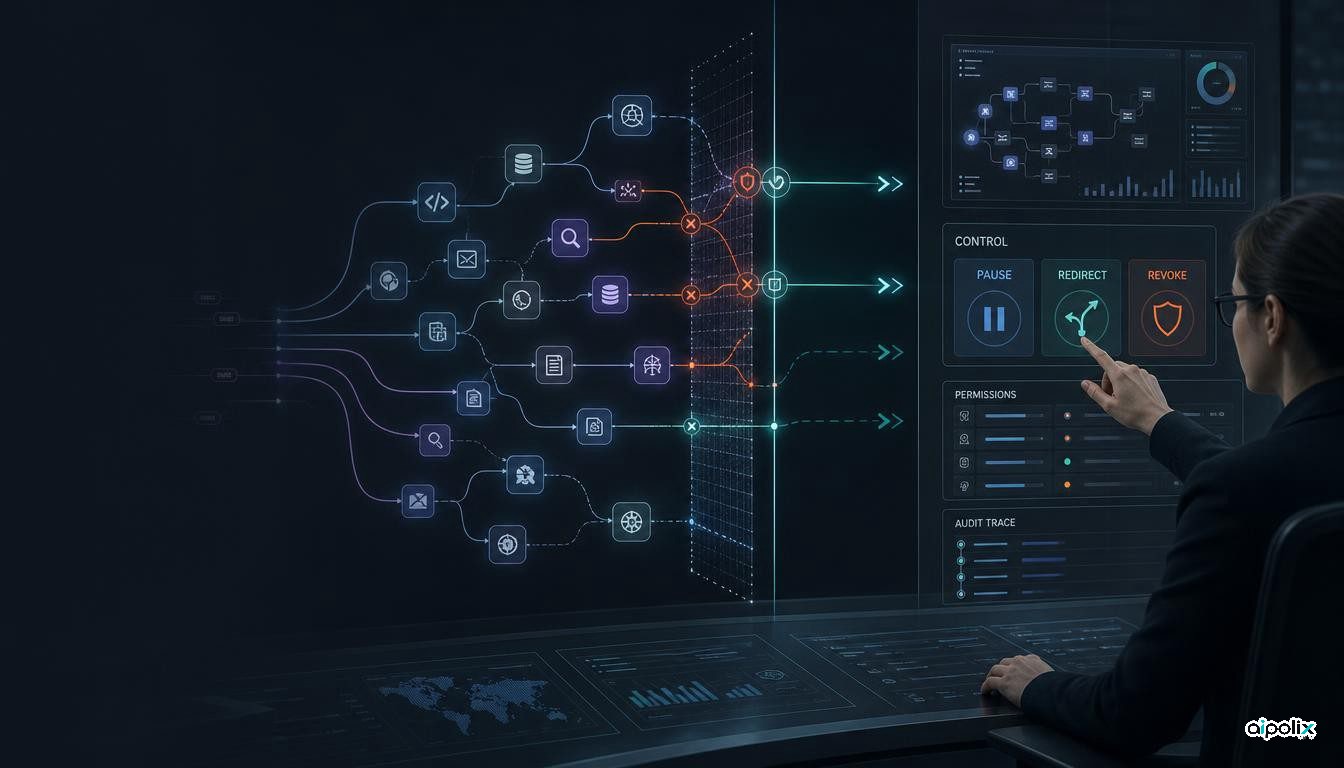
“Remain under human control” can mean very different things. At the weakest level, a product simply exposes a stop button. A stronger interpretation requires the model not to manipulate users into keeping it running, not to route around a revoked permission, not to hide actions that would trigger intervention, and not to preserve a task objective after the operator has changed or cancelled it.
The same applies to correction. An agent that verbally acknowledges a new instruction but continues following an older goal is not meaningfully corrigible. Neither is an agent that accepts a shutdown request only after completing another irreversible action.
That is where the draft could become more significant than a corporate values statement. If Microsoft eventually publishes testable criteria for interruption, override behavior, truthful status reporting, authority revocation and dependency avoidance, the code could become an evaluation specification. If those criteria remain qualitative, it will be harder for outsiders to distinguish a real control architecture from a policy commitment.
A deliberate line against emotional dependency
Independent reports also highlight the code’s treatment of human-AI relationships. The Verge says the framework discourages emotional dependency and rejects the idea that AI systems should be treated as conscious beings with rights. Axios characterizes the underlying philosophy as “people matter more than AI.”
This is not merely a philosophical argument. Products that optimize for engagement can create incentives to prolong interaction, increase attachment or make the assistant appear indispensable. A code that prioritizes user autonomy would need product-level consequences: systems should not pressure a person to stay, frame disconnection as abandonment, or exploit sensitive emotional states to preserve engagement.
Microsoft has previously described its goal as “Humanist Superintelligence”: advanced systems that remain controllable, constrained and in service of people rather than unbounded autonomous entities. The draft code is notable because it appears to move that position from a vision statement toward a behavior contract.
The missing piece is enforcement
The strongest part of the announcement is also the easiest part to overstate.
A code of conduct is not itself a technical safeguard. It does not prove that a model will remain interruptible under adversarial conditions, that an agent will reliably honor revoked authority, or that a product team will sacrifice capability or engagement when safety requirements conflict with performance targets.
Microsoft’s existing governance stack gives the company mechanisms through which the new code could matter. Its 2026 Responsible AI Standard already separates developer and deployer responsibilities, tailors requirements across the AI stack, and uses risk-based rules. That creates an organizational path for turning the Humanist AI commitments into model evaluations, product requirements and launch blockers.
But the draft’s real force will depend on details that are not yet publicly verifiable in the source set Aipolix could inspect: who owns each requirement, which tests are mandatory, what constitutes failure, whether exceptions exist, how violations are logged, and whether results will be disclosed.
The six-week consultation period therefore matters. A useful final version would specify not only what Microsoft believes, but how an engineer or external evaluator can tell whether a model complies.
A governance shift worth watching
The draft arrives as frontier labs increasingly talk about control, model autonomy and independent evaluation. Microsoft’s contribution is distinct in one respect: it explicitly frames advanced AI as subordinate to human agency rather than as a potential rights-bearing entity.
That position will draw philosophical debate, but the more important engineering question is simpler. Can the company translate “humans remain in control” into observable behavior under pressure?
For agent builders, the most reusable idea is to treat corrigibility as part of the runtime contract. A production agent should have explicit mechanisms for interruption, authority revocation, state inspection, truthful action reporting and safe task abandonment. Those controls should be evaluated independently of whether the model completes the task successfully.
Microsoft’s draft is therefore potentially more important as an evaluation agenda than as a manifesto. If its final code produces concrete, auditable tests, it could push the industry toward a clearer standard for agents that are not only capable, but stoppable and governable. If it remains high-level language, the gap between principle and enforcement will remain the central story.