
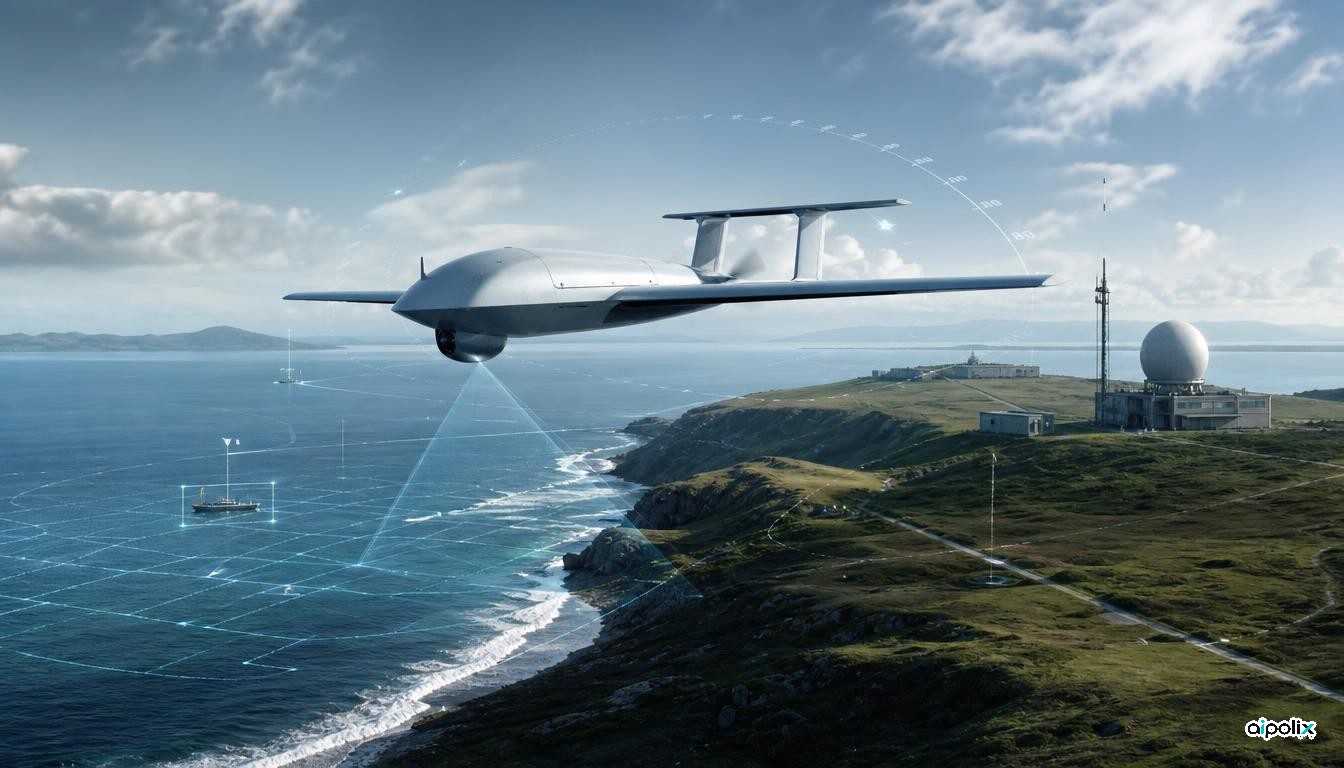
TEKEVER has raised the first close of a $580 million Series D financing at a $6.4 billion valuation, giving the Portugal-founded autonomous-systems company a much larger capital base for international expansion, manufacturing, technology development and acquisitions. UC Investments and Baillie Gifford led the round, with Merlyn Advisors joining as a strategic investor and existing shareholders also participating. The company says additional closings may follow.
The financing is notable because TEKEVER is not pitching AI as a standalone software product. Its systems combine unmanned aircraft, autonomy software, sensing and intelligence services, which means scaling the business requires capital across software, hardware, manufacturing, deployment and support. That makes the round a useful test of a broader European thesis: whether AI-enabled autonomy can become an industrial capability rather than remain a collection of promising demonstrations.
Capital is moving from models into operational autonomy
TEKEVER says the new funds will deepen its international presence, expand industrial and technological capacity, accelerate acquisitions and support its AI-powered autonomous systems. Those uses matter more than the headline valuation. A company operating physical autonomous systems cannot scale by increasing inference capacity alone. It needs production lines, supply chains, sensors, airframes, integration, field support and the software infrastructure that connects them.
The timing also follows TEKEVER’s selection for the British Army’s CORVUS surveillance programme, worth up to £400 million over ten years and based on its AR5 platform. Reuters noted that the company has accumulated more than 50,000 operational flight hours in Ukraine since 2022. Operational exposure can create a data and engineering feedback loop that is difficult for a software-only competitor to reproduce, but it also raises the standard for reliability: systems used in contested environments must work under degraded communications, changing mission requirements and adversarial pressure.
A $6.4B valuation is not a benchmark
The strongest caution is simple: financing validates investor demand, not technical performance. TEKEVER describes itself as an AI-powered autonomy company, but neither the funding announcement nor the corroborating report provides a controlled benchmark that separates the contribution of its AI stack from aircraft design, sensors, human operators, communications and mission planning.
That distinction matters for buyers and policymakers. Autonomous-system claims can collapse several different capabilities into one label: navigation, target recognition, sensor fusion, route planning, multi-vehicle coordination and decision support. A procurement team should ask which functions are genuinely autonomous, what happens when models are uncertain, where humans remain in the authorization chain, and how software updates are validated before deployment.
Aipolix’s analysis is that TEKEVER’s next constraint is likely to shift from proving that autonomous systems can work to proving that the entire operating model can scale without weakening verification. More capital can accelerate deployment, but it can also increase configuration diversity, supplier dependencies and software-update frequency. Those are governance and systems-engineering problems, not merely financing problems.
Portugal’s relevance is larger than the headquarters question
TEKEVER was founded in Portugal in 2001 and now describes a footprint spanning Portugal, the UK, France, the US and Estonia. Reuters describes it as Portugal-founded and now headquartered in Britain. That corporate evolution should not obscure the Portuguese significance of the round. TEKEVER still lists Lisbon operations and has contracts involving Portuguese defence and maritime surveillance.
For Portugal, the important signal is that a locally rooted engineering company can accumulate operational autonomy expertise and attract global growth capital at a scale normally associated with much larger technology ecosystems. The spillover opportunity is not only employment. It includes aerospace supply chains, robotics, sensing, embedded systems, AI engineering, testing and dual-use procurement expertise.
The risk is that valuation narratives can outrun local capability formation. Portugal benefits most if engineering, research, supplier development and high-value operational knowledge continue to deepen locally rather than if the country is remembered only as the company’s place of origin.
Europe is testing a sovereign-autonomy thesis
The round also fits Europe’s push for greater technological sovereignty in defence and critical infrastructure. TEKEVER explicitly frames its technology around sovereign capability, while its investors emphasize the importance of European technology companies that can industrialize quickly.
Sovereignty, however, should be measured at the dependency layer. A system assembled in Europe can still depend on foreign compute, sensors, communications components, model tooling or cloud services. The meaningful questions are which components can be substituted, which software can be audited and maintained independently, and whether customers retain operational control when external services are unavailable.
That is why the Series D is materially relevant to AI even though it is a financing event. It funds the transition from an AI-enabled product portfolio toward a larger industrial system. The next evidence should come from execution: manufacturing throughput, deployment reliability, autonomy boundaries, customer outcomes and the ability to maintain sovereign control as the platform expands.