
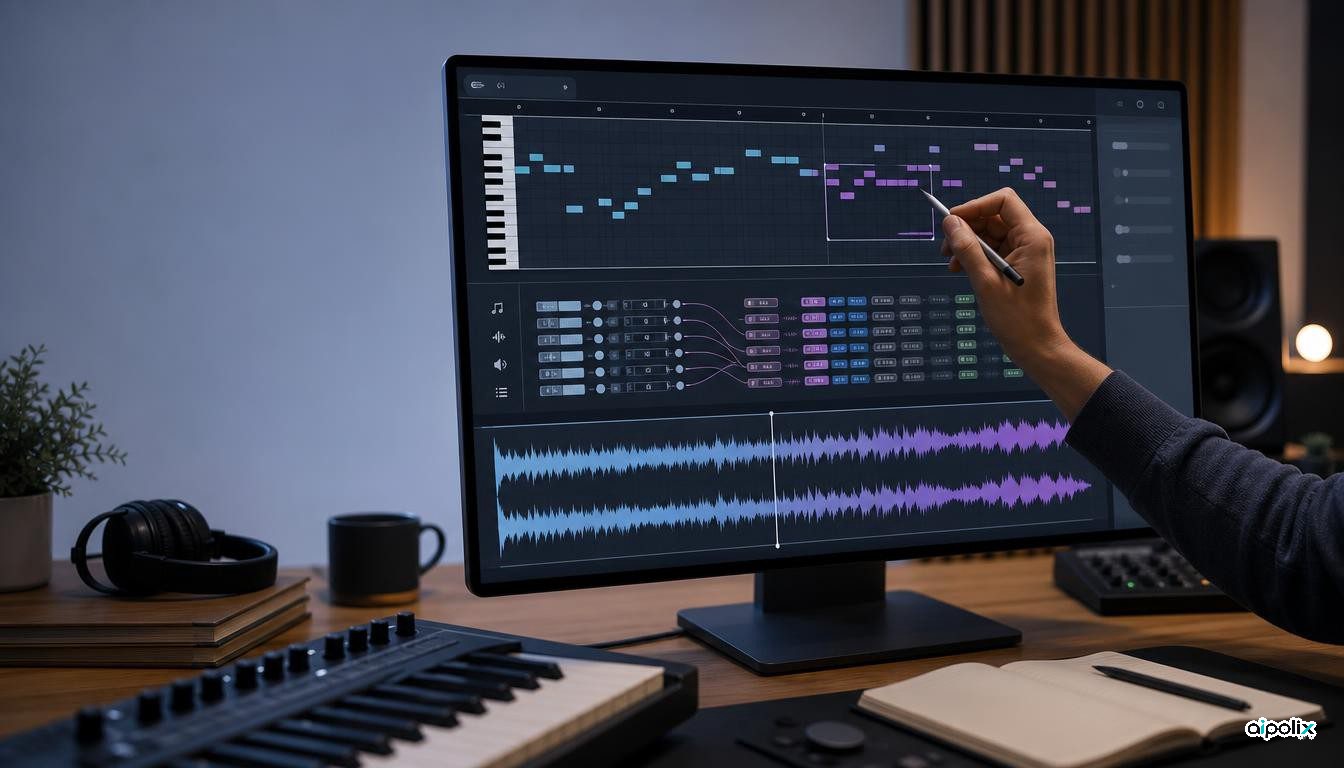
YuE2 takes a different route to controllable music generation: before it renders audio, it can write an editable symbolic score.
Multimodal Art Projection (M·A·P) has released the YuE2-3B weights and inference package on Hugging Face, alongside a project site, listening demos and the WildSongBench evaluation. The model is designed to turn lyrics and a style prompt into a full song with vocals and accompaniment, but its most distinctive feature is the intermediate representation. In its default mode, YuE2 plans melody and chords as an ABC score before producing semantic music tokens, acoustic latents and finally 48 kHz stereo audio.
That makes the score a control surface rather than a hidden internal state. A user—or an external agent—can inspect it, change the melody or harmony, keep only the melody for a cover, or feed an edited score back into the renderer.
The score is the interface
The architecture uses a roughly 3.59-billion-parameter AR–NAR Mixture-of-Transformers backbone. The same backbone handles symbolic planning and semantic music generation, then flow matching produces acoustic latents that a separate VAE decodes into audio.
For creators and tool builders, the interesting part is not the model size. It is the separation between planning and rendering.
YuE2 exposes three practical modes. The default full mode plans melody and chords. melody keeps the symbolic plan to melody alone and is recommended for cover generation. off skips symbolic planning and generates directly. The pipeline also exposes a planning call separately, so an application can obtain the score first, inspect or modify it, and only then spend compute on audio synthesis.
That is a useful systems property. Most text-to-music products treat the generated waveform as the first meaningful artifact. YuE2 inserts a structured object in the middle that humans and software can manipulate with ordinary tools.
“Agentic editing” is an orchestration pattern, not a magical capability
The project also demonstrates what it calls agentic music editing. In the published example, an agent receives the current score, prompt, lyrics and a requested musical change, then rewrites those artifacts and asks YuE2 to render the next version. The demo follows one song through nine editing steps and fourteen versions.
The distinction matters. YuE2 itself is not an autonomous music producer that understands a conversation and edits audio end to end. The agent performs the interpretation and planning work around the model; YuE2 provides the symbolic and audio generation substrate.
That modularity is still valuable. A coding-style agent can reason over text and ABC notation much more reliably than it can directly edit a long waveform. The score gives the workflow an inspectable state that can be versioned, diffed and constrained.
For AI product teams, that may be the larger idea behind the release: structured intermediate representations can make generative media easier to control than pure prompt-to-output pipelines.
The benchmark headline needs a careful reading
M·A·P reports that YuE2 best-of-8 reaches 6.9632 on the SongBench average in WildSongBench, ahead of Suno v5 at 6.8721, Suno v6 at 6.5562 and Suno v6 Wild at 6.4195.
But this is not a simple apples-to-apples claim that one local model “beats Suno.”
The project explicitly documents different selection budgets. YuE2 best-of-8 generates eight candidates and selects using Musicality, Q3O and phoneme error rate. The regular YuE2 setting scores 6.7316 on SongBench. Suno v6 and Suno v6 Wild use two candidates with repeated ASR scoring; older proprietary outputs retain the candidate protocols under which they were delivered.
So the strongest number partly measures the value of a larger sampling-and-selection budget. That does not make it invalid, but it changes what the result proves.
A more defensible conclusion is that YuE2 is competitive on the project’s published full-song evaluation while offering something the proprietary comparison systems do not expose in the same way: downloadable weights and an editable symbolic generation path.
The benchmark itself covers 192 prompts and 17 settings. The project also reports zero-shot cover results on SHS100K and publishes the evaluation tables and protocols. Those are useful artifacts, but the reported quality comparisons remain first-party results and have not yet been independently reproduced.
It can run locally, but “open” has limits
The Hugging Face quick start targets Linux, Python 3.10+ and an NVIDIA GPU with BF16 support. The documentation recommends a 24 GB GPU. On an RTX 4090, the authors report generating a 3.6-minute song in about 71 seconds in full symbolic-planning mode, with roughly 11.18 GiB peak VRAM in that measured run.
That is unusually accessible for full-song generation, especially compared with server-only commercial music systems. It also creates room for private workflows where lyrics, reference scores or unreleased material do not have to be sent to a hosted service.
However, the word “open” needs qualification.
The YuE2 checkpoint weights are licensed under CC BY-NC 4.0, which prohibits commercial use without additional permission. That is materially different from a permissive open-source or commercially usable open-weight license. The release also states that code, tokenizer files, evaluation assets and bundled third-party components can carry separate licenses.
For researchers, hobbyists and non-commercial experimentation, the public weights are significant. For startups or media companies planning to ship a product, the license is a gating issue, not a footnote.
The project says its models were trained primarily on CC0 music and synthetic data and lists 346,000 hours for YuE2. That provenance statement is useful, but it is still the developer’s disclosure rather than an independently audited training-data report.
Why symbolic planning may matter more than the leaderboard
Music generation has an editing problem. A prompt can request “make the chorus brighter” or “keep the melody but change the harmony,” but a model that only exposes audio gives the application little deterministic structure to operate on.
YuE2’s symbolic layer creates a different workflow. Melody and chords become inspectable artifacts. A user can preserve one part and alter another. An agent can propose a small score change rather than regenerating an entire song blindly. Version history can capture what changed between iterations.
That does not guarantee musical correctness. ABC notation is a compressed representation of a performance, and many qualities people care about—timbre, phrasing, production, vocal delivery—still live downstream in the audio model. A good symbolic plan can still render badly, and a good render can depend on choices not represented in the score.
Yet the architecture gives developers a place to impose constraints before synthesis. That is strategically more interesting than a marginal benchmark lead.
The same pattern is appearing across generative systems: an LLM or agent produces a structured plan, a specialized model turns that plan into a high-dimensional artifact, and the structured layer becomes the point where humans, policies and tools can intervene.
For music, YuE2 makes that pattern concrete.
A strong research release, not a drop-in Suno replacement
YuE2 combines three capabilities that rarely arrive together in a public release: full-song generation, editable symbolic planning and local inference on a single high-end consumer GPU.
The release is technically substantial and the demos are easy to inspect. The benchmark package is also unusually explicit about its selection protocol, including the fact that the headline best-of-8 result uses more candidate generation than some comparison settings.
Those strengths should not be turned into a stronger claim than the evidence supports. The quality results are first-party, selection budgets differ, commercial use of the weights is restricted, and an external agent—not YuE2 alone—drives the conversational editing loop.
The important shift is therefore not “open music has beaten Suno.” It is that a capable public-weight music generator now exposes the composition itself as an editable intermediate state.
That is a much more useful building block for serious creative tools.