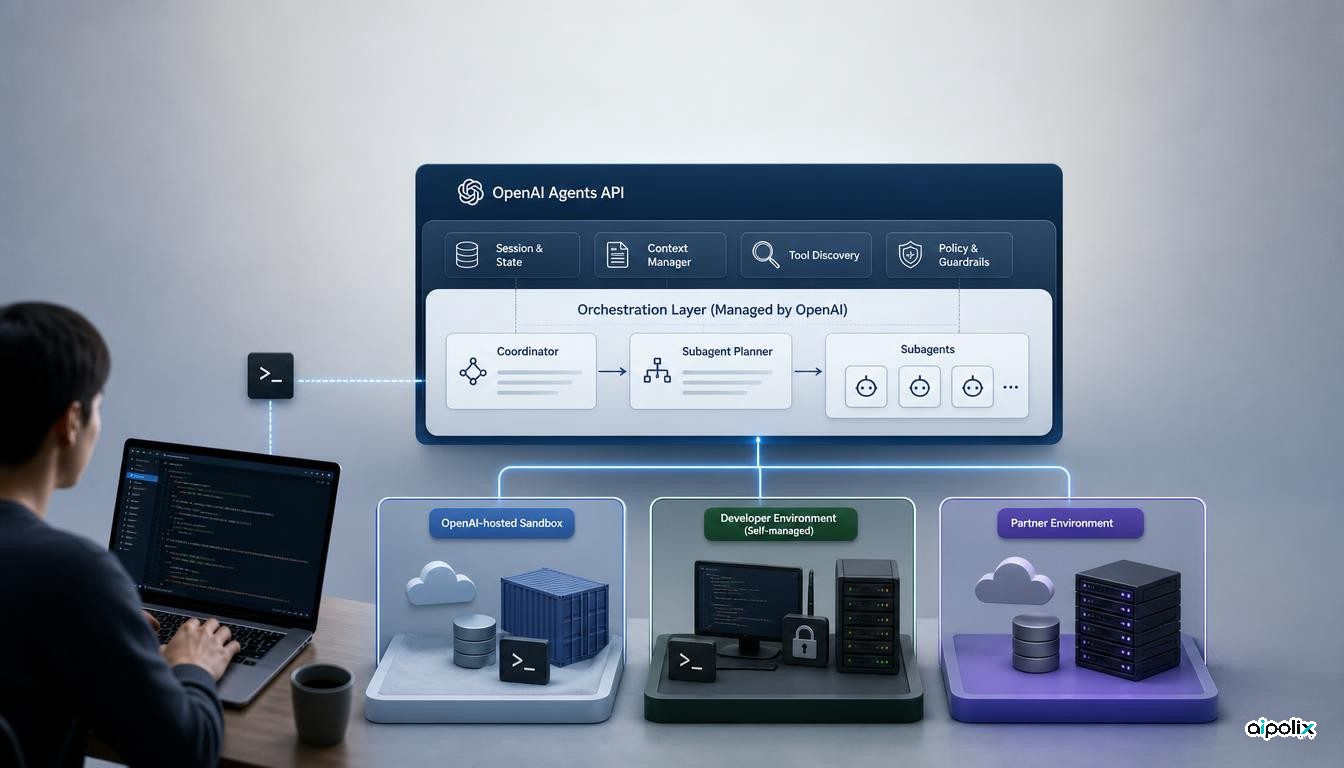
OpenAI has released the Agents API in public beta, exposing the managed agent harness behind Codex as a service for developers. Instead of building the full orchestration layer around a model, teams can provide a task, model, tools and compute environment while OpenAI operates the harness that manages long-running sessions, context and agent coordination.
The release matters because it moves competition in agent infrastructure one layer above the model endpoint. The core product is not a new model. It is a hosted execution loop that OpenAI says is based on the open-source Codex harness, with support for long-running work, tool use, context compaction and subagents.
The API separates orchestration from execution
OpenAI gives developers several choices for where work actually runs. An agent can execute in an OpenAI-managed sandbox, in infrastructure controlled by the developer, or through supported sandbox partners. OpenAI still operates the harness that coordinates the session.
That split is architecturally important. A team can keep code, files or runtime dependencies inside its own environment while delegating higher-level orchestration to OpenAI. This is different from a fully hosted agent where both the control loop and execution environment sit inside one provider boundary.
It also means that "self-hosted execution" should not be confused with "self-hosted agent." If OpenAI is still managing session state, context handling and orchestration, some operational dependency remains with the provider even when the shell, files and compute live elsewhere.
Long-running agent mechanics become a managed service
The Agents API includes capabilities intended to reduce the custom engineering normally required for long tasks. OpenAI describes automatic context compaction for sessions approaching context limits, tool search that can load tool definitions only when they are relevant, programmatic tool calling and support for subagents.
Those features target familiar failure points in production agent systems. Long-running agents accumulate context, tool schemas consume tokens, and parallel work often requires custom coordination logic. Turning these mechanisms into a managed service can shorten the amount of harness code each application team has to own.
The trade-off is that harness behavior becomes part of the provider dependency. A model can be swapped relatively easily when an application owns its own loop. It is harder to reproduce behavior when session management, compaction, tool-selection behavior and subagent orchestration are implemented by a hosted control layer.
Open source improves inspectability, not portability by itself
OpenAI says the service is powered by the open-source Codex harness. The public openai/codex repository gives developers access to the codebase and makes the underlying agent loop more inspectable than a closed orchestration service.
That is useful, but source availability does not automatically make a hosted agent run reproducible elsewhere. Production behavior can still depend on provider-side versions, configuration, managed state, sandbox integrations and deployment timing.
Aipolix's analysis is that teams should treat the harness version as part of the execution provenance of an agent, in the same way they already track model versions. Recording only the requested model can be insufficient if a change in orchestration, context compaction or tool selection alters the result while the model name stays the same.
For regulated or high-assurance workloads, logs should distinguish at least four layers: requested model, harness or orchestration version where available, execution environment, and tools or permissions exposed to the agent. That makes incident analysis and regression testing more useful than a single model identifier.
The security boundary is now explicitly split
The ability to run an agent on developer-controlled infrastructure creates a useful security option, but it also creates a shared-responsibility boundary. OpenAI can operate the control loop while the customer controls the environment in which commands execute.
This can reduce the need to place every file or dependency in an OpenAI-hosted sandbox, but it does not remove the need to assess what information flows through the managed orchestration layer. Teams need to decide which secrets, files, tool outputs and intermediate state are visible to the harness and which remain local.
The same distinction matters for permissions. A sandbox can isolate execution, but the agent's effective authority also depends on the tools and credentials made available to it. Moving compute to a private environment does not make an over-permissioned agent safe.
Agents API turns the harness into a platform dependency
The practical significance of the release is that OpenAI is productizing the layer between models and applications. Developers can now consume the Codex-style loop without rebuilding session persistence, context management and multi-agent coordination themselves.
That can reduce engineering cost, especially for teams that do not want to maintain their own agent runtime. It can also increase architectural coupling to the provider's orchestration semantics.
The most useful evaluation therefore is not only whether the API completes a benchmark faster. Teams should test what happens when sessions become long, tools fail, permissions change, subagents disagree, context is compacted and execution moves between environments. Those conditions reveal whether the managed harness improves reliability without creating an opaque dependency.
Agents API is still in public beta, so production guarantees and interfaces may change before general availability. For now, the release is best understood as a shift in where agent infrastructure can be bought rather than built: the model remains one component, while the harness itself becomes a first-class managed service.