Copado has introduced Agentia Headless, a developer-facing layer that lets coding agents operate parts of a Salesforce delivery pipeline from an IDE or terminal. The interesting change is not that another vendor added an AI assistant. It is that the agent can now call deployment, testing and release operations through a local Model Context Protocol server and CLI while Copado remains the system of record.
That makes Agentia Headless a useful example of where agentic software engineering is moving: away from chat interfaces and toward controlled execution against real delivery systems. It also makes the product’s guardrails more important than its generation features.
Copado’s own documentation labels the current command surface a Product Preview and Alpha. The company’s September 14 announcement says broader availability begins in November 2026. Those two facts should temper any claim that the workflow is already a mature production standard.
The agent gets tools, but not unrestricted authority
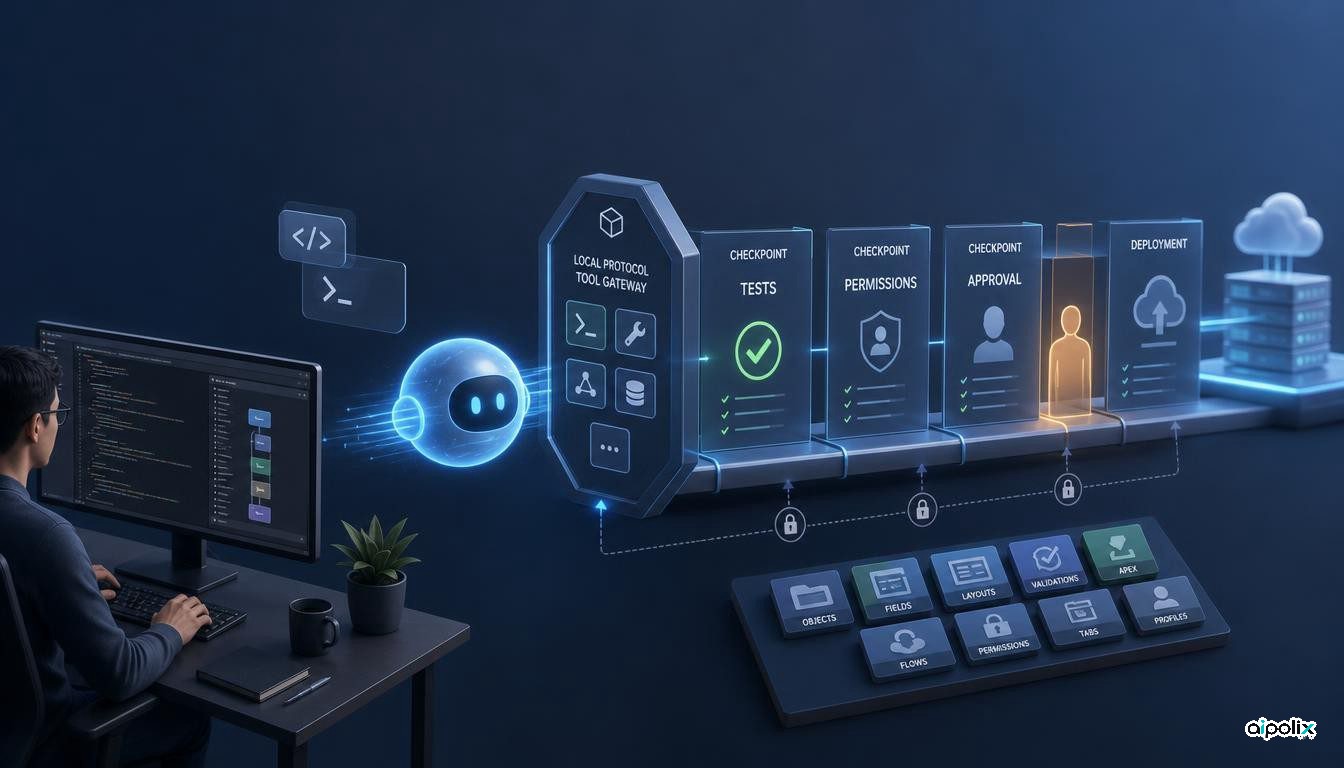
Agentia Headless exposes Copado operations through a CLI and a local MCP server. The documentation describes a sequence in which an IDE agent can inspect work, modify metadata, run tests, push changes and submit them through the delivery pipeline.
That is a materially different control surface from an assistant that only writes code. An agent with access to delivery commands can affect repositories, Salesforce environments, test runs and promotion workflows. In other words, the risk boundary moves from “what code did the model generate?” to “what operations can the model invoke, under which identity, and what must stop for human approval?”
Copado has made several useful choices around that boundary. Its documentation says destructive operations require an explicit --yes flag in non-interactive CLI use or confirm: true through MCP. Training material also says promotion and deployment require explicit user approval rather than being automatic. Project permission commands are scoped to a project, while some sensitive or long-running operations remain CLI-only instead of being exposed through MCP.
These are not glamorous features, but they are the part of the design that matters most for enterprise agent deployment.
Local MCP does not mean local authority
The phrase “local MCP” could easily be misread as meaning the workflow is self-contained on the developer’s machine. It is not.
The MCP server runs locally and exposes Agentia commands to Cursor, Copilot or another compatible agent. But Copado remains the system of record for pipelines, logs, promotions and quality-gate configuration. Authentication still connects the CLI to configured Copado products and environments.
That separation is important. The local process is an execution interface; the authoritative state remains in the delivery platform. This can be a stronger architecture than letting an IDE agent own deployment state itself, because audit, policy and pipeline history stay in a system designed for release management.
But it also means the real security question is credential scope. A local agent can only be as safe as the credentials and project permissions available to the CLI. If a broad credential is placed behind an MCP tool, a “local” integration can still expose a large remote blast radius.
Copado is turning governance into callable infrastructure
The most interesting design choice is that quality gates and workflow rules are not described as prose instructions for the model to remember. They are exposed as delivery-system controls.
The documentation says local quality gates can include PMD, SOQL, security and compliance checks. It also describes separate local and cloud development paths that must not be mixed for a user story. Agent skills provide workflow instructions, while the CLI and MCP tools perform the actual operations.
That division is useful: the agent can reason about what to do, but enforcement can live outside the model. This follows a broader pattern emerging in agentic engineering. Durable controls are stronger when they are represented as permissions, confirmations, state transitions and deterministic checks rather than prompt text.
Aipolix’s analysis is that Agentia Headless matters less as a Salesforce-specific coding assistant and more as an example of this architectural split: reasoning in the agent, authority in the tool layer, and release state in an external control plane.
The alpha label matters
There is an important limitation in the evidence.
Copado’s product page says “Product Preview · Alpha” and warns that commands, flags and behavior may change. The quickstart installs @copado/agentia-cli@alpha. The September 14 company announcement, meanwhile, says Agentia Headless will be available through Copado and partners starting in November 2026.
The safest interpretation is that an alpha or preview surface is accessible now while broader commercial availability is planned for November. That is not the same as general availability, and it means organizations should not treat the present command contract as stable.
There are also claims that cannot yet be accepted as independent performance evidence. Copado cites faster releases and lower defect rates, but the available figures are company-reported and are not accompanied here by a public, reproducible benchmark. Those numbers are useful context, not proof of the new Headless layer’s effect.
What engineering teams should take from it
For teams building coding agents, the practical lesson is not “add MCP.” It is to define a transaction boundary around agent actions.
A deploy-capable agent should have a narrow identity, scoped permissions, deterministic quality checks, explicit confirmation for destructive or high-impact operations, auditable state transitions and a reliable system of record. The agent should also be able to inspect enough context to make a decision without silently gaining the authority to execute every possible next step.
Agentia Headless is still an alpha product and its public evidence does not establish how well these controls hold up under adversarial prompts, compromised developer environments or complex multi-agent chains. But its control model is worth watching because it treats deployment authority as an engineering surface rather than a prompt-design problem.
That is the more important development: as coding agents move from generating patches to operating delivery pipelines, the quality of the authorization boundary will matter at least as much as the quality of the model.