
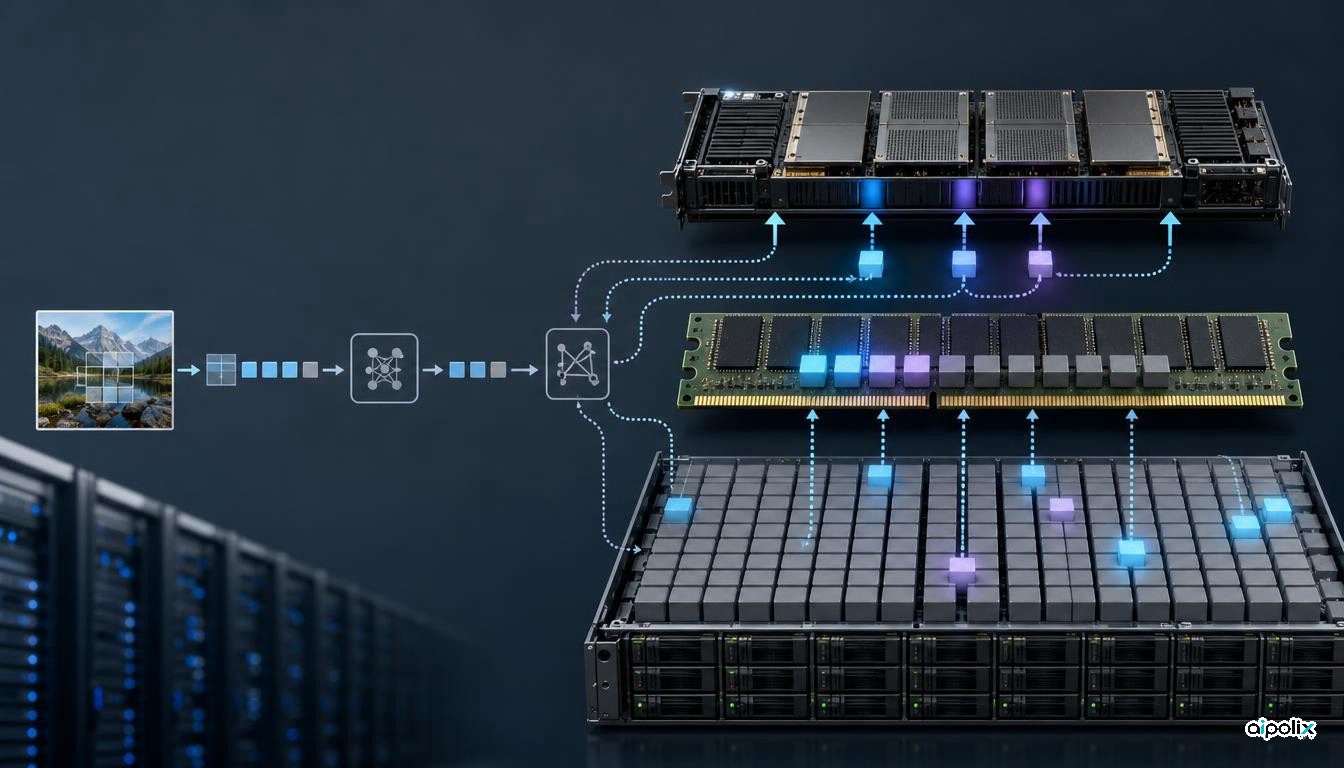
Colibrì 1.11.0 adds native support for DeepSeek V4.1 Flash, turning a 510 GB checkpoint into something that can run on a CPU-and-SSD host without first converting the released weights. The open-source runtime reads the model's fp8 dense weights and fp4 routed experts directly, while keeping most of the 552 billion-parameter model on storage and fetching the pieces needed for each token.
The release is technically significant because it tackles a different constraint from conventional quantization stories. The project is not claiming that a 510 GB model suddenly fits in ordinary memory. Instead, it treats storage, RAM and accelerator memory as a hierarchy and makes the model's sparse structure explicit enough to stream the active parts on demand.
That makes the model runnable on hardware that could never hold the full checkpoint in VRAM, but Colibrì's own measurements also show the trade-off clearly: making a model fit is not the same as making it fast.
Native weights remove a costly conversion step
DeepSeek V4.1 Flash is a 552B-parameter mixture-of-experts model. Colibrì's technical note breaks its released checkpoint into roughly 203 GB of Engram tables, 289 GB of routed experts and about 18 GB of dense, embedding and vision weights.
Version 1.11.0 reads the released fp8 and fp4 formats directly. The project says the routed expert layout is byte-compatible with the mxfp4 path already used for Kimi K3, so users do not have to rewrite hundreds of gigabytes into a Colibrì-specific representation before inference.
A small preparation step still creates metadata that cannot be reconstructed cheaply at load time, including token maps and hashing parameters for the Engram tables. The documentation explains why some of those values are stored as decimal strings: rounding 64-bit multipliers through a floating-point representation could silently redirect n-gram lookups to different rows.
That detail matters because this is not only a capacity optimization. When model state is streamed from disk, file layout, hashes, cache ownership and rollback behavior become part of the correctness boundary.
The release validates semantics, not just execution
The changelog says the DeepSeek V4.1 Flash engine is tested token-for-token against a separate torch-only CPU reference across multiple cache capacities and speculative-decoding modes. The vision path is compared numerically as well.
That is stronger evidence than merely demonstrating that the model produces text. Colibrì is changing where model state lives and when it is fetched, so an optimization that changes routing, index ownership or speculative rollback can create plausible output while no longer matching sequential inference.
The project explicitly treats exactness as a release condition. Its DSpark speculative path proposes several tokens, sends them back through the main model for verification, and restores per-position state when a draft is rejected. The documentation also records experiments that were removed because they measured worse rather than leaving only successful optimizations in the narrative.
This does not independently prove model-level quality or production reliability. It does provide a reproducible engineering claim about the runtime: the optimized path is intended to preserve the model's decoding semantics while changing the memory and I/O schedule.
Storage bandwidth becomes the real performance budget
Colibrì reports that each DeepSeek V4.1 Flash token may require about 4.5 GB of routed-expert data, while the 203 GB Engram component is accessed through much smaller random lookups. That asymmetry explains why the checkpoint can remain mostly on disk and why the storage path still dominates practical performance.
For the released checkpoint, the changelog reports a cold-run improvement from 78.7 seconds to 25.1 seconds for a measured turn during development, moving from 0.305 to 0.957 tokens per second. A five-turn chat is reported at 1.14 to 1.58 tokens per second. Those are project measurements, not independent benchmarks, and they should not be generalized to unspecified hardware.
A separate experiment in the technical note shows speculative decoding improving one cold 24-token workload from 0.206 to 0.242 tokens per second on a 16-thread CPU server that held 68% of experts. The authors also warn that a warm page cache can outweigh the code optimization being measured.
The useful conclusion is therefore not that commodity inference has reached cloud-like latency. It is that once capacity is solved by streaming, the next budget is I/O: SSD bandwidth, random-read latency, page-cache state and the fraction of hot experts that can stay in faster memory.
The architecture changes what “local inference” means
Local inference is often framed as a question of whether a model fits into GPU memory. Colibrì's approach makes that definition too narrow.
A host can run a model far larger than its VRAM by keeping dense components resident, caching frequently used experts and treating storage as the cold tier. For experiments, offline analysis and users who value local control more than interactive latency, that is a meaningful expansion of the deployment envelope.
But it also creates a new operational profile. Performance becomes workload-sensitive because expert popularity and cache warmth matter. Storage failure and corruption need explicit checks. Reproducible benchmarking requires controlling cache state. And a configuration that technically serves a model may still be unsuitable for an interactive agent if each token arrives too slowly.
Aipolix's analysis is that Colibrì 1.11.0 moves the local-inference boundary from “can the weights fit?” to “can the memory hierarchy feed the active weights fast enough?” That is a more useful systems question for sparse frontier models.
What developers should take from the release
The release is most interesting as an inference-systems artifact, not as another DeepSeek announcement. Aipolix already covers DeepSeek V4.1 Flash as a model event; Colibrì 1.11.0 is a separate implementation event that demonstrates a concrete deployment path for the released checkpoint.
For developers evaluating it, the right metrics are not stars or the fact that the model starts. They are token-exactness against a reference, cold and warm throughput, storage bandwidth, cache hit behavior, RAM and VRAM placement, and whether the resulting latency matches the workload.
The project provides enough implementation detail to make those questions testable. It also publishes limitations: some command paths are not wired for this family, per-turn accounting is optional, and the performance figures depend heavily on cache and hardware conditions.
That transparency is the strongest reason the release is worth attention. Colibrì does not erase the cost of a 510 GB model. It makes that cost visible as a storage-and-memory scheduling problem that engineers can measure and tune.