
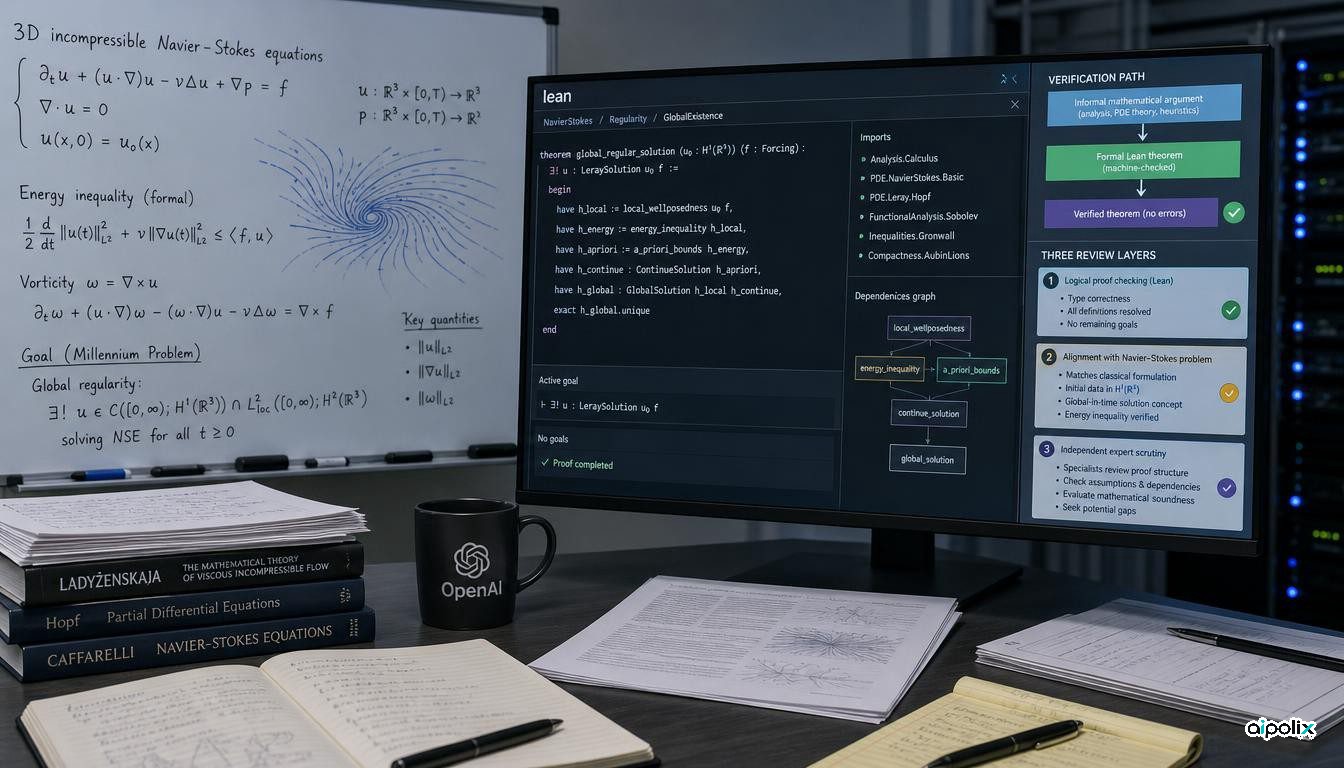
OpenAI says one of its models has produced a proposed solution to the Navier–Stokes Millennium Prize Problem, together with a written argument and a formal proof in Lean. The announcement is potentially important because the problem is one of the Clay Mathematics Institute's Millennium Prize Problems and because OpenAI is presenting not only a natural-language mathematical argument but also a machine-checkable formalization.
The right way to read the result today is as a high-stakes research claim, not as a settled historical fact. Nature reported the announcement as a potentially major breakthrough, while also emphasizing that the mathematical community still needs to examine the work. OpenAI itself describes the result as a proposed solution. That distinction matters: formal verification can confirm that a proof follows from encoded definitions and lemmas, but it does not automatically establish that the formal statement perfectly matches the intended mathematical problem or that every modeling assumption is accepted by experts.
Lean changes the verification surface
The strongest technical feature of the announcement is the presence of a formal proof. In ordinary mathematics, verification depends on experts reading a written argument, reconstructing omitted steps and checking whether every assumption has been used correctly. A Lean formalization moves a substantial part of that process into a proof assistant.
That does not eliminate human review. Someone still has to verify that the theorem encoded in Lean is the theorem people actually care about, that definitions correspond to the accepted formulation and that no hidden mismatch has been introduced between the informal statement and the formal object. But once that alignment is established, machine checking can make certain classes of logical error much harder to hide.
For AI-generated mathematics, this is especially important. Language models can produce persuasive arguments that contain subtle gaps. A formal proof gives reviewers a second representation that is less dependent on prose quality.
A machine-checked proof is not the same as community acceptance
The Aipolix analysis is that this result exposes a useful distinction for AI-assisted science: logical verification, problem alignment and scientific acceptance are separate gates.
Lean can address one part of the first gate. Experts must still determine whether the formal theorem corresponds exactly to the Millennium Problem and whether the surrounding mathematical interpretation is sound. The wider community then needs time to reproduce the reasoning, inspect the construction and understand how it relates to prior work.
This distinction matters beyond Navier–Stokes. As AI systems generate more research, organizations will need evidence chains showing not only the final answer but how the claim was formalized, what was independently checked and which parts remain judgment calls.
The claim raises the bar for research provenance
A result of this importance also makes provenance more operationally significant. When an AI system contributes to frontier mathematics, reviewers need to know which artifacts were generated by the model, which definitions and lemmas came from existing libraries, what human guidance was provided and how the final theorem statement evolved.
A formal proof helps because it creates a concrete artifact that can be versioned and inspected. It does not, by itself, answer questions about intellectual provenance or priority. Those require a separate record of inputs, intermediate drafts, references and human contributions.
For organizations using AI in research, this suggests a governance pattern: keep the proof artifact, model/session metadata, source references and human interventions tied together. The more important the claim, the less acceptable it becomes to preserve only a polished final paper.
Why this is different from benchmark-style math results
Many AI mathematics announcements are evaluated through problem sets, benchmark scores or counts of solved exercises. A Millennium Prize Problem is different. There is no useful leaderboard shortcut. The value of the claim depends on whether a new argument survives sustained expert scrutiny.
That makes the verification process itself part of the story. The important capability is not simply that a model produced an answer that looks mathematically sophisticated. It is that OpenAI is presenting an artifact designed to be checked at two levels: by mathematicians and by a formal proof system.
If the work holds up, the implication would be much larger than a benchmark gain because it would show an AI system participating in a research process that produces a result at the frontier of mathematics. If it does not hold up, the formal artifact will still provide a useful case study in where machine-checked reasoning can and cannot substitute for expert interpretation.
What teams should watch next
The next evidence should come from independent mathematical review. Useful signals include public inspection of the Lean files, attempts to reproduce or simplify the argument, expert commentary on whether the formal statement matches the Millennium formulation and any corrections or revisions issued by OpenAI.
It is also worth watching how OpenAI documents the boundary between model work and human work. For AI research governance, that boundary is becoming as important as model capability itself.
For now, the defensible conclusion is narrow but significant: OpenAI has released a proposed Navier–Stokes solution with a formal Lean proof, and the combination gives the mathematical community a stronger verification artifact than prose alone. Whether it becomes an accepted solution remains an open question.